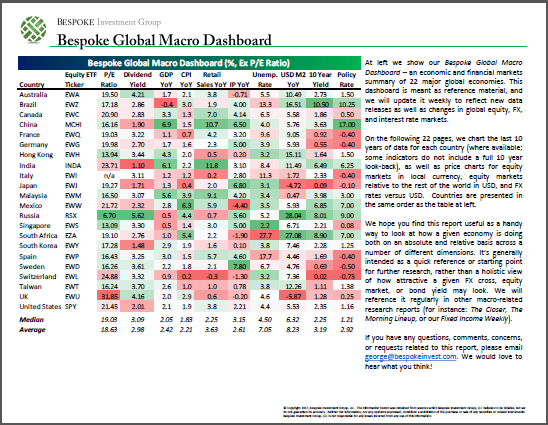
Bespoke’s Global Macro Dashboard — 4/18/18
Bespoke’s Global Macro Dashboard is a high-level summary of 22 major economies from around the world. For each country, we provide charts of local equity market prices, relative performance versus global equities, price to earnings ratios, dividend yields, economic growth, unemployment, retail sales and industrial production growth, inflation, money supply, spot FX performance versus the dollar, policy rate, and ten year local government bond yield interest rates. The report is intended as a tool for both reference and idea generation. It’s clients’ first stop for basic background info on how a given economy is performing, and what issues are driving the narrative for that economy. The dashboard helps you get up to speed on and keep track of the basics for the most important economies around the world, informing starting points for further research and risk management. It’s published weekly every Wednesday at the Bespoke Institutional membership level.
You can access our Global Macro Dashboard by starting a 14-day free trial to Bespoke Institutional now!
Netflix (NFLX) Pulls FANGs Along For the Ride
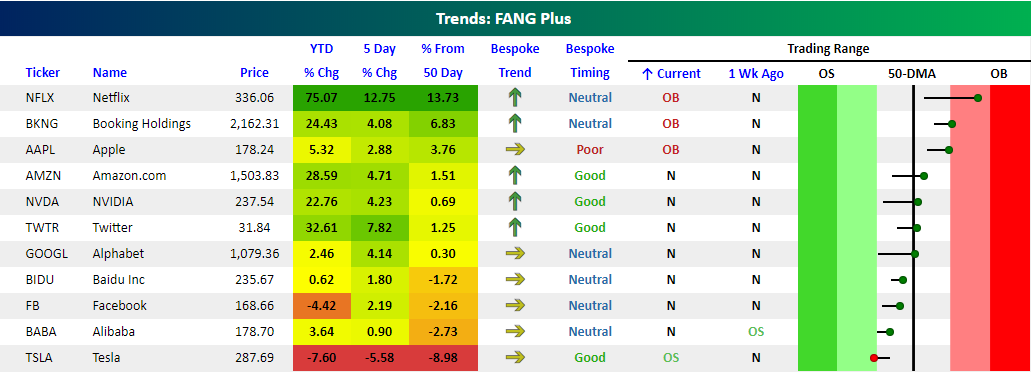
With a gain of over 9% on Tuesday after its strong earnings report on Monday afternoon, shares of Netflix (NFLX) are up an almost ridiculous 75% YTD, 13% in just the last week, and now over 13% above the 50-DMA. The rally for NFLX has been so huge that its market cap is now just $8 billion below Disney (DIS). Using our Trend Analyzer tool, we created a custom portfolio comprising the eleven stocks that make up the FANG+ index to see how the market’s favorite momentum stocks are trading relative to their trading ranges. With its big gain on Tuesday, NFLX is currently the most overbought of the stocks in the group, but along with Booking (BKNG) and Apple (AAPL) it is one of just three stocks in the group trading at overbought levels right now. The majority of the stocks in the group are currently trading in neutral territory and basically within +/-2% of their 50-DMAs. The only oversold stock in the group is Tesla (TSLA), and it is also the only one that is down over the last week. In terms of timing, though, TSLA actually has a Good rating along with Amazon.com (AMZN), NVIDIA (NVDA), and Twitter (TWTR).
Our Trend Analyzer tool lets you monitor trend and timing measures for all US stocks and major ETFs across asset classes. It’s accessible via a Bespoke Premium or Bespoke Institutional membership.
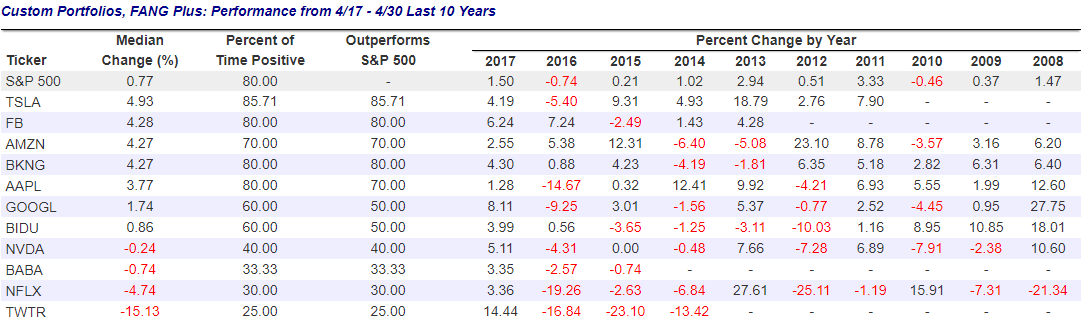
Our Stock Seasonality Database is another useful tool that allows clients to see how various equity markets, asset classes, and individual stocks have historically performed over different time periods. The table below shows how the stocks that make up the FANG+ index have historically performed in the period from the close on 4/17 through the remainder of April. For each stock, we list its median percent change, the percentage of time the stock has traded higher, how frequently it outperforms the S&P 500, and then how it performed during this period in each individual year.
While TSLA is the FANG+ stock that has been the weakest performer lately, the tide may be ready to turn for the stock as the second half of April has actually been a good time of year with a median gain of 4.93% and positive returns 86% of the time. Along with TSLA, shares of Facebook (FB), AMZN, and BKNG have all seen median gains of over 4%. Just four of the FANG+ stocks have seen median returns that are negative, and of those, NFLX and Twitter (TWTR) are the only ones where the median decline is more than 1%. TWTR has been an especially weak performer during this period since it has been public, but we would note that the sample size is relatively small at just four years. Finally, 2017 was an especially good year for the FANG+ stocks as all eleven of them posted gains during the back half of April, with ten of them exceeding the 1.5% gain of the S&P 500.
Our Stock Seasonality Database tool lets you analyze the historical performance of all US stocks and major ETFs across asset classes over different user-defined time periods. It’s accessible via a Bespoke Premium or Bespoke Institutional membership.
The Closer — Gap & Run, Residential Construction, Industrial Production — 4/17/18
Log-in here if you’re a member with access to the Closer.
Looking for deeper insight on markets? In tonight’s Closer sent to Bespoke Institutional clients, we review recent equity price action, rapid spread tightening in high yield bonds, still-slow bank lending, a very detailed review of residential construction activity, and finally a look at industrial production.
See today’s post-market Closer and everything else Bespoke publishes by starting a 14-day free trial to Bespoke Institutional today!
The Last Hour Finally Hangs On…By a Thread
We’ve been talking quite a lot recently about the equity market’s inability to hang on to gains in the last hour of trading. Heading into today, the index had traded down in the last hour of trading for six straight sessions. Today, equities were strong throughout the trading day and even started to leg higher just as we entered the final hour of trading. It looked like the streak of selling was easily coming to an end, but the bears didn’t go down without a fight. In the final half hour, equities started to give up some of their gains, and by the time the bell rang, the S&P 500 was up just barely in the last hour for a total gain of just 0.21 points!
While today’s last hour gain ended the six-day streak of selling, the trend of last hour selling remains in place. For example, over the last 25 trading days, the S&P 500 has declined in the last hour of trading 18 times (72%), which is well above the historical average of 44% for all 25 trading day periods since 1983. In case your curious, the record for most last hour declines over a 25-trading day period was in the Summer of 2015, when the 25-day total hit 21 a handful of times between late June and early July. If you remember that period, the rest of the Summer wasn’t particularly enjoyable for bulls.

B.I.G. Tips – Death by Amazon – 4/17/18
Chart of the Day: Healthy Housing
Bespoke Stock Scores — 4/17/18
Housing Starts and Building Permits Boosted by Multi-Family
Data related to Housing Starts and Building Permits for the month of March came in stronger than expected earlier today. Housing Starts for March came in at a seasonally-adjusted annualized rate of 1.319 mln compared to expectations for a rate of 1.267 mln, while Building Permits hit a rate of 1.354 mln, which was 33K greater than forecasts. In the case of both data series, March’s readings were just shy of the current cycle’s highs, but still well in the hole compared to the peak run rate of over 2.2 mln during the last expansion.
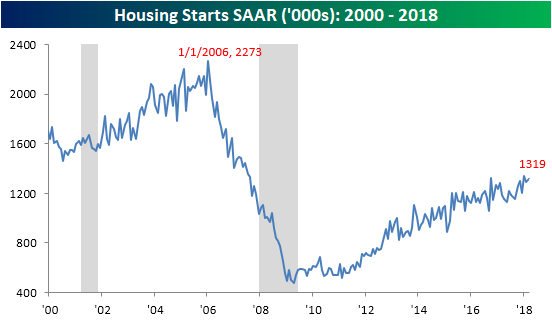
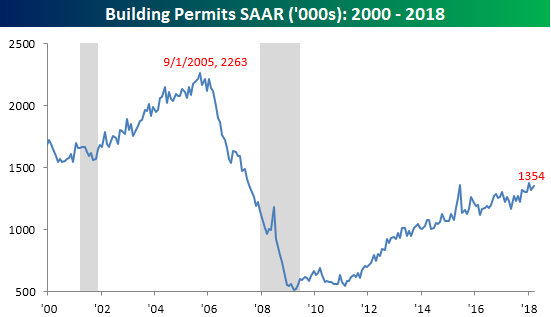
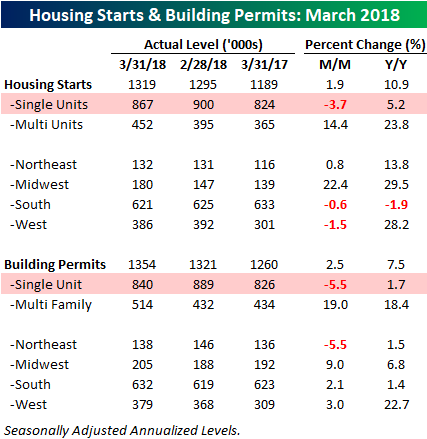
While the headline data was strong in both reports, underneath the surface the trend wasn’t quite as positive. The table below breaks down both reports by size of unit and region. The key thing that sticks out in both reports is that single-family units actually declined on a m/m basis with a drop of 3.7% in Housing Starts and a decline of over 5% in Building Permits. Multi-family unit starts and permits, however, were up by double-digit percentages. On a regional basis, the Midwest was the strongest m/m in both starts and permits, while the Northeast was the only region to see a m/m drop in permits. All in all, it would have been preferable to see a stronger showing from single-family units, but the longer term trend for housing remains solid.
Bespokecast Episode 24 — Ernie Tedeschi — Now Available on iTunes, GooglePlay, Stitcher and More
 Our newest episode of Bespokecast is now available! Be sure to subscribe to Bespokecast on your preferred podcast app to gain access to our full collection of episodes. We’d also love for you to provide a review as well!
In this episode of Bespokecast, we talk to Ernie Tedeschi of Evercore ISI. Ernie is a policy economist and Head of Fiscal Analysis, and has been immersed in analysis of public policy his entire career. He’s had broad experience in the private sector, as well as working at the US Treasury for several years in a policy evaluation role. In our discussion, we focus on the current policy backdrop for the US, primarily through the lens of the newly released long-term budget and economic growth forecasts updated by the CBO in early April. We also review Fed policy, and get Ernie’s thoughts on Amazon’s HQ2, the outlook for the Bay Area, and more. You can follow Ernie on Twitter here and see what he’s writing on Medium here.
To listen to our newest episode or subscribe to the podcast via iTunes, GooglePlay, OvercastFM, or Stitcher, please click the button or links below. Please note that third-party podcast feeds may update at a lag of a few hours to this blog post.

It Happened Right Under Mickey’s Nose
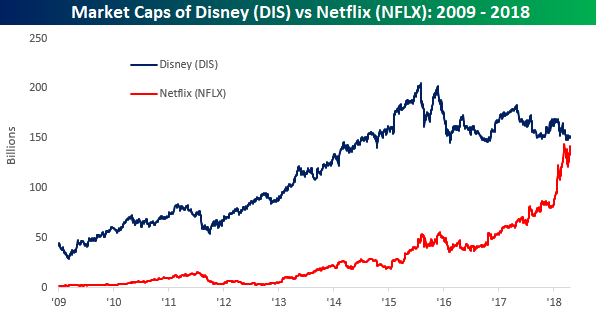
Sometimes big changes happen right under our eyes and we barely notice, until one day we look at the same thing we’ve been looking at every day and suddenly realize how different it has become. The example of Netflix and Disney is a perfect example. For more than a few years now, there has been constant speculation that Disney would buy Netflix. Five years ago, that would have been an easily digestible acquisition for Disney when its market cap was 10x the market cap of Netflix. Even two years ago, when Disney was four times the size of Netflix, they could have gotten it done. Nowadays, it looks like that opportunity has passed. With Netflix set to open higher by about 7% this morning, the stock will have a market cap of over $142 billion compared to Disney’s market cap of $152 billion. As shown in the chart below, the market caps of the two stocks have never been closer than they are now.