
A Defensive Stand Heading into Month End
With just eleven days left in the first quarter, it certainly isn’t looking like it’s going to go out the way it came in. While the year started with equity markets ripping higher, led by FANG, equities can’t seem to catch a break lately as any gains seem to be met with selling. Looking out over the final days of Q1, any strength that the market has shown in the final days of Q1 over the last ten years has been on the defensive side with sectors known for their higher yields leading the way.
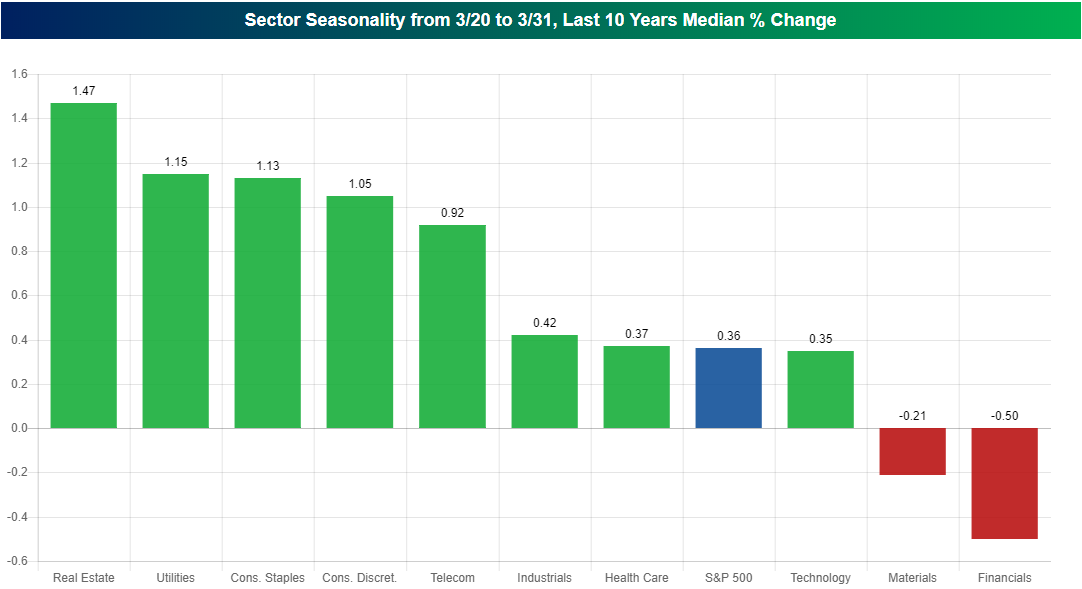
The chart below is from our Stock Seasonality Tool (available to Premium and Institutional members), where you can look up seasonal trends for the US market, sectors, individual stocks, ETFs, foreign markets, and even your own custom portfolios in just a few easy clicks. Using the tool , we have screened the S&P 500 for its performance from the close on March 20th through the end of the month. If you run the screen yourself with the same criteria, you will not only see the chart below, but the screen will also show the best and worst performing stocks in the S&P 500, as well as the five best and worst performing stocks in each sector. If you click on the “Custom Seasonality Analysis” section, you can refine your “US Equity Markets” search further by market cap and number of years to analyze. For “Global Equity Indices” you can refine the search by region, and for ETFs you can narrow down your search by Styles, Sectors, Groups, Regions, Countries, Currencies, Commodities, Fixed Income, and Hedged/Leveraged.

Real Estate has been the top performing sector from March 20th through March 31st with a median gain of 1.47%. After Real Estate, the next best-performing sectors are Utilities, Consumer Staples, Consumer Discretionary and Telecom Services. While these sectors have seen median gains of close to 1% or more, the S&P 500’s median gain has been 0.36%, and no other sector has seen a gain of more than 0.50%. On the downside, Financials have been the worst performing sector with a median decline of 0.50%, and the only other sector that has been down is Materials (-0.21%).
With five of eleven sectors seeing median gains of close to 1% or more, you may be asking yourself how the S&P 500’s median performance is so much lower. A big part of that has to do with the weighting of the five sectors that have outperformed. With sectors like Real Estate, Utilities, and Telecom Services each accounting for less than a 3% weight in the index, their gains don’t move the needle very much. In fact, even when you account for both consumer sectors, the combined weight of the five top performing sectors totals just over 27%, which is only two percentage points more than the 25%+ weighting of the Technology sector.
Bespoke Stock Scores — 3/20/18
Bespokecast Episode 23 — Darin Friedrichs — Now Available on iTunes, GooglePlay, Stitcher and More
Our newest episode of Bespokecast is now available! Be sure to subscribe to Bespokecast on your preferred podcast app to gain access to our full collection of episodes. We’d also love for you to provide a review as well!
In this episode of Bespokecast, we talk to Darin Friedrichs, an agriculture markets expert and trader based in Dalian, China. Darin walks us through the evolving global agricultural landscape, including the basic mechanics of supply and demand drivers in various crop markets, the effect of recent trade negotiations, and the long-term outlook for crops. We also get Darin’s perspective on the evolution of China and some basic trading strategies in agricultural futures markets. You can follow Darin on Twitter @crushspread.
To listen to our newest episode or subscribe to the podcast via iTunes, GooglePlay, OvercastFM, or Stitcher, please click the button or links below. Please note that third-party podcast feeds may update at a lag of a few hours to this blog post.

The Closer — Facebook, Bill Sales — 3/19/18
Log-in here if you’re a member with access to the Closer.
Looking for deeper insight on markets? In tonight’s Closer sent to Bespoke Institutional clients, we take a look at the fundamental assumptions underpinning Facebook (FB) and the technical outlook after today’s flush. We also review massive and growing bill issuance.
See today’s post-market Closer and everything else Bespoke publishes by starting a 14-day free trial to Bespoke Institutional today!
S&P Internals
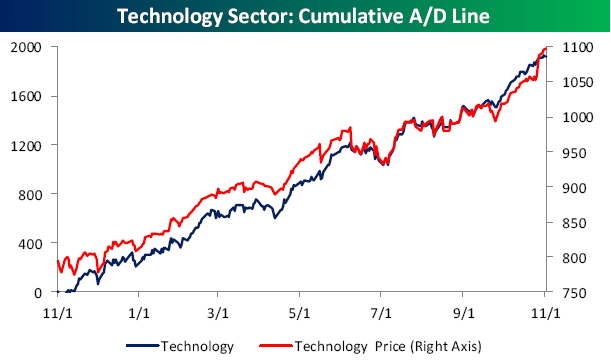
In an earlier post, we took a look at the members of the Dow Jones Industrial Average through our Trend Analyzer Tool. Along those lines, in this post we wanted to provide a quick snapshot of how stocks in the S&P 500 are performing by sector. As many have pointed out, Technology has been a big driver of year to date (YTD) returns for the overall market, and these charts show it. First, the average performance of stocks in the Technology sector YTD has been a gain of 10.2%. The next closest sector (Health Care) has an average gain of less than half of that at 4.2%, while the sector with the third best average return is Financials at less than a third of Tech’s total. After Financials, no other sector has a better average gain than the overall average for the S&P 500 (+0.6%). With Energy leading the way to the downside (-8.4%), in four sectors the average YTD return of stocks in the sector is a decline of 5% or more, and a total of six sectors have average YTD returns that are in the red.

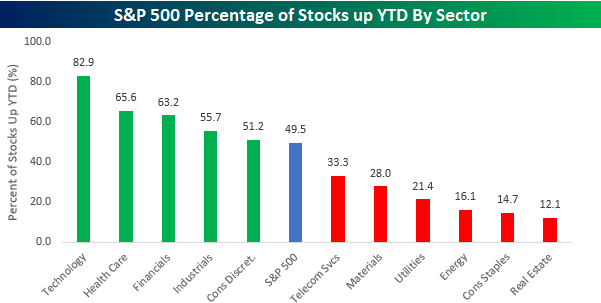
The second way to look at some of the weakness within the market is to look at the percentage of each sector’s components that are up YTD. Here the stratification between tech and non-tech is just as or maybe even more pronounced. Within the Technology sector, just under 83% of stocks in the sector are up YTD (even after Monday’s dump). The next closest sector is Health Care with less than two-thirds. For the S&P 500, just under half of its components are in the black YTD. What’s most striking about the chart below, though, is that there are currently six sectors where two-thirds or more of the sector’s components are down on the year. If Tech wasn’t a quarter of the market, the S&P 500 would be down a lot more on the year.
Dow Internals
Today’s 400+ point decline for the Dow (as of 3:20 PM) has put the index back into the red for the year. The Dow is also down more than 2.5% over the last 5 trading days, and it’s more than 3% below its 50-day moving average. You can see these stats on the US Index ETFs page at our Trend Analyzer Tool.
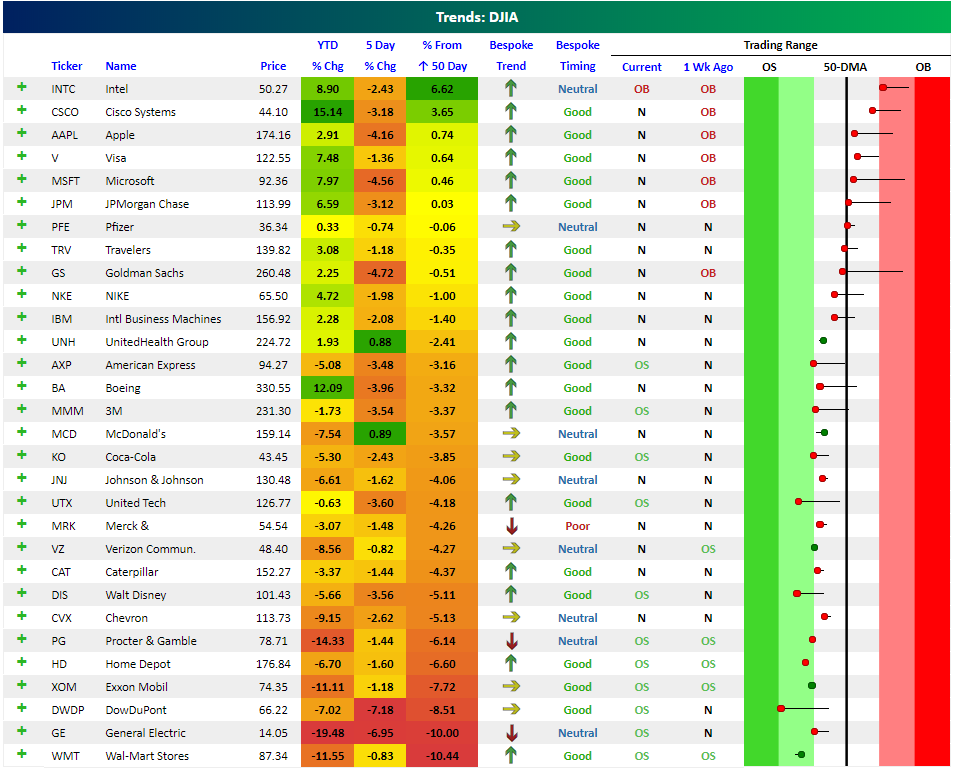
But what about the internals of the Dow 30? Below is a snapshot of the 30 Dow members run through our Trend Analyzer Tool as well. (This page is normally only available to Premium and Institutional members.)
The thirty Dow stocks are sorted by distance from 50-day moving average in the snapshot below. As you can see, just six Dow stocks remain above their 50-DMAs, and just one Dow stock remains overbought (INTC). On the flip side, twenty-four Dow stocks are below their 50-DMAs, and eleven are now in oversold territory. DowDuPont (DWDP), Wal Mart (WMT), Disney (DIS), and United Tech (UTX) are the most oversold.
Based on these readings, the Dow’s internals appear quite weak at the moment.
B.I.G. Tips — Curve Flattens
Chart of the Day: Energy Edging In
Bespoke Brunch Reads: 3/18/18
Welcome to Bespoke Brunch Reads — a linkfest of the favorite things we read over the past week. The links are mostly market related, but there are some other interesting subjects covered as well. We hope you enjoy the food for thought as a supplement to the research we provide you during the week.
Investing
Spurious correlations are kryptonite of Wall St’s AI rush by Robin Wigglesworth (FT)
When you run enough data sets through regressions, you will inevitably find some correlations. The question is, are they spurious and fleeting, or helpful in identifying forward returns? [Link; paywall]
Hedge Funds That Use AI Just Had Their Worst Month Ever by Dani Burger (Bloomberg)
While hedge funds that invest based on algorithms are still very small in AUM terms, they still get a lot of attention and it’s worth remembering they’re anything but bulletproof. [Link; auto-playing video]
What’s the Biggest Trade on the New York Stock Exchange? The Last One by Corrie Driebusch, Alexander Osipovich and Gregory Zuckerman (WSJ)
With an increasing share of investing being done through various types of passive vehicles, the end-of-day NYSE auction has grown in importance. [Link; paywall]
Economics
Forming an Alliance With U.S. Allies Against Bad Chinese Trade Practices Won’t Be Enough to Bring the Trade Deficit Down by Brad W. Setser (Council on Foreign Relations)
A dense 1300 words on the drivers of the US trade deficit, which are only partly related to China. A host of other countries have much larger current account surpluses versus their economies’ size and pursue much more aggressive policy to protect those surpluses. [Link]
Tracking the international footprints of global firms by Stefan Avdjiev, Mary Everett, Philip R. Lane, and Hyun Song Shin (BIS Quarterly Review)
As companies’ ownership structures have shifted into complex global networks of financing, concepts like the current account balance haven’t kept up in keeping track of international economic activity. [Link, 20 page PDF]
Will Employment Keep Growing? Disabled Workers Offer a Clue by Ernie Tedeeschi (NYT)
The population of workers not in the labor force due to illness or disability are declining as the economy continues to churn out job creation, suggesting there’s still slack left in the labor market. [Link; soft paywall]
The Kingdom
Saudis Said to Use Coercion and Abuse to Seize Billions by Ben Hubbard, David D. Kirkpatrick, Kate Kelly, and Mark Mazetti (NYT)
An accounting of the “anti-corruption campaign” that was really more like the consolidation of assets within a crime family, conducted using ankle monitors and luxury hotel imprisonment rather than cement galoshes. [Link; soft paywall]
Lighter Fare
This Woman Wrote Her Novel At A Tire Store And Now They Are Her Biggest Fans by Farrah Penn (BuzzFeed)
A woman struggling with writers block found her most productive penning would happen at the tire store. She is now the small shop’s Writer In Residence. [Link]
This Company Will 3-D Print You in Action-Figure Form by Kevin J. Ryan, Jardley Jean-Louis and Chris Beier (Inc)
Ever wanted to immortalize yourself in toy form? This company gives you the chance to do just that. [Link]
Dark Days
She found a dating app on her boyfriend’s phone. Then she bought a samurai sword. by Kyle Swenson (WaPo)
Between the colorful headline and the details of this story, we don’t want to wreck it with a wordy description, but luckily nobody was killed despite the best efforts at first degree murder. [Link]
Hundreds of Missouri’s 15-year-old brides may have married their rapists by Eric Adler (The Kansas City Star)
Missouri’s lax laws around teenage marriage make it a safe haven for perpetrators of statutory rape and their accomplices, who marry victims in order to avoid jail time. [Link]
Long Reads
Why Wikipedia Works by Brian Feldman (NY Mag)
Immensely profitable companies, casual researchers, and everyone in between rely on Wikipedia for quick, reliable information about the world. How did it become so dominant and ubiquitous, and how does it stay that way? [Link]
Vanilla valuation by Julie Van Rosendaal (Globe & Mail)
All you need to know about vanilla. The flavor is found in places you might not expect it (chocolate, for instance), is highly labor intensive and weather-sensitive, and is grown in relatively few places. [Link; soft paywall]
Bankruptcy
Behind the Breakneck Unraveling of Toys ‘R’ Us by Eliza Ronalds-Hannon, Matthew Townsend, and Lauren Coleman-Lochner (Bloomberg)
How a beloved brand collapsed into bankruptcy. [Link; auto-playing video]
Dogs
United Flies Dog To Japan By Mistake (CBS Chicago/AP)
In addition to killing a dog by stuffing it into an overhead compartment this week, United also apparently sent a canine passenger across the Pacific in error. [Link; auto-playing video]
Paralympics
The Loneliness of the American Paralympics Reporter by Ben Shpigel (NYT)
The New York Times is one of only two outlets to send correspondents for coverage of the Winter Paralympic Games; this summary is insightful into what that process is like, and how little interest is expressed towards the impaired athletes’ pursuit of excellence. [Link; soft paywall]
Education
I’d Be an ‘A’ Student if I Could Just Read My Notes by Melissa Korn (WSJ)
Modern college students are under-practiced at writing with pen and paper, and the results show when they encounter professors who ban laptops in class. [Link; paywall]
Read Bespoke’s most actionable market research by starting a two-week free trial today! Get started here.
Have a great Sunday!