B.I.G. Tips – Which Stock Characteristics Have Been Leading and Lagging?
Fixed Income Weekly – 3/21/18
Searching for ways to better understand the fixed income space or looking for actionable ideals in this asset class? Bespoke’s Fixed Income Weekly provides an update on rates and credit every Wednesday. We start off with a fresh piece of analysis driven by what’s in the headlines or driving the market in a given week. We then provide charts of how US Treasury futures and rates are trading, before moving on to a summary of recent fixed income ETF performance, short-term interest rates including money market funds, and a trade idea. We summarize changes and recent developments for a variety of yield curves (UST, bund, Eurodollar, US breakeven inflation and Bespoke’s Global Yield Curve) before finishing with a review of recent UST yield curve changes, spread changes for major credit products and international bonds, and 1 year return profiles for a cross section of the fixed income world.
In this week’s note, we take a look at the ex ante carry of various global currencies.
Our Fixed Income Weekly helps investors stay on top of fixed income markets and gain new perspective on the developments in interest rates. You can sign up for a Bespoke research trial below to see this week’s report and everything else Bespoke publishes free for the next two weeks!
Click here and start a 14-day free trial to Bespoke Institutional to see our newest Fixed Income Weekly now!
Chart of the Day – Facebook Drawdown Reaches 10%
Bespoke’s Global Macro Dashboard — 3/21/18
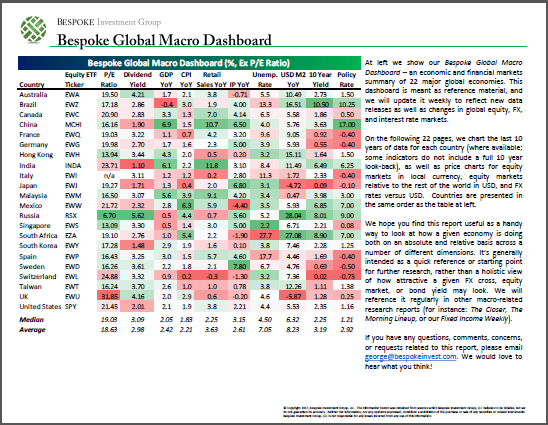
Bespoke’s Global Macro Dashboard is a high-level summary of 22 major economies from around the world. For each country, we provide charts of local equity market prices, relative performance versus global equities, price to earnings ratios, dividend yields, economic growth, unemployment, retail sales and industrial production growth, inflation, money supply, spot FX performance versus the dollar, policy rate, and ten year local government bond yield interest rates. The report is intended as a tool for both reference and idea generation. It’s clients’ first stop for basic background info on how a given economy is performing, and what issues are driving the narrative for that economy. The dashboard helps you get up to speed on and keep track of the basics for the most important economies around the world, informing starting points for further research and risk management. It’s published weekly every Wednesday at the Bespoke Institutional membership level.
You can access our Global Macro Dashboard by starting a 14-day free trial to Bespoke Institutional now!
FANG Check-Up After Facebook (FB) Struggles
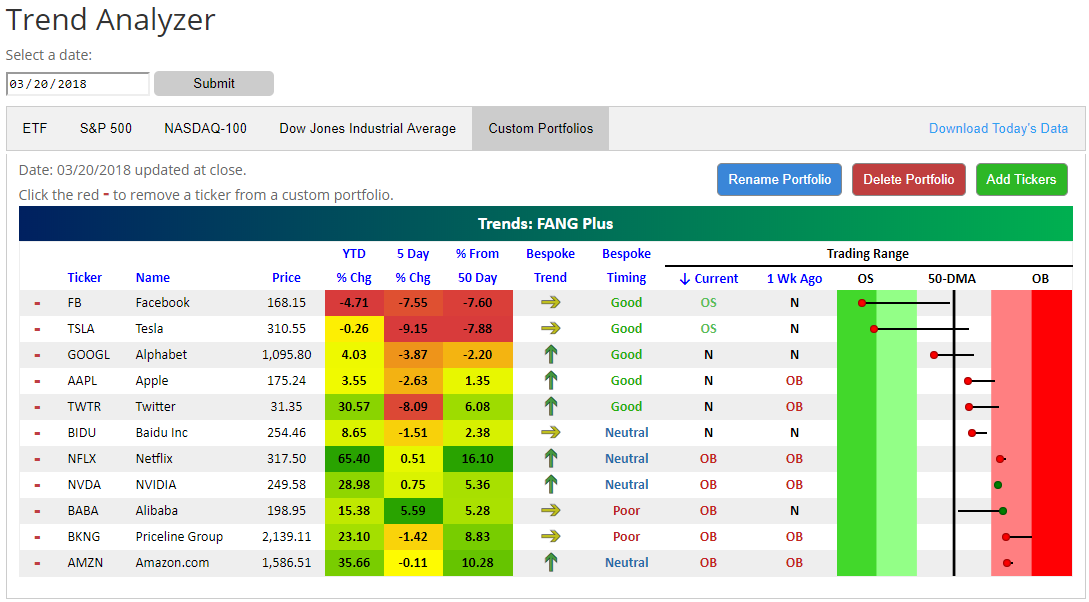
Facebook (FB) has had a rough start to the trading week as shares have dropped from $185 down to $168 in what seems like the blink of an eye. With the drop, we wanted to see how Facebook (FB) and other FANG+ names look in our popular Trend Analyzer tool (available to Premium and Institutional subscribers).
To do this, we’ve simply set up a custom portfolio of the four FANG names (FB, AMZN, NFLX, GOOGL) plus a few more momentum names that trade similarly.
The first snapshot below shows the FANG+ names in our Trend Analyzer sorted alphabetically. The second snapshot is sorted from most oversold to most overbought.
As you can see, Facebook (FB) has experienced a dramatic drop of 7.55% over the last week to put it into extreme oversold territory. The only other name in the screen that’s oversold is Tesla (TSLA).
The one stock that stands out to the upside is Alibaba (BABA). Given that it’s a Chinese-based Tech behemoth, there doesn’t seem to be much concern over privacy issues (like we’ve seen with some of the big FANG names this week). Over the last week, BABA is up 5.59%, which has left it in overbought territory as of the close today.
Along with BABA, the four other overbought stocks in this group are Netflix (NFLX), NVIDIA (NVDA), Priceline Group (BKNG), and Amazon (AMZN).
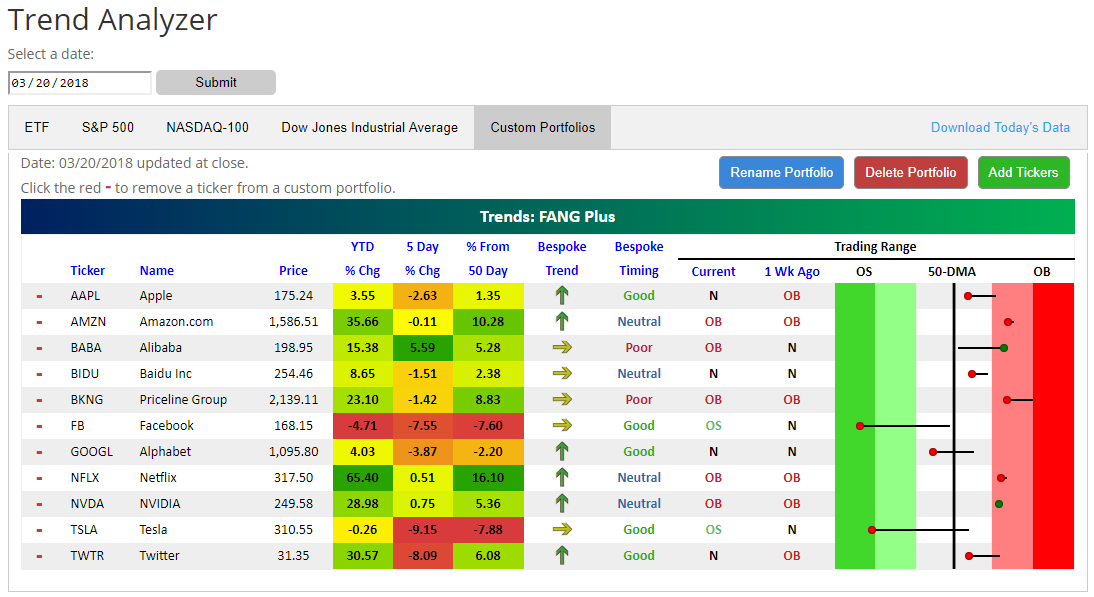
FANG+ sorted by most oversold to most overbought:
The Closer — Digital Economics, International Sectors — 3/20/18
Log-in here if you’re a member with access to the Closer.
Looking for deeper insight on markets? In tonight’s Closer sent to Bespoke Institutional clients, we review new data from the BEA analyzing the digital economy. We also take a look at sector performance for the non-US global equity market.
See today’s post-market Closer and everything else Bespoke publishes by starting a 14-day free trial to Bespoke Institutional today!
B.I.G. Tips – Fed Days March 2018
B.I.G. Tips – Flat Curves
Chart of the Day: Selling The Close
Take the Trading Day Off
In early February we published a report for our research subscribers showing that more than 100% of SPY’s price change since 1993 (when it began trading) can be attributed to after-hours trading. If you bought SPY at the close on every trading day since 1993 and sold it at the next trading day’s open, you’d have a gain of 569%. Conversely, if you bought SPY at the open of every trading day and sold it at the close that same day, amazingly, you’d be down 8.2%. Below is a historical chart showing the cumulative price change since 1993 for both of these strategies. (Jeff Sommer at the NY Times wrote a piece referencing this trading phenomenon that we found that you can view here.)
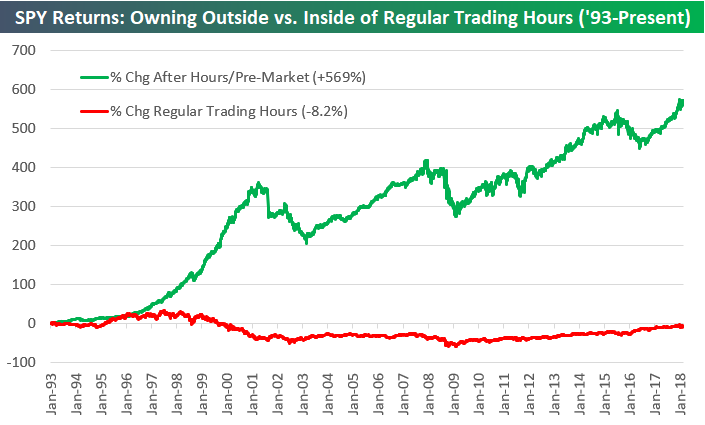
The chart above looks at the trading strategy over a very long time period. Today we wanted to see how the strategy has been doing just over the last year.
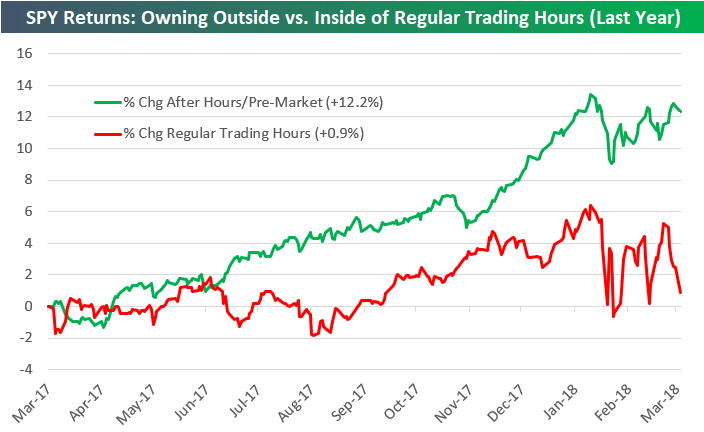
As shown below, after-hours trading is still where it’s at. Over the last year, had you bought SPY at the close every trading day and then sold it at the open the next morning, you’d be up 12.2%. Had you done the opposite and bought SPY at the open of every trading day and sold it at the close that same day, you’d only be up 0.9%.
So far in 2018, the after-hours strategy has meandered along, while the intraday strategy has really struggled of late. Translated: there has been a lot of selling going on during regular trading hours recently.