
Four Down, Eight to Go — Asset Class Returns in April and YTD
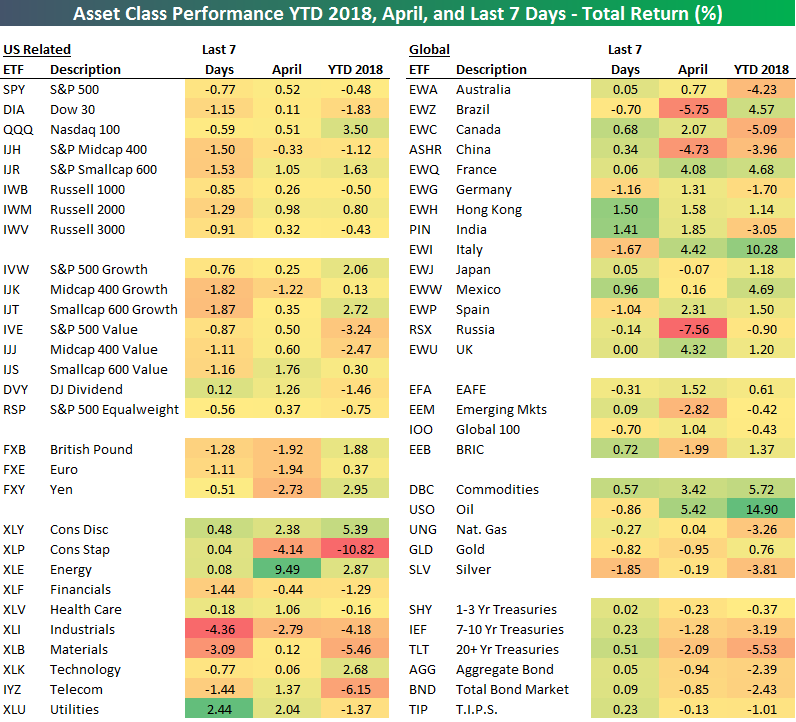
With 2018 already one-third complete, investors sure don’t have much to show for it so far. Below we have updated our ETF Asset Class Performance Matrix summarizing the returns of ETFs representing various asset classes YTD, in the month of April, as well as the last seven days of the month. For the purposes of this post, we’ll focus on returns in April. For the month, the S&P 500 broke a streak of two straight multi-percentage point declines as SPY gained a paltry 0.52%. That’s hardly enough to put a dent in the 6%+ decline from the prior two months, but you have to start somewhere! Most other major US index ETFs also saw modest gains in April except for mid caps (IJH), which were down slightly. We would also point out that April would have been considerably better had it not been for a sell-off in the last week of the month, which erased most of the month’s prior gains. Hmm. A sell-off that erased early gains. That’s starting to sound like a familiar pattern isn’t it?
Within US sectors, returns were a lot more spread apart than the modest changes that the major indices saw. Energy (XLE) was the big winner in April, surging over 9%, while Consumer Staples (XLP) and Industrials (XLI) both fell more than 2.5%. Industrials were having a good April up until the month’s final week. The negative reversal in Caterpillar (CAT) after its earnings report and weakness in the defense contractors contributed to a 4.4% decline for XLI in the last week of the month. In addition to Energy, both Consumer Discretionary (XLY) and Utilities (XLU) saw gains of more than 2% in April.
Like individual sectors, international indices also saw widely varied returns in April. While Russia (RSX) and Brazil (EWZ) both fell more than 5%, France (EWQ), Italy (EWI) and the UK (EWU) were all up over 4%. Keep in mind, too, when looking at these results that they are in dollar-adjusted terms. Therefore, in local currency terms, these indices were up even more. Take France for example. While EWQ was up 4.1% in dollar terms, in local currency, it rallied 5.7%.
In the commodity space, oil rallied 5.4% in April, which propelled the overall commodities ETF (DBC) higher by 3.42%. Gold (GLD) and silver (SLV) were both down marginally.
Finally, Treasury ETFs all fell in April, which means Treasury yields were higher across the board.
The Closer — Five Fed, Inflation On Target, Mexico Banks On Growth — 4/30/18
Log-in here if you’re a member with access to the Closer.
Looking for deeper insight on markets? In tonight’s Closer sent to Bespoke Institutional clients, we discuss the manufacturing activity indices ahead of tomorrow’s ISM release. We also review strong core PCE inflation data updated by the BEA today as well as the backdrop for Mexican banks.
See today’s post-market Closer and everything else Bespoke publishes by starting a 14-day free trial to Bespoke Institutional today!
Chart of the Day: “Sell in May” By the Numbers
A Shortage of Shorts in the FAANG Stocks
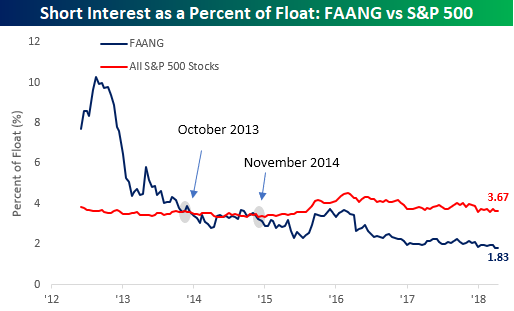
With issues of privacy, security, and unfair market positioning surrounding a number of the FAANG stocks, plus the fact that some of them faced recent selling pressure, we were surprised last week to see that the average short interest as a percentage of float (SIPF) for the five stocks that make up FAANG (Facebook, Amazon.com, Apple, Netflix, and Alphabet) remains right near record lows. That’s right, the average SIPF level for these five names is just 1.83%. Perhaps even more surprising is that their average short interest level is half the average of the S&P 500 (3.67%).
Times have really changed for the FAANG stocks over the last several years. Back in late 2012, when Facebook first went public, the average SIPF level for the FAANG stocks was around 10%. Since then, short interest has steadily declined. October 2013 was the first time that short interest for the FAANGs dropped below the S&P 500, but it wasn’t until November of the next year that short interest stayed there and continued to decline. The fact that short interest levels are so low for the FAANG stocks isn’t entirely surprising. For starters, these are now among the largest market cap stocks in the world, and it is common for mega-cap stocks to have lower than average short interest levels as it takes a lot more capital to short a meaningful percentage of the company. That being said, there certainly seems to be a shortage of skepticism regarding these names.
Bespoke Market Calendar — May 2018
Please click the image below to view our May 2018 market calendar. This calendar includes the S&P 500’s average percentage change and average intraday chart pattern for each trading day during the upcoming month. It also includes market holidays and options expiration dates plus the dates of key economic indicator releases.

B.I.G. Tips – May 2018 Seasonality
Bespoke Matrix of Economic Indicators: 4/30/18
Slow and Steady Wins the Race
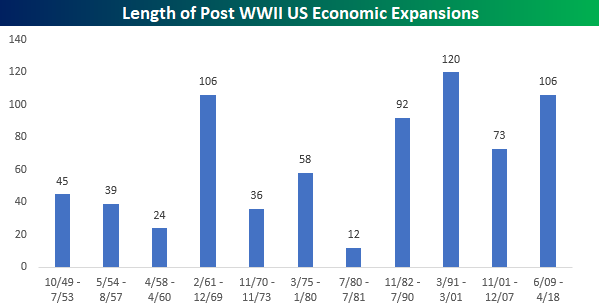
It all began 106 months ago today. After a devastating recession and financial crisis, the US economy finally hit rock bottom in June 2009, and “green shoots” began to emerge. While the recovery has been anything but strong, it has been pretty darn consistent. At 106 months now, beginning tomorrow, the current period will move into second place all by itself in terms of longest US economic expansions. Not to get ahead of ourselves, but in order to match the record long expansion for the 1990s/early 2000s, the expansion would have to extend into the second half of 2019.
Bespoke Brunch Reads: 4/29/18
Welcome to Bespoke Brunch Reads — a linkfest of the favorite things we read over the past week. The links are mostly market related, but there are some other interesting subjects covered as well. We hope you enjoy the food for thought as a supplement to the research we provide you during the week.
Brave New World
You could be flirting on dating apps with paid impersonators by Chloe Rose Stuart-Ulin (Quartz)
A look inside the world of freelance virtual dating assistance, who flirt on behalf of clients on apps like Tinder; with one in three heterosexual Americans meeting their future spouse online these days, questions loom about the line between assistant and scam artist. [Link]
We’re underestimating the mind-warping potential of fake video by Brian Resnick (Vox)
Higher quality computer techniques are helping blend the line between the real and the imagined, and the implications for our society are staggering. [Link]
Amazon’s new Alexa-powered Dot encourages kids to use the word ‘please’ by Jason Del Rey (Recode)
One of the features in the new kids-and-family targeted Echo Dot encourages pint-sized users to use “please” when communicating with Alexa. [Link]
Took an ancestry DNA test? You might be a ‘genetic informant’ unleashing secrets about your relatives by Ashley May (USA Today)
Investigators in Sacramento used DNA from a crime scene to compare versus genealogical websites and identify the killer. We would not be surprised to see this end up as a Supreme Court case. [Link]
Labor Markets
High-Paying Trade Jobs Sit Empty, While High School Grads Line Up For University by Ashley Gross and Jon Marcus (NPR)
High schoolers have had the mantra “go to college” drummed into them repeatedly, but that means that many high-paying blue collar jobs are going wanting as students forego opportunities in pursuit of a college degree. [Link]
Why Working on the Railroad Comes With a $25,000 Signing Bonus by Paul Ziobro (WSJ)
Strong freight volumes, low unemployment, and a dearth of willing workers mean big incentives are being dangled infront of workers to start a career on the railroad. [Link; paywall]
The Call for Jobs for All by Matthew C. Klein (Barron’s)
A background explainer on the idea of a jobs guarantee, proposed recently by a number of Senators and backed by modern monetary theory. [Link; paywall]
Crypto
Crypto World Gains Even More Options: Five New Fundstrat Indexes by Janine Wolf (Bloomberg)
Fundstrat, an independent research shop, has introduced 5 different price indices based on the typo of crypto asset; the five indices comprise 75% of existing crypto market cap. [Link]
Bitcoin is the greatest scam in history by Bill Harris (Recode)
The founding CEO of PayPal thinks that bitcoin – and, by implication, other crypto assets – is a scam, because its only useful application is in criminal activity. [Link]
Investing
Being Short and Right Can Be Bad by Matt Levine (Bloomberg)
How do you make a put option work when the underlying can’t trade? This is the question behind Longfin, a blockchain fraud stock which has been suspended due to an SEC investigation. [Link]
Hedge fund billionaire Steve Cohen’s venture capital group is on a fintech tear by Liz Moyer (CNBC)
The venture arm of former hedge fund operator turned family office investor (as a result of an insider trading investigation) has been throwing gobs of cash at financial technology startups. [Link]
Automobiles
Ford to stop selling every car in North America but the Mustang and Focus Active by Matt Burns (Techcrunch)
Amidst an over-saturated market for sedans, Ford is discontinuing virtually all car sales in the United States to focus on trucks, SUVs, and its commercial offerings. [Link]
Electric Buses Are Hurting the Oil Industry by Jeremy Hodges (Bloomberg)
17% of China’s buses are electric, accounting for 99% of total global deployment of the technology. The result is 279,000 barrels of oil per day not used, a non-trivial and rising share of global demand. [Link; auto-playing video]
Google and Facebook Likely to Benefit From Europe’s Privacy Crackdown by Sam Schechner and Nick Kostov (WSJ)
New privacy regulations in Europe could result in burdens smaller firms are unable to meet, creating a competitive advantage for larger players. [Link; paywall]
Think macro: record actions in Google Sheets to skip repetitive work by Ryan Weber (Google)
In its bid to replace Excel, Google Sheets has introduced functionality designed to replicate VBA macros which are often used as a time saving device in the Microsoft program. [Link]
Health Care
Medicare will require hospitals to post prices online by Ricardo Alkonso-Zaldivar (MSN/AP)
The government agency responsible for overseeing Medicare and Medicaid will now require hospitals to post prices online, in an effort to improve competition via greater transparency. [Link]
Student Loans
Drew Cloud Is a Well-Known Expert on Student Loans. One Problem: He’s Not Real. by Dan Bauman and Chris Quintana (The Chronicle of Higher Education)
Numerous media sources have been citing an “expert” on student loans that was actually an invented persona speaking on behalf of a student loan refinancing company. [Link]
Baseball
Mickey Mantle baseball card sells for $2.8 million at auction by Chris Perez (NYPost)
The latest in a long saga of “seriously?” prices for rare objects, a Micky Mantle baseball card has set a record for post-WW2 era cards (it’s the second-highest price paid for any card). [Link]
Read Bespoke’s most actionable market research by starting a two-week free trial today! Get started here.
Have a great Sunday!