
Exxon Mobil (XOM) Golden Cross
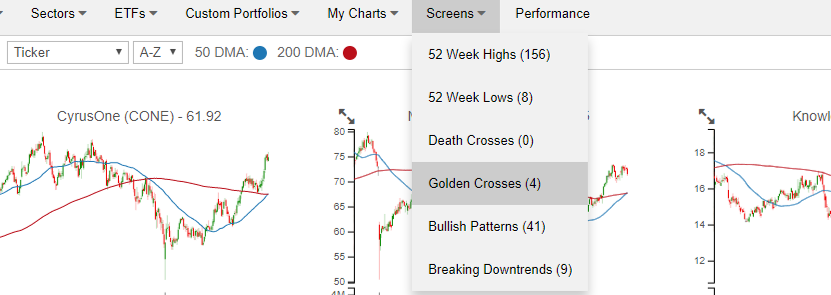
Our recently launched Chart Scanner has become an incredibly popular and useful tool for clients as it gives a user the ability to quickly scan through hundreds of charts in order to find the most attractive (or unattractive) patterns. Included with the tool are a number of pre-defined screens that allow users to see stocks that hit 52-week highs or lows in the previous session, experienced “death” or “golden” crosses, as well as charts which we view as having bullish or bearish patterns. Each of these screens can be found using the drop-down box at the top of the page (as illustrated in the image below). To unlock our Chart Scanner tool, simply sign up for a two-week free trial to Bespoke Premium. You won’t be disappointed!
One stock that showed up on our Golden Cross screen today was Exxon Mobil (XOM). After a rough first quarter for the stock, shares of XOM came roaring back in the second quarter and just yesterday completed the formation. For anyone who is unfamiliar with the term, a Golden Cross occurs when a stock’s upwardly sloping 50-day moving average (DMA) crosses above its 200-DMA, which also has to be rising. Conversely, a Death Cross occurs when a downwardly sloping 50-DMA crosses below the 200-DMA, which also has to be moving lower. Technicians consider Golden Cross formations to be a positive signal, while a Death Cross is considered to be negative. In practice, however, that is not always the case.
The chart below shows the performance of XOM over the last ten years, and we have included arrows to show occurrences of each Golden Cross for the stock. Prior to yesterday’s formation, XOM had seen five other Golden Crosses over the last ten years with the most recent occurring back in December 2013.

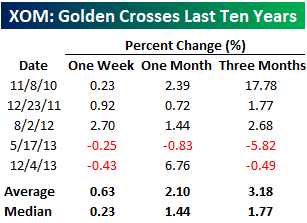
We mentioned above that Golden Crosses haven’t always been bullish for future stock returns in practice, but in the case of XOM, prior occurrences have, for the most part, been positive for the stock. Even in this case, though, it hasn’t been overwhelmingly bullish. The table below lists the one week, one month, and three month returns for the stock following each prior Golden Cross. In the week that followed the five prior occurrences, XOM averaged a gain of 0.63% (median: 0.23%) with positive returns just three out of five times. One month later the stock saw an average gain of 2.10% (median: 2.10%) with gains four out of five times, while the average three-month return was a gain of 3.18% (median: 1.77%) with gains three out of five times.
Fixed Income Weekly – 7/11/18
Searching for ways to better understand the fixed income space or looking for actionable ideals in this asset class? Bespoke’s Fixed Income Weekly provides an update on rates and credit every Wednesday. We start off with a fresh piece of analysis driven by what’s in the headlines or driving the market in a given week. We then provide charts of how US Treasury futures and rates are trading, before moving on to a summary of recent fixed income ETF performance, short-term interest rates including money market funds, and a trade idea. We summarize changes and recent developments for a variety of yield curves (UST, bund, Eurodollar, US breakeven inflation and Bespoke’s Global Yield Curve) before finishing with a review of recent UST yield curve changes, spread changes for major credit products and international bonds, and 1 year return profiles for a cross section of the fixed income world.
In our analysis today we take a look at which developed market bond markets are richest or cheapest versus overnight index swaps (OIS).
Our Fixed Income Weekly helps investors stay on top of fixed income markets and gain new perspective on the developments in interest rates. You can sign up for a Bespoke research trial below to see this week’s report and everything else Bespoke publishes free for the next two weeks!
Click here and start a 14-day free trial to Bespoke Institutional to see our newest Fixed Income Weekly now!
Chart of the Day: Huge Forecasts Ahead Of Earnings
Bespoke’s Global Macro Dashboard — 7/11/18
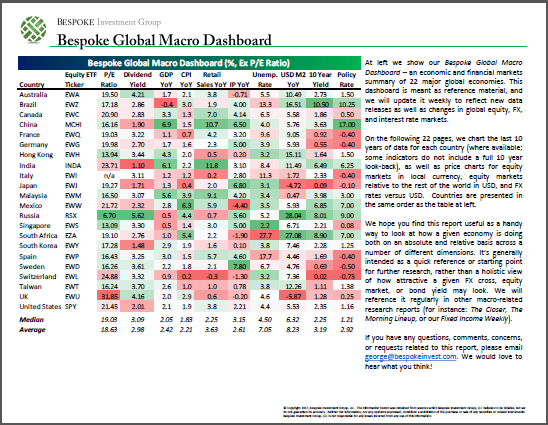
Bespoke’s Global Macro Dashboard is a high-level summary of 22 major economies from around the world. For each country, we provide charts of local equity market prices, relative performance versus global equities, price to earnings ratios, dividend yields, economic growth, unemployment, retail sales and industrial production growth, inflation, money supply, spot FX performance versus the dollar, policy rate, and ten year local government bond yield interest rates. The report is intended as a tool for both reference and idea generation. It’s clients’ first stop for basic background info on how a given economy is performing, and what issues are driving the narrative for that economy. The dashboard helps you get up to speed on and keep track of the basics for the most important economies around the world, informing starting points for further research and risk management. It’s published weekly every Wednesday at the Bespoke Institutional membership level.
You can access our Global Macro Dashboard by starting a 14-day free trial to Bespoke Institutional now!
The Closer — Quits Surge, Curves Flatten — 7/10/18
Log-in here if you’re a member with access to the Closer.
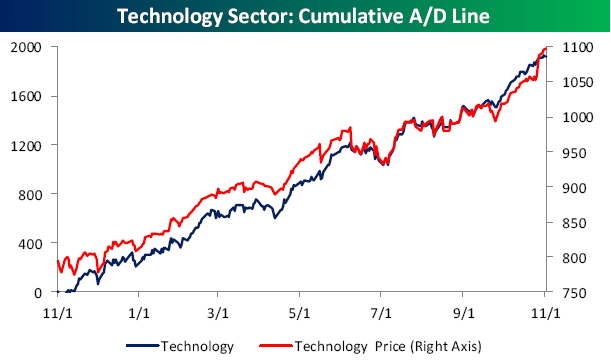
Looking for deeper insight on markets? In tonight’s Closer sent to Bespoke Institutional clients, we review a very constructive JOLTS report from the BLS, including implications for wage growth. We also take a look at yield curves, which in some cases have already inverted.
See today’s post-market Closer and everything else Bespoke publishes by starting a 14-day free trial to Bespoke Institutional today!
Small Businesses Still Giddy
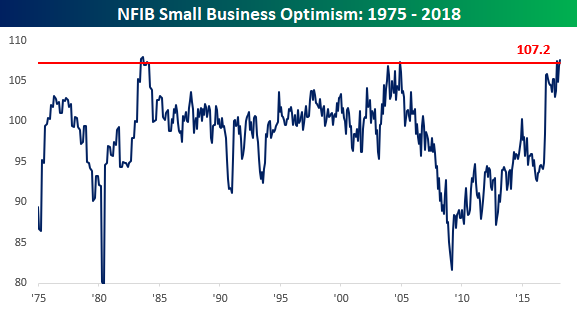
Optimism on the part of small businesses declined slightly this month, but current levels of confidence remain right near record highs. In this month’s survey, the index of Small Business Optimism dropped from 107.8 down to 107.2. Not only was that ahead of consensus expectations, but it was also the 7th highest monthly reading in the history of the report. A period spanning 480 months dating back to the start of 1975. The opening sentence of the commentary section of the report pretty much sums things up with the statement that “Small business owners continue to report astounding optimism as they celebrate strong sales, the creation of jobs, and more profits.”
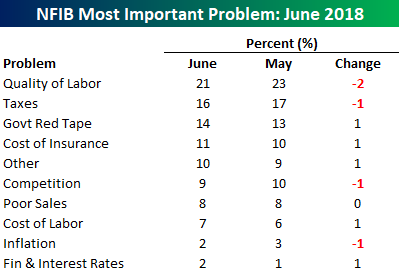
While small business owners are just about as confident as they’ve ever been, there are always issues that businesses face in the day to day to operation of their business. In the table below, we summarize which issues businesses rank as their biggest problems. Topping the list once again this month was “Quality of Labor” which was cited by 21% of all respondents. That’s actually down from last month’s reading of 23%, but it’s still high nonetheless and suggests that wage pressures begin to build underneath the surface. One surprising aspect of this list is the issues that aren’t problems. As shown at the bottom of the table, the three smallest problems for businesses are Finance & Interest Rates (2%), Inflation (2%), and Cost of Labor (%). With the Unemployment Rate right near multi-decade lows, the FOMC hiking rates, and inflation trending higher, one would think that the combined total of these three problems would at least be greater than 11%, but that hasn’t been the case yet.
Franco-Belgian Ballgames & Bourses
As we type this, the second half is underway in the FIFA World Cup semi-final between Belgium and France. The game is an entertaining 1-0 (France ahead) thriller filled with history: the two countries share an official language, a border, and a long history featuring episodes like twin summer revolutions in 1830 or mutual invasion by Germany in both World Wars. Today, however, the two are opposed on the pitch. What about in financial markets? It turns out the result is actually instructive about the difference between short- and long-term relative performance.
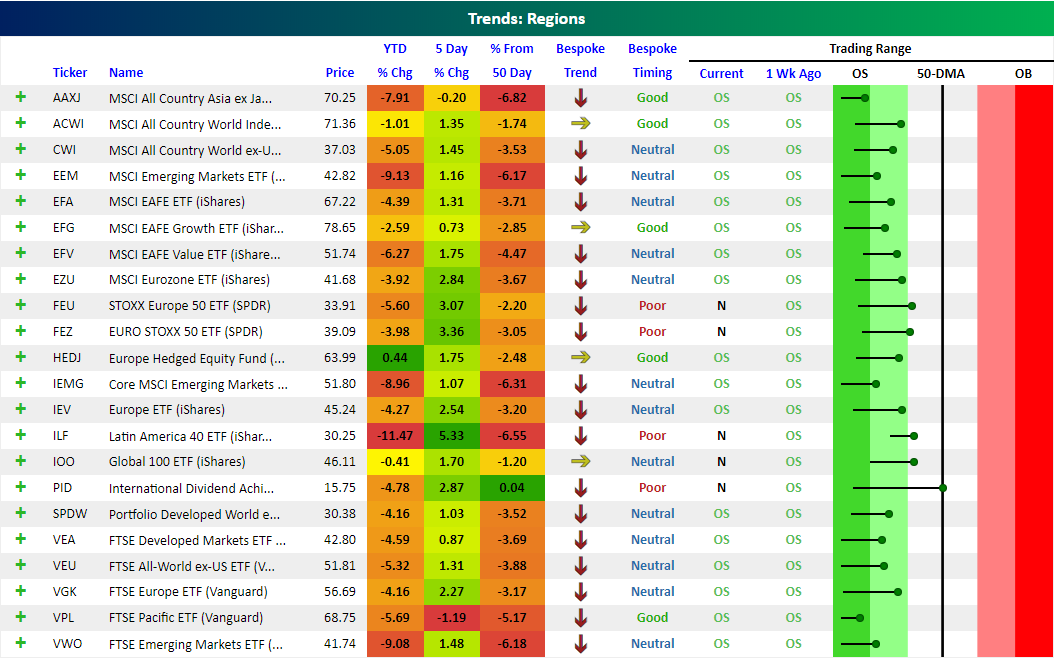
We have USD total returns for each country’s MSCI index dating back to the start of 1999. Since then, Belgium has outperformed France in 11 of 20 years, including a streak of seven straight wins from 2009 to 2015. As shown in the last chart below, though, France has been the winner the last three years including 2018 YTD. So does that mean Belgium has been a better bet for investors? No. Since our data starts, France has outperformed Belgium dramatically, returning 138% to investors versus 58% for Belgium. In other words, while Belgium has won more “matches” over the last couple of decades, France has a truly massive leg up when it comes to the “goal” differential between the two countries.
Update on S&P 500 Domestics vs Internationals
Bespoke Stock Scores — 7/10/18
The Closer — Trade Recap, Consumer Credit, Relative Performance — 7/9/18
Log-in here if you’re a member with access to the Closer.
Looking for deeper insight on markets? In tonight’s Closer sent to Bespoke Institutional clients, we review trade balance data updated by the Census last Friday, consumer credit growth reported by the Fed today, and relative performance of equities versus underlying drivers.
See today’s post-market Closer and everything else Bespoke publishes by starting a 14-day free trial to Bespoke Institutional today!