Trend Analyzer – 10/2/2018 – Small-Caps Get Oversold
As shown below in the snapshot of our Trend Analyzer tool, small-cap and mid-cap stocks have had a rough go of it lately. The Core S&P Small-Cap (IJR) and Micro-Cap (IWC) are both down the most of the major US index ETFs since last week at -2.17% and -2.18%, respectively. Along with the Russell 2000 (IWM), these ETFs have each moved well below their 50-day moving averages into oversold territory. This is the first time in a while that we have seen multiple ETFs oversold at the same time. Unfortunately—with the exception of the Dow (DIA) and Nasdaq (QQQ) who have continued to perform well recently—even the ones that have edged out gains are not necessarily saving graces.

Morning Lineup – Off the Lows
What was looking like quite a bad morning for US equities when our alarms went off a few hours ago is looking a lot more manageable now as futures have rallied off their lows.
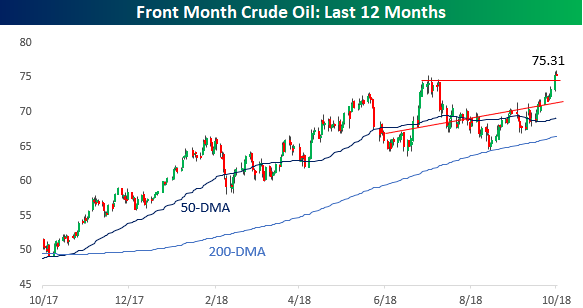
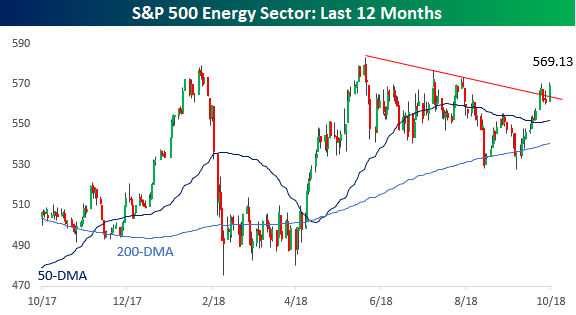
In yesterday’s session, the big star of the day was oil and the Energy sector in general. Driven by a 2.8% rally in crude oil prices, the S&P 500 Energy sector jumped 1.5%. Checking out the charts for oil and the Energy sector show some positive trends.
Crude oil prices are relatively quiet today, but yesterday’s rally took the front month future to a new 52-week high with a breakout above the summer highs.
While not at a new high, the S&P 500 Energy sector looks to be on the right path after convincingly breaking its downtrend from the highs in the Spring. Also working in the sector’s favor is that along with the rally in crude oil, natural gas prices also rallied yesterday to their highest prices since January.
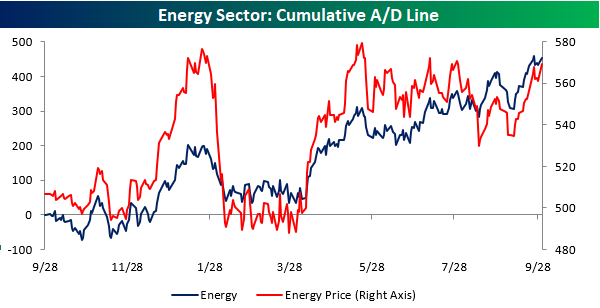
Internals for the Energy sector also look positive. The chart below compares the sector’s price and cumulative A/D line. While prices aren’t yet at new highs, breadth has been strong and consistently trending higher for the last several weeks.
Start a two-week free trial to Bespoke Premium to see today’s full Morning Lineup report. You’ll receive it in your inbox each morning an hour before the open to get your trading day started.

The Closer — Seasonal Tailwinds, Manufacturing Headwinds — 10/1/18
Log-in here if you’re a member with access to the Closer.
Looking for deeper insight on markets? In tonight’s Closer sent to Bespoke Institutional clients, we take a look at the very positive seasonality that historically dominates Q4. We also review manufacturing sentiment data from around the US and global economy and today’s residential construction release for the month of August.
See today’s post-market Closer and everything else Bespoke publishes by starting a 14-day free trial to Bespoke Institutional today!
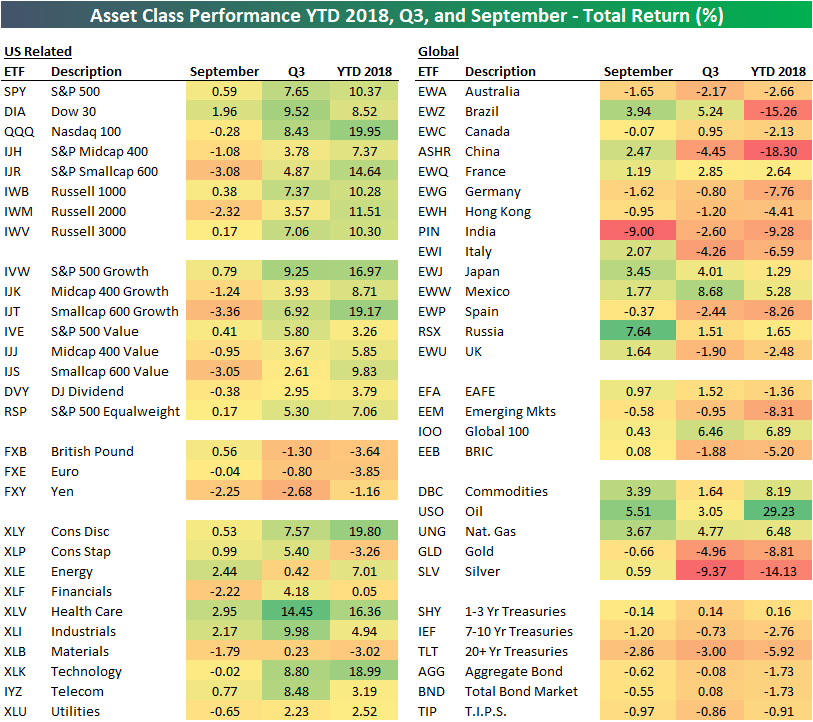
September, Q3, and YTD 2018 Asset Class Performance
Below is a snapshot of total returns for various asset classes through the first three quarters of 2018. In September, we saw gains for the S&P 500 and Dow 30, but we saw declines for the Nasdaq 100 and small-caps. The Technology sector was also down in September along with Financials, Materials, and Utilities.
Outside of the US, India (PIN) got slammed in September with a drop of 9%. Russia, on the other hand, saw a gain of 7.64% on the month as commodities rallied.
Fixed income ETFs were down across the board in September, and they’re down YTD as well on a total return basis.

Bespoke Summary of Economic Indicators: 10/1/18
Italy’s Budget Woes
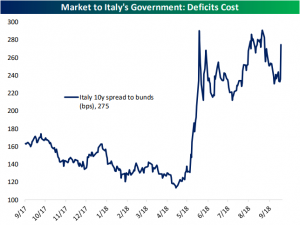
European equities ended last week by unwinding two weeks worth of solid gains. On Friday, the STOXX 600 was down 0.83% on very high volumes, but the real chaos was in Italy where the FTSE MIB was down 3.7%. Within the STOXX 600, Banks felt the pain the most, down 2.8% with Insurance not far behind at 1.7%. Italian banks made up four of the worst five performers in the broad STOXX 600, with Banco BPM, Unione di Banche Italia, UniCredit, and Intesa Sanpaolo all off at least 7.8%. The FTSE MIB saw a continuation of these issues today, falling 0.49% on the session.

The reason for all the chaos was the Italian government destroying market hopes of fiscal restraint. Thursday night, they announced a deficit-to-GDP target for the 2019 budget of 2.4% of GDP. Italian government debt-to-GDP is 132%, and its economic indicators consistently lag; there’s just no way they can sustainably spend 2+% of GDP if the markets don’t want to let them. Eurozone officials echoed these concerns in a meeting earlier today and look to mitigate escalation of these concerns.

While much has been made of the Italy-EU fault lines, this market-imposed discipline is much more binding at present and saves much of the work that EU bodies might otherwise have to do in restraining Italian spending.
Oil Breaks Out to New 52-Week High
The price of crude oil is breaking out today as shown in the chart below. At $74.73/barrel, crude is now at its highest level in nearly four years.
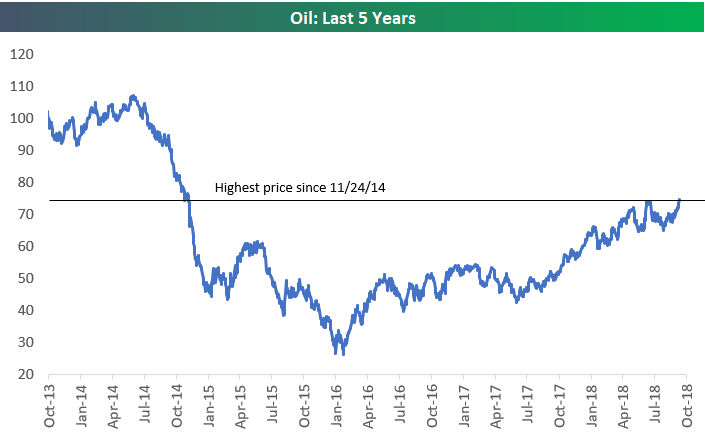
While the five-year chart above looks relatively constructive, an even longer term chart going back to 1990 looks more daunting for oil bulls. For the chart below to turn more bullish from a technical perspective, we’d want to see price move above resistance near $110.

Bespoke Market Calendar — October 2018
Please click the image below to view our October 2018 market calendar. This calendar includes the S&P 500’s average percentage change and average intraday chart pattern for each trading day during the upcoming month. It also includes market holidays and options expiration dates plus the dates of key economic indicator releases.

This Week’s Economic Indicators
We are kicking off October with a relatively light few days on the economic data front. Overnight, Manufacturing and Service PMIs were released alongside Retail Sales for multiple countries including Germany, Italy, Switzerland, France, and the UK. Japan’s quarterly Tankan business surveys were updated with most series missing expectations.
Back home this morning, the US Manufacturing PMI for September came in right inline with expectations. ISM Manufacturing and Prices Paid were released shortly after and both came in below expectations. After no releases tomorrow, Wednesday will round out the ISM and PMI releases with the services portion of both indicators.
On Friday, we will see if the labor market continues its hot streak when Nonfarm Payrolls for September hits the tape. Payrolls and U3 unemployment are estimated to decline once again while hours are expected to go unchanged. Average hourly earnings are predicted to see a slight downtick in YoY growth. See the table below for the rest of the upcoming US data releases this week. You can always check out the day’s economic releases here with our Economic Monitor.

ISM Manufacturing Drops More Than Expected
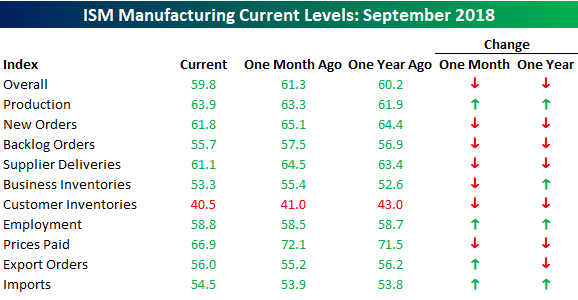
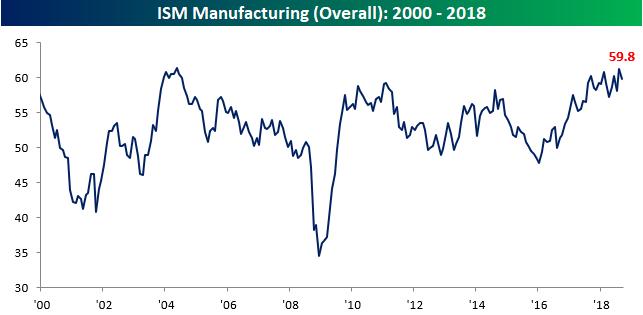
After surging to a multi-year high in August, the ISM Manufacturing index pulled back slightly more than expected in September, falling from 61.3 down to 59.8 versus expectations for a drop to 60.0. As shown in the chart, though, activity is still at extremely robust levels.
In terms of the commentary of this month’s report, it was generally positive, but that strength is being clouded by the issue of tariffs, which is showing up in a number of sectors like Computer and Electronic Products, Chemicals, Furniture, and Plastics.

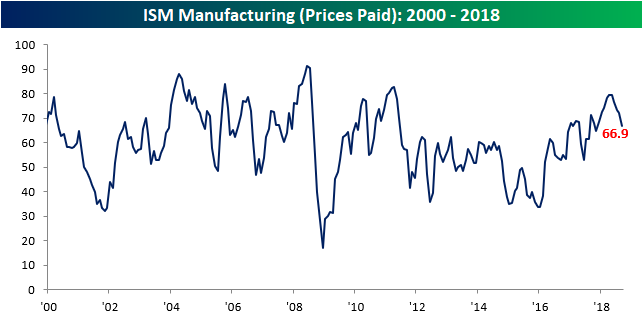
As far as the breakdown of this month’s report is concerned, breadth was relatively weak. On a m/m basis, just four categories improved while six declined. Production was one bright spot, as were Export and Import Orders, which is a bit surprising given the recent barriers to trade. The only other category to show a m/m increase was Employment. On the downside, the most notable decline was Prices Paid. That index dropped from 72.1 down to 66.9 which is the lowest monthly reading of the year and largest m/m decline since last June. Here again, one would expect the increasingly tense trade environment to be having upward rather than downward pressure on prices.