The Closer – Russell’s New High, Courts, Valuations – 9/18/25
Log-in here if you’re a member with access to the Closer.
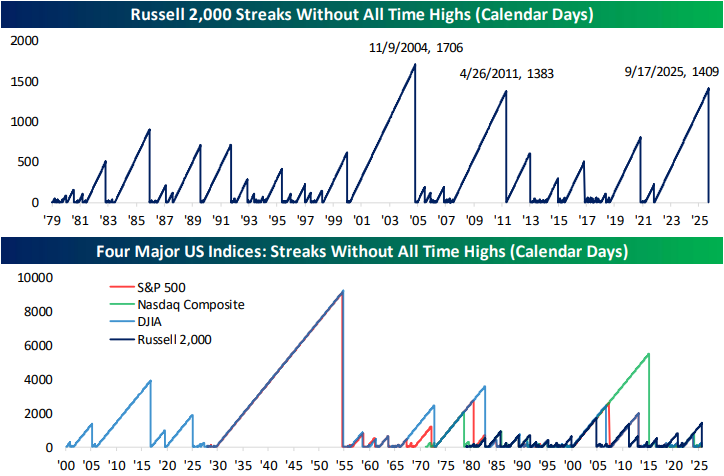
Looking for deeper insight into markets? In tonight’s Closer sent to Bespoke Institutional clients, we begin with a look at the Russell 2,000’s breakout to fresh all time highs, comparing its streak without a high to similar streaks of the past (page 1). Next, we review today’s news surrounding the Supreme Court, Fed Governor Cook, and tariffs (page 2). We then delve into equity market valuations (pages 2 and 3) before shifting into macro data that includes claims (page 4), TICS (page 5), regional Fed Manufacturing gauges (page 6), and freight volumes and prices (page 7).
See today’s full post-market Closer and everything else Bespoke publishes by starting a 14-day trial to Bespoke Institutional today!
Chart of the Day: NVIDIA (NVDA) Falls Behind
Bespoke’s Morning Lineup – 9/18/25 – Slow Moving Rally
See what’s driving market performance around the world in today’s Morning Lineup. Bespoke’s Morning Lineup is the best way to start your trading day. Read it now by starting a two-week trial to Bespoke Premium. CLICK HERE to learn more and start your trial.
“He who waits to do a great deal of good at once will never do anything.” – Samuel Johnson

Below is a snippet of commentary from today’s Morning Lineup. Start a two-week trial to Bespoke Premium to view the full report.
Investors apparently slept on the Fed’s announcement yesterday and woke up in a good mood. The S&P 500 is on pace to open up by 0.75% this morning, while the Nasdaq is on track to open up by more than 1%, and small caps are leading the way with a gain of 1.25%. The US strength follows what was a mostly positive night in Asia, where China was the only country to trade lower, while Japan and Korea both shot higher by over 1%. The strength in Japan came even as Machinery Orders fell 4.6% m/m compared to forecasts for a drop of just 1.8%. In Europe, stocks are also higher across the board as the STOXX 600 rallies 0.8%.
This morning in the US, there’s little in the way of earnings data, and the only reports on the economic calendar are jobless claims at 8:30 and the Philly Fed and Leading Indicators at 10 AM.
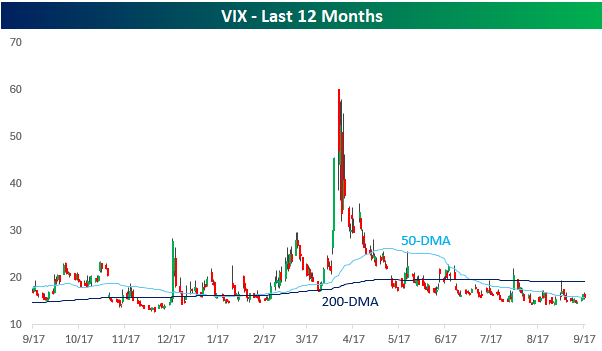
Like the quote above, the market’s grind higher for the last several months has been more gradual than a move concentrated into a handful of days. There are several ways to illustrate this, and we’ll start with the VIX. At 14.8 this morning, the VIX is on pace for its lowest close since late August, not exactly a level you would expect for what historically has been one of the most volatile months of the year. As shown in the chart below, if the VIX was an EKG, we’d be putting a sheet over the patient as it has flatlined since first falling back below its 200-DMA in June.
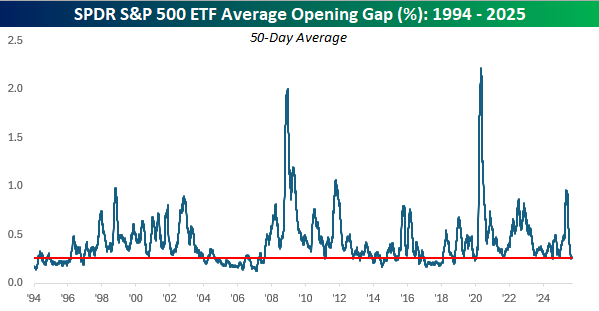
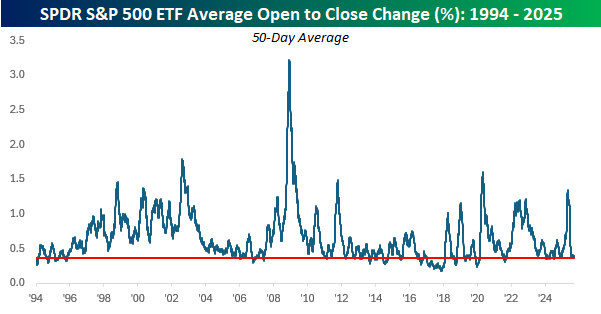
In addition to the low VIX, another example of the gradual moves is by looking at the S&P 500’s average opening gap. Using SPY as a proxy, the S&P 500’s average change at the open relative to the prior days’ close over the last 50 trading days has been 0.25%, and there has only been one day when the S&P 500 gapped up or down more than 1% (9/2/25: -1.17%). After volatility at the open rocketed to the highest levels since COVID back in April, the average daily change has sunk like a stone to some of the lowest levels of the last five years.
Just as volatility has been subdued at the opening bell, it has also been tamed during regular trading hours. Just like the average opening gap, intraday volatility shot higher in April only to come crashing down in the summer to around the lowest levels of the last five years. The old cliché says to never short a dull market, and that’s the only piece of advice an investor has needed over the last few months.
The Closer – FOMC Reactions, Residential Construction – 9/17/25
Log-in here if you’re a member with access to the Closer.
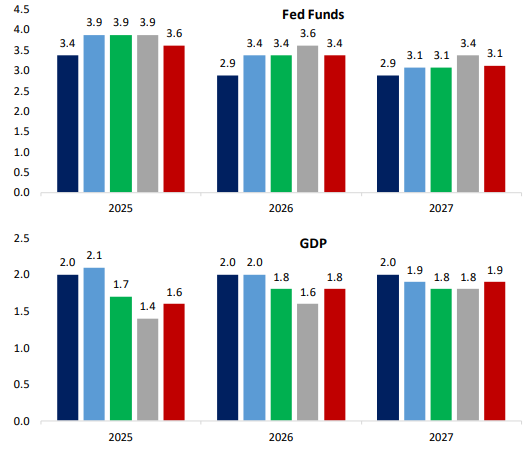
Looking for deeper insight into markets? In tonight’s Closer sent to Bespoke Institutional clients, we recap the Fed decision beginning with a review of the update of the Summary of Economic Projections (page 1) followed by a dive into the market’s reaction to the rate cut (pages 2 and 3). We wrap up the report with a review of the latest residential construction figures (page 4).
See today’s full post-market Closer and everything else Bespoke publishes by starting a 14-day trial to Bespoke Institutional today!
Bespoke Baskets Update – September 2025
Overbought Becomes the Norm For the Nasdaq
The chart below shows the Nasdaq’s daily close relative to its trading range expressed in terms of standard deviations relative to its 50-day moving average (DMA). We also update a similar chart for the S&P 500 every day in our Morning Lineup. When the line is in the white zone, it indicates that the Nasdaq is trading within its normal trading range (less than one standard deviation above or below the 50-DMA). When it rises into the red zones, it indicates various levels of overbought, while readings in the green zones represent short-term oversold levels. Heading into this morning, the Nasdaq was firmly into ‘extreme’ overbought territory (2+ standard deviations above its 50-DMA) after trading almost exclusively at overbought levels for the last four months.
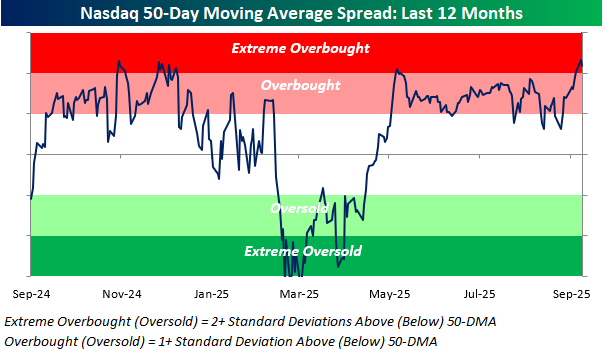
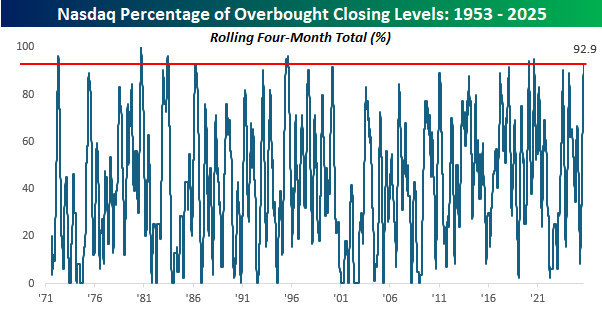
Normally, overbought or oversold levels revert to the mean over time, so situations like the present are very unusual. Over the last four months, the Nasdaq has closed at overbought levels on just under 93% of trading days. While readings this high aren’t unprecedented, they are rare. In fact, there hasn’t been a higher frequency of overbought daily closes for the Nasdaq in a four-month window since August 2020, and the reading has only been above 85% on 0.04% of all trading days in the Nasdaq’s history. Overbought markets can’t stay overbought forever, so eventually we’ll see the market pull back from these levels, but for now, it’s been an unbelievable run.

Another Powell Fed Day
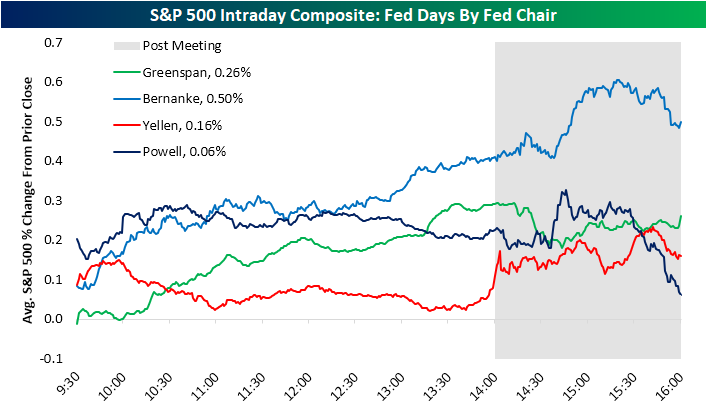
Fed Day is here! The FOMC concludes its meeting this afternoon and in all likelihood Powell and company will cut rates by 25 bps. As we have highlighted in the past, when it comes to how stocks respond to the FOMC, Powell Fed Days have on average been the worst of any Fed Chair. By the close of trading, the S&P 500 has only averaged a 6 bps gain on Fed days since Powell has been at the helm. That compares to 16 bps for his predecessor, a 50 bps gain for Bernanke and a 26 bps gain for Greenspan. While that may be the case for full-day changes, it’s worth nothing that earlier in the day would be an entirely different story. In fact, between 2:30 PM EST and up until the final half hour of trading, Powell Fed days have actually been on pace for the second strongest stock price reactions of any Fed chair. That means sharp declines at the end of the day can largely be credited for the Fed day weakness during Powell’s tenure. It almost wouldn’t be a Powell Fed day without a post-presser sell-off!
Below is a closer look at the S&P 500’s average intraday path on Powell Fed days. The red line shows the S&P’s average path across all 61 Powell Fed days since his tenure began in 2018, while the blue line shows just the last ten Powell Fed days. Under both scenarios, the market has been sitting on solid gains heading into the 2 PM ET rate decision, but the final hour of trading has averaged a pretty steep drop.
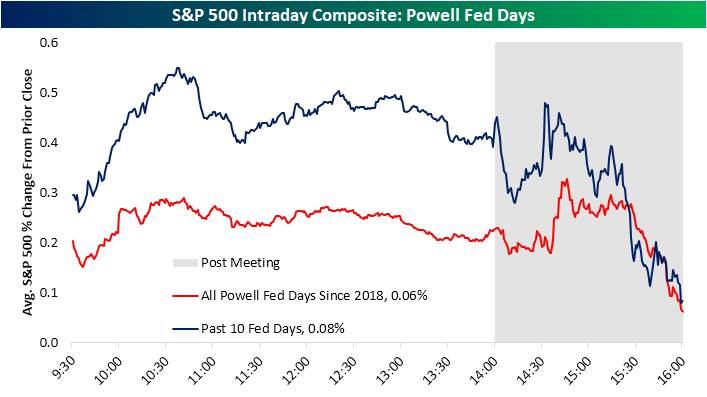
Chart of the Day – Rate-Cut Fed Days and Beyond
Bespoke’s Morning Lineup – 9/17/25 – Everybody Rallies
See what’s driving market performance around the world in today’s Morning Lineup. Bespoke’s Morning Lineup is the best way to start your trading day. Read it now by starting a two-week trial to Bespoke Premium. CLICK HERE to learn more and start your trial.
“To hell with facts! We need stories!” – Ken Kesey
Below is a snippet of commentary from today’s Morning Lineup. Start a two-week trial to Bespoke Premium to view the full report.
The long-awaited Fed decision day has arrived, and despite an Atlanta Fed GDPNow forecast for growth of 3.4% in Q3, stronger-than-expected retail sales in August, still relatively low (but admittedly rising jobless claims), and higher-than-normal inflation, the Fed will likely cut rates this afternoon. That’s not to say there is no justification for a rate cut. Continuing jobless claims remain elevated, job growth has practically evaporated, and both the manufacturing sector of the economy and housing remain weak. Additionally, other secondary indicators, such as heavy truck sales, have been particularly weak. There are very few people who would say that the Fed should not be cutting rates today, but given how fast sentiment towards rate cuts has shifted, it’s hard to argue that the President using the bully pulpit of the White House hasn’t at least played in role in shifting the conversation.
Heading into today’s session, equity futures are modestly negative along with treasury yields, crude oil, gold, and crypto. Housing Starts and Building Permits were also just released, and both reports missed expectations by a relatively wide margin, providing more justification for a cut today.
Overnight in Asia and this morning in Europe, equity markets had mixed returns. CPI in the Eurozone came in lower than expected, while it was hotter than expected in the UK. On a y/y basis, CPI for the Eurozone came in slightly lower than expected at 2.0% compared to forecasts for 2.1%.
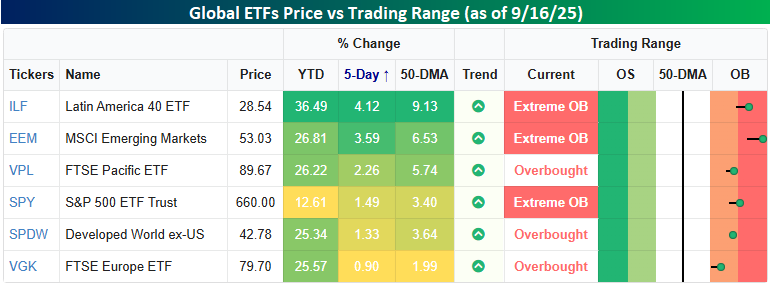
As we head into this afternoon’s expected rate cut from the Federal Reserve, US stocks have been in rally mode, but they’re not alone, at least from the perspective of a US investor. The snapshot below from our Trend Analyzer shows where various global ETFs closed yesterday relative to their short-term trading ranges. The S&P 500, as measured by the SPDR S&P 500 ETF (SPY) is up 1.5% over the last five trading days and closed yesterday in ‘extreme’ overbought territory (more than 2 standard deviations above its 50-DMA), but it’s not the only one and certainly not the best performer. Of the ETFs shown in the spotlight, three have outperformed the US over the last week, and SPY is the worst performer on a YTD basis.
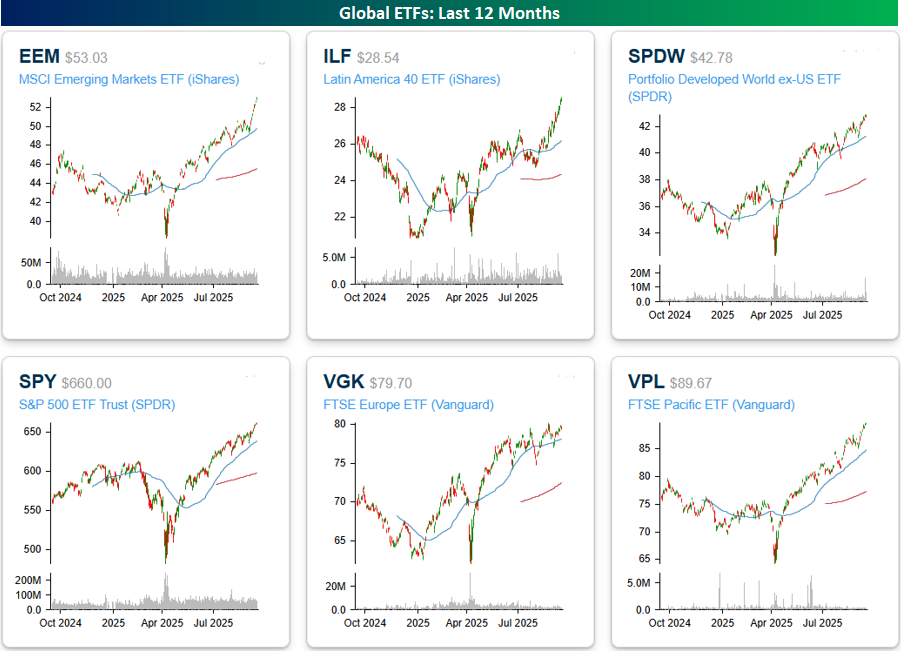
A look at one-year price charts of all six ETFs shows that they’re all either at or right near 52-week highs heading into today’s session. The only difference is the slope of their advances heading into those highs. The MSCI Emerging Markets ETF (EEM) and the Latin America 40 ETF (ILF) have been moving almost vertically over the last couple of weeks, while the FTSE Europe ETF (VGK) has been moving in more of a sideways range.
Country ETFs Looking for Record Years
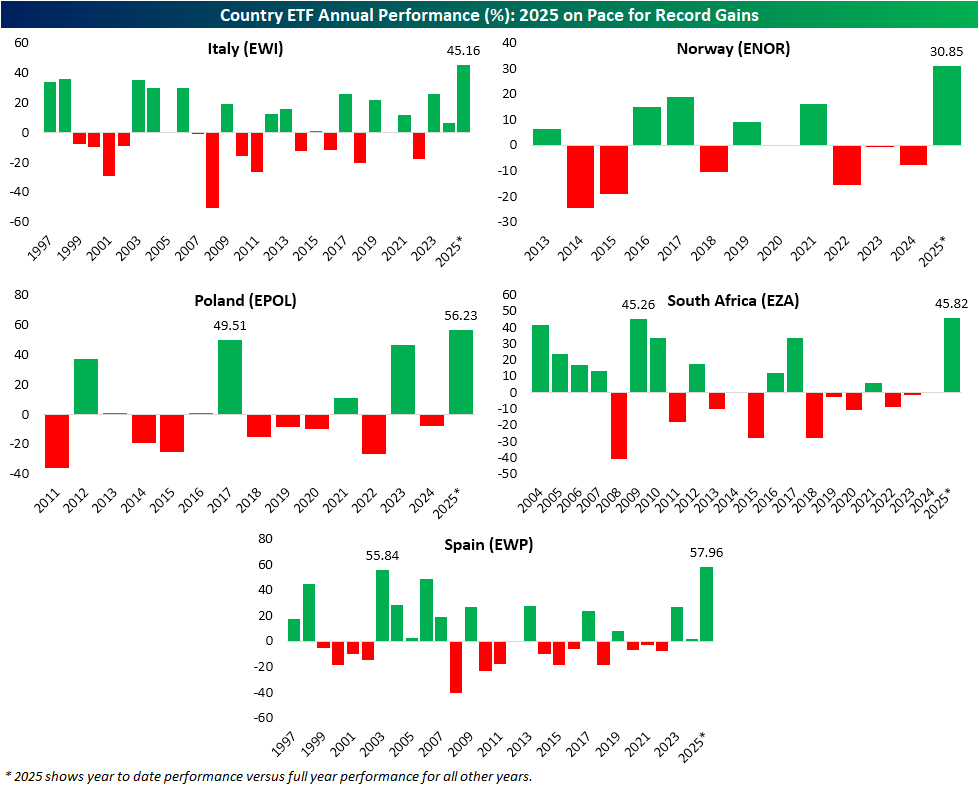
Now in the home stretch of Q3, international stocks have had a banner year in 2025. Whereas the United States’ S&P 500 (SPY) is currently up 12.7% year to date, the MSCI All World Ex. US ETFs (ACWX) have gained well over 24% in that same span. Looking at individual country ETFs in the iShares MSCI family, there have been some monumental winners. For example, Italy (EWI) is up over 45% on a year to date basis. That puts it on pace for the ETF’s largest annual gain on record (it began trading in March 1996) if it holds. The ETF tracking Spain (EWP) has similarly been around since the late 1990s, and its 58% gain this year narrowly beats the 55.8% gain observed in 2003 for its best year on record. Elsewhere in Europe, Norway (ENOR) and Poland (EPOL) are likewise sitting on what would be record gains, although those ETFs have much less extensive histories of a little more than a decade. Finally, we would note that outside of Europe, there is one other country whose tracking ETF is looking for a record. That is South Africa (EZA) which is currently up 45.8%. While that is in fact looking to be a record annual gain, it’s by a much more narrow margin than the others. In 2009, EZA rose 45.3% which is only 50 bps of underperformance relative to this year.