
Nothing SHY About This
shy /SHī/ – adjective 1. being reserved or having or showing nervousness or timidity in the company of other people.
When one thinks about short-term US Treasuries and their traditional day-to-day price action, shy is a pretty good description. Traditionally, short-term Treasuries have not been the place an investor who was looking for action would go to look. That’s what tech stocks are for! As the Fed has embarked on what has been the most rapid pace of rate hikes in at least 40 years, though, no type of financial asset, including short-term Treasuries, has been spared. The chart below shows the iShares 1-3 Year Treasury Bond ETF (with the aptly named ticker SHY) over the last year. A year ago, the ETF was trading just above $84, and last week it was down near $80 before rebounding over the past few days to a high of $82.02 yesterday. A one-year range of just under 5% is hardly volatile, but from the perspective of a short-term Treasury investor, it’s a gigantic move.

The last week has been a period of historic volatility for US Treasuries – at least relative to the last 20 years. The chart below shows the daily percentage changes in SHY since its inception in July 2002. Yesterday, the ETF had its largest-ever one-day gain at just under 1% (0.997%). You can also see from the chart that ever since the FOMC started hiking rates in early 2022, the magnitude of SHY’s average daily moves has rapidly expanded.

Monday’s (3/13) nearly 1% rally in SHY also marked a milestone for the ETF in that it experienced a one-day gain or loss of at least 0.25% for three consecutive trading days. That tied the longest-ever streak of 0.25% daily moves from back in September 2008 just after Lehman declared bankruptcy. With SHY down 0.34% on the day in late trading Tuesday, it is now on pace for its 4th straight day of 0.25% daily moves. Yup, you read that correctly; volatility in short-term Treasuries is greater now than it was during the Financial crisis! When Powell said last Summer that fighting inflation would ‘bring some pain’, he wasn’t kidding. As a result, SHY may want to consider changing its ticker to something more applicable. “BOLD” is available. Click here to learn more about Bespoke All Access, our premium membership offering.

Some Good and Some Bad in Small Business Optimism
Early this morning, the NFIB released the results of its February survey of small business optimism. The headline index rose to 90.9 versus expectations of it remaining unchanged at 90.3. In spite of the bounce, small businesses continue to report some of the worst sentiment of the past decade with the February reading right back in line with the April 2020 low.

Diving deeper into the categories of the report, breadth was mixed. Of the ten inputs into the headline number, four were lower month over month, one was unchanged, and the other half were higher. For the most part, these indices also remain in the bottom decile of their historical readings.

In today’s Morning Lineup, we highlighted how the report’s labor metrics have been improving in each of the past four months on an aggregate basis. Plans to increase employment remain healthy in the 77th percentile while the percentage of respondents reporting job openings as hard to fill hit a new record high after rising by a near record 9 points month over month. Although openings were harder to fill, firms also took on more workers. With actual employment changes moving up to 4, it hit the highest level of the post-pandemic period. However, that did clash with hiring plans falling 2 points to match December for one of the lowest readings of the past few years. Likewise, plans to increase compensation are at the lower end of their recent range even while actual observed changes to compensation have improved in the past few months.

The same dynamic in which plans are headed in the opposite direction of actual changes can be observed with regards to capital expenditures. Capital expenditure plans were unchanged at 21 last month for the joint lowest reading since March 2021. Meanwhile, actual capital expenditures rose to 60, the highest since March 2020 and credit conditions have improved. Turning to inventories, satisfaction (meaning the net percent of firms reporting if inventories are too low versus too high) fell to the lowest since the spring of 2020. As a result, a net 7% of firms are reporting that they plan to decrease inventories in the coming months.

Finally, we would note that on net more firms are seeing lower rather than higher sales in spite of improvements to inflation metrics. The outlook for general business conditions has yet to see any improvement as few businesses report now is a good time to expand.

Most firms report now as a poor time to expand due to economic conditions at 36% of responses. The next most commonly credited reason is political climate followed by interest rates, which at 7% match the December reading for the highest since at least 2020. Click here to learn more about Bespoke’s premium stock market research service.
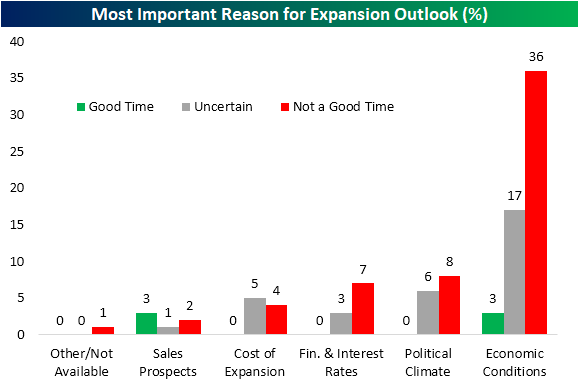
Chart of the Day – Market Timing Model Turns Positive
Bespoke’s Morning Lineup – 3/14/23 – The Number You’ve All Been Waiting For
See what’s driving market performance around the world in today’s Morning Lineup. Bespoke’s Morning Lineup is the best way to start your trading day. Read it now by starting a two-week trial to Bespoke Premium. CLICK HERE to learn more and start your trial.
“History is largely a history of inflation, usually inflations engineered by governments for the gain of governments.” – Friedrich August von Hayek

Below is a snippet of content from today’s Morning Lineup for Bespoke Premium members. Start a two-week trial to Bespoke Premium now to access the full report.
Futures have been rallying this morning as bond yields move higher as investors breathe a sigh of relief due to the fact that there were no additional bank blowups overnight. Regional banks are seeing the most strength as a stock like First Republic (FRC) is up over 60% in the pre-market. That’s great if you bought the stock yesterday, but it’s still down sharply from where it closed last Friday, let alone where it was coming into the year.
The big number of the morning is obviously the February CPI and that reading came in right in line with forecasts at the headline level (0.4%). Ex Food and Energy, the reading was 0.5% which was slightly higher than expected (0.4%). On a y/y basis, both headline (6.0%) and core (5.5%) were right in line with forecasts. Markets were worried about another hot reading, so the immediate reaction has been a modest bounce in equity futures.
While the moves have been the most pronounced in the Treasury market and regional banks stocks, volatility and extreme reversals have been showing up all over global financial markets in the last several days. Take the equity market of Japan. Last week, the TOPIX finally broke above multi-month resistance to new 52-week highs on Thursday. From a technical standpoint, the action looked like a textbook breakout with well-defined support at former resistance near the 2,000 level. That was Thursday.
In the three days that followed, the TOPX has been down at least 1.5% every day for a total decline of 6%. And that support around the 2,000 level? It was more like Swiss cheese. In last night’s trading, the TOPIX also sliced right through its 50-day moving average (DMA) although it did find some support at the 200-DMA.

Going all the way back to the mid-1980s, the last four trading days for the TOPIX represent just the second time that the index hit a 52-week high and then followed that up with three straight declines of at least 1%. The other period was in October 2003 when the TOPIX hit a 52-week high on 10/20 and then followed that high up with daily declines of 1.1%, 1.8%, and 5.3%, respectively for a total decline of 8.8%. During that correction, the TOPIX’s total decline from that 52-week high pullback was 14.5% before the index went on to recover and resume its upward trend.

Our Morning Lineup keeps readers on top of earnings data, economic news, global headlines, and market internals. We’re biased (of course!), but we think it’s the best and most helpful pre-market report in existence!
Start a two-week trial to Bespoke Premium to read today’s full Morning Lineup.
A Look at the Financial Sector’s Weighting
At its YTD high back on February 7th, the S&P Financial sector ETF (XLF) was up more than 8% on the year. Since that high, the sector has fallen more than 13% and is now down more than 6% YTD.
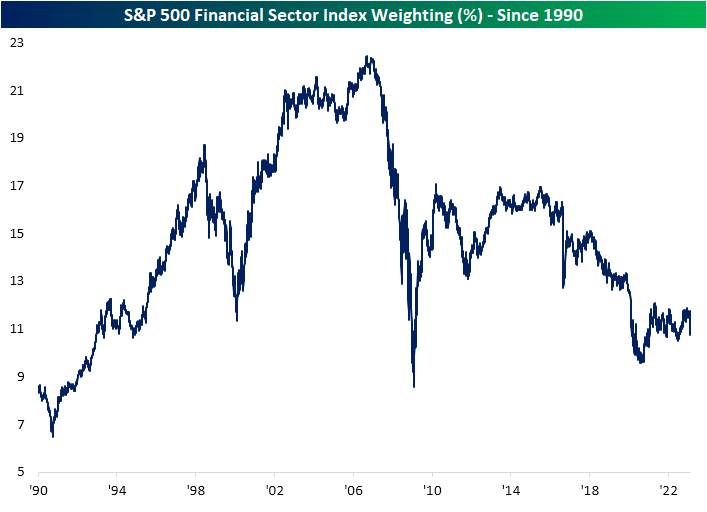
With systemic risk in the Financial system making front-page headlines again, we checked in on the sector’s weighting in the S&P 500 to see how it compares to where things stood back in the mid-2000s ahead of the Financial Crisis. Below is a look at the Financial sector’s weighting in the S&P going back to 1990. As of this writing, the Financial sector has a weighting of 10.73% in the S&P. That’s down a full percentage point from where it was at the end of February.
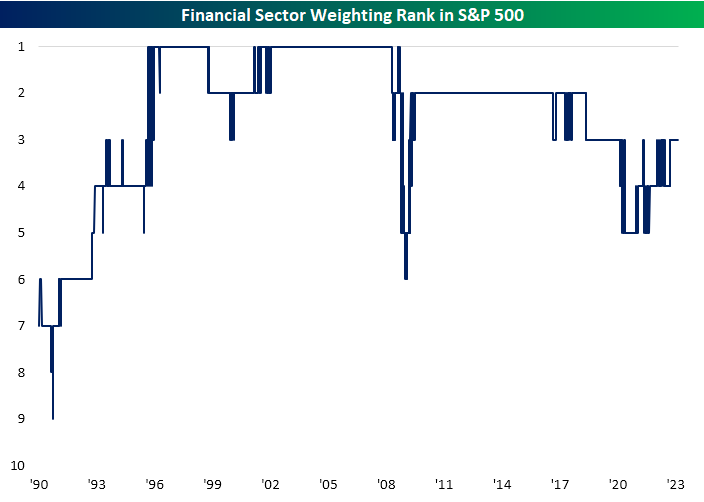
What’s interesting to note is how much smaller the sector is today compared to its weighting back in early 2006 when we were on the cusp of the Financial Crisis. At its peak in early 2006, the sector’s weight in the S&P had ballooned to 22.4%, which made it the largest sector of the S&P at the time. When the Financial sector, which is a sector meant to service the rest of the economy becomes the largest sector, something’s off! Of course, the Financial Crisis following the bursting of the housing bubble of the mid-2000s corrected this problem, as the Financial sector’s weighting fell from north of 22% down to south of 9% when the bottom was finally put in back in early 2009. During this latest bout of issues for Financials, the sector is still big enough to be the third largest sector in the S&P behind Tech and Health Care, but it’s not nearly as “weighty” as it was before the Financial Crisis, and its weighting has actually been trending lower for the last 7-8 years. Click here to learn more about Bespoke’s premium stock market research service.
Don’t Forget About CPI
With all the worry about the potential for bank runs, you may have forgotten that there’s a CPI report tomorrow morning. After January data came in higher than investors had hoped, consensus forecasts for Tuesday’s February CPI are calling for a 0.4% m/m increase on both a headline and core basis. Based on recent trends, while the bias towards higher-than-expected readings hasn’t been as extreme as it was just a few months ago, lower-than-expected headline readings have been hard to come by over the last year with just three in the last 12 months.

In terms of seasonality, history isn’t really on the side of those who are looking for a lower-than-expected report tomorrow. Going back to 1999, headline CPI reports released in March have been lower than expected just two times which is easily the lowest of any month. In total, of the 24 CPI reports released in March since 1999, 10 have been higher than expected, 12 have been inline, and two have missed forecasts. Will tomorrow be the third time the charm? Click here to learn more about Bespoke’s premium stock market research service.

Chart of the Day – Extreme Moves in Fed Funds
March Volatility Emerging
The month of March is nearly halfway through and volatility has begun to pick up. Whereas the S&P 500 was up around 2% month to date as of this time last week, currently the index is down over 2.5%. As shown below, since the end of WWII March ranks in the middle of the pack with regards to the average spread between its Intra month high and low (on a closing basis). That compares with months like October—the most volatile of the year—which has averaged an Intra month range of just under 8%.

Although historically March might not be the most volatile month, in recent years that Intra month volatility has kicked up. In the chart below we show the spread between March’s Intra month highs and lows for each year since the end of WWII. Over time, there has consistently been some ebb and flow in this reading with some outlier years in particularly volatile times like the late 1990s and early 2000s and then of course 2020. October has historically been known as a month for market turnarounds, but March has become increasingly active on that front as well. Click here to learn more about Bespoke’s premium stock market research service.

Bespoke’s Morning Lineup – 3/13/23 – Seven Dangerous Words
See what’s driving market performance around the world in today’s Morning Lineup. Bespoke’s Morning Lineup is the best way to start your trading day. Read it now by starting a two-week trial to Bespoke Premium. CLICK HERE to learn more and start your trial.
“The fundamentals of America’s economy are strong.” – John McCain 4/17/08
Below is a snippet of content from today’s Morning Lineup for Bespoke Premium members. Start a two-week trial to Bespoke Premium now to access the full report.
Phrases like the seven words above never seem to be made when markets and the economy are running smoothly, and we’ve heard a number of similar phrases like this made by officials over the weekend and this morning. That’s definitely not to say that the events of the last week and today are a repeat of 2008, but these types of comments almost never have their intended purpose of providing comfort to investors.
What’s happened over the weekend has been notable and will have both intended and unintended ramifications down the line. With deposits at US banks having essentially been backstopped by the actions of the Federal Government, one could argue that the banking system has been de facto nationalized, and the consequences of that are completely unknown, so we won’t even begin to speculate.
The flight to safety has been incredibly pronounced in the Treasury market as the 2-year yield is down nearly 50 basis points (bps) this morning after falling 29 bps on Friday and 20 bps Thursday. What’s truly remarkable about these declines is that they came just after the 2-year yield topped 5% for the first time since June 2007. Going all the way back to 1977, the last time the 2-year yield dropped more than this in a three-day span was just after the 1987 crash, and then before that, it happened in multiple periods from late 1979 through early 1983.

Finally, despite little direct connection between what’s going on with SVB and other US regional banks, European bank stocks have also seen sharp declines in the last two days as the STOXX 600 Bank Index is down over 9%. Analysts are out defending the banks as having ‘limited risk’. That may be true with regards to SVB and other regional US banks specifically, but European banks aren’t immune to the overall trend impacting US banks (a rapid surge in interest rates shortly after central bank officials were assuring markets that any increase in rates would be gradual).

Our Morning Lineup keeps readers on top of earnings data, economic news, global headlines, and market internals. We’re biased (of course!), but we think it’s the best and most helpful pre-market report in existence!
Start a two-week trial to Bespoke Premium to read today’s full Morning Lineup.
Bespoke Brunch Reads: 3/12/23
Welcome to Bespoke Brunch Reads — a linkfest of the favorite things we read over the past week. The links are mostly market related, but there are some other interesting subjects covered as well. We hope you enjoy the food for thought as a supplement to the research we provide you during the week.
While you’re here, join Bespoke Premium with a 30-day trial!
Entertainment
WWE in talks with state gambling regulators to legalize betting on scripted match results by Alex Sherman (CNBC)
Seeking to get in on the sports gambling goldrush, wrestling matches (which are scripted with results pre-determined) are trying to become legally sanctioned gambling events. [Link]
Why Are So Many Guys Obsessed With Master and Commander? by Gabriella Paiella (GQ)
An investigation into the enduring popularity of a mid-budget sailing movie set during the Napoleonic Wars which has persisted to become a near-obsession for men of a certain age. [Link]
The Stunt Awards by Bilge Ebiri and Brandon Streussnig (Vulture)
An important corrective to the glaring omissions of the traditional Academy Awards, which conspicuously overlook the stunt professions which make movies great. [Link]
Doom Loops
The Dollar’s Imperial Circle by Ozge Akinci, Gianluca Benigno, Serra Pelin, and Jonathan Turek (Liberty Street Economics)
A new model characterizes the dollar’s role in the global economy as a procyclical force which wrecks factory activity and commodity prices as the greenback gains steam. [Link]
North Carolina trucking company to shut down after top customer pulls out by Clarissa Hawes (FreightWaves)
Demands for “massive rate and volume concessions” from customers led FreightWorks to shutter the doors, laying off 200 employees including 140 drivers. [Link]
Real Estate
Millionaires row no more: Number of houses that cost seven figures nationwide is dropping by Swapna Venugopal Ramaswamy (USAToday)
Only about 7% of the US housing market is worth more than $1mm, a drop of 1.6 percentage points versus the peak of the market but still almost double the 4% at that price level from January of 2020. [Link; auto-playing video]
Ukraine
Dispatch From Kyiv: Ballet in a Time of War by Carol Schaeffer (The Nation)
Ballet, bombs, and the strange world of Kyiv which has been spared Russian occupation but is still a acutely war-time city as the invasion pushes through its second year. [Link; soft paywall]
Renewables
This geothermal startup showed its wells can be used like a giant underground battery by James Temple (MIT Technology Review)
A Nevada geothermal company thinks it may be able to turn its wells into what is in effect a giant battery, with important implications for keeping amperage flowing when renewable generation is no longer operating. [Link]
Unhappy Customers
How ‘Excuseflation’ Is Keeping Prices — and Corporate Profits — High by Tracy Alloway and Joe Wiesenthal (BNN/Bloomberg)
Corporations have been eager to push prices higher and take advantage of unique disruptions, driving prices higher with input costs but not returning the favor after input disruptions calm. [Link]
As Customer Problems Hit a Record High, More People Seek ‘Revenge’ by Katie Deighton (WSJ)
The National Customer Rage Survey has been run since 1976 and its 2023 edition showed a uniquely poisoned relationship between businesses in aggregate and their customers. [Link; paywall]
Elon
Bodyguards Follow Elon Musk Everywhere at Twitter HQ, Even to Restroom, Says Engineer by Philippe Naughton (The Daily Beast)
Employees report Twitter and Tesla CEO Elon Musk gets followed around the social media company’s headquarters by two bodyguards. [Link]
Elon Musk Is Planning a Texas Utopia—His Own Town By Kirsten Grind, Rebecca Elliott, Ted Mann, and Julie Bykowicz (WSJ)
The company town is back, this time plotting itself outside of Austin, TX. A “Texas utopia” is in the cards near SpaceX and Boring Co facilities in the Lone Star State. [Link; paywall]
Read Bespoke’s most actionable market research by joining Bespoke Premium today! Get started here.
Have a great weekend!