
S&P 500 Gains Despite Bad Breadth
The S&P 500 is fighting (unsuccessfully at this point) for its eighth positive session in a row today (the longest winning streak for the index in exactly two years). But looking under the hood at the past two sessions, there has been some underlying weakness. Although Monday and Tuesday saw the S&P 500 rise 17.5 bps and 28.4 bps, respectively, net daily breadth (advancers less decliners) was negative on both days. Whenever we hear talk of weak breadth on market up days, comparisons are usually made to the 1999/2000 period right before the Dot Com bubble’s peak. While it has been very uncommon for the S&P 500 to be up on back-to-back days when breadth was negative, not all (or even most) of the prior occurrences were isolated to just the period leading up to the Dot Com peak.
In the table below, we show 19 prior times that the S&P 500 rose in back-to-back sessions with negative daily breadth readings on both days and no other occurrences in the prior three months. The most recent occurrence was back in June 2021, and one thing that stands out is just how bad breadth has been in this period. On Monday and Tuesday, cumulative breadth was at -267, and the only prior instance with worse breadth over the course of the two up days was in July 2015. While returns were outright negative for the following six months after that July 2015 occurrence, as a whole, these past occurrences with gains on negative breadth have not been an especially bearish or bullish signal. On both an average and median basis, performance was generally in line with the S&P 500’s performance for all periods since 1990.

In looking at the table above, on most of the days when the market was up and breadth was negative, the magnitude of the gains was very small, and in many cases, the S&P 500 didn’t even move a tenth of one percent (10 bps) on either day. With that in mind, we filtered the table above to show only days when the S&P 500 was up at least 10 bps on each of the days when breadth was negative. Adding in that criteria, the 19 prior occurrences get whittled down to just six, and in this case, four of the six occurrences were in the months leading up to and after the Dot Com peak. While forward returns over the next week were positive all six times, average and median returns over the next one and three months were actually negative. Longer-term, six and twelve-month returns were split with a wide variance between average and median performance. These past examples suggest that while weak breadth on back-to-back positive days for the S&P 500 is not an outright negative, it’s hardly a positive indicator either.


Chart of the Day — Treasury Yields, Oil, and the Dollar Pull Back
Bespoke’s Morning Lineup – 11/8/23 – Listless Wednesday
See what’s driving market performance around the world in today’s Morning Lineup. Bespoke’s Morning Lineup is the best way to start your trading day. Read it now by starting a two-week trial to Bespoke Premium. CLICK HERE to learn more and start your trial.
“Libraries should be open to all—except the censor.” – John F Kennedy

Below is some introductory commentary of today’s Morning Lineup. Start a two-week trial to Bespoke Premium to get full access.
Futures are little changed this morning but biased to the positive side, as the direction of the market is listless with little in the way of economic data or major earnings reports to speak of. Perhaps the most notable move has been in crude oil, where WTI is down over 1% after falling through its 200-day moving average yesterday.
Yesterday’s gain for the Nasdaq was the index’s eighth straight positive day in a row and the longest streak of consecutive gains since November 2021. In the process of this 8.3% rally, the Nasdaq has also managed to reclaim both its 50 and 200-day moving averages (DMA)- levels it was below before the streak started. While the Nasdaq has managed to trade back above both of its key moving averages, it finished the day right at the downtrend that has been in place since the summer highs, so that is a potential roadblock as the rally looks to keep going.

Eight-day winning streaks are nothing out of the ordinary for the Nasdaq. Since the index’s inception back in 1971, there have been 86 prior winning streaks of at least eight days with the longest, back in 1979, stretching to 19 days. In the current streak, we’re not even halfway there. What is much more uncommon for the Nasdaq is to start an eight-day winning streak below both its 50 and 200-DMAs and by the eighth day of the streak to trade back above both of those levels. Since 1971, there have only been ten prior periods where that occurred (red lines in the chart).

Sign up for a two-week trial to Bespoke Premium to continue reading more of today’s macro analysis.
Chart of the Day – Moody Markets
Bespoke’s Consumer Pulse Report — November 2023
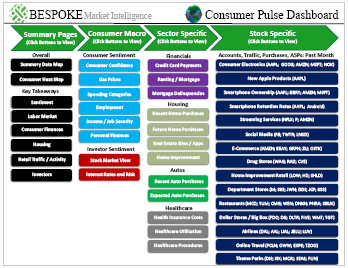
Bespoke’s Consumer Pulse Report is an analysis of a huge consumer survey that we run each month. Our goal with this survey is to track trends across the economic and financial landscape in the US. Using the results from our proprietary monthly survey, we dissect and analyze all of the data and publish the Consumer Pulse Report, which we sell access to on a subscription basis. Sign up for a 30-day free trial to our Bespoke Consumer Pulse subscription service. With a trial, you’ll get coverage of consumer electronics, social media, streaming media, retail, autos, and much more. The report also has numerous proprietary US economic data points that are extremely timely and useful for investors.
We’ve just released our most recent monthly report to Pulse subscribers, and it’s definitely worth the read if you’re curious about the health of the consumer in the current market environment. Start a 30-day free trial for a full breakdown of all of our proprietary Pulse economic indicators.
Bespoke’s Morning Lineup – 11/7/23 – A Day of Rest
See what’s driving market performance around the world in today’s Morning Lineup. Bespoke’s Morning Lineup is the best way to start your trading day. Read it now by starting a two-week trial to Bespoke Premium. CLICK HERE to learn more and start your trial.
“Man is the only creature who refuses to be what he is.” – Albert Camus
Below is some introductory commentary of today’s Morning Lineup. Start a two-week trial to Bespoke Premium to get full access.
And on the seventh day, the market rested. After six straight days of the rally looks like it’s taking a day off as equities, crude oil, gold, bitcoin, and even treasury yields are lower. Some of the concerns this morning can be tied to comments made by Minneapolis Fed President Kashkari who said he cannot rule out further rate hikes. On the economic calendar, it’s another light session this morning as will be the case most of the week even as the quantity of earnings reports remains very busy.
Over in Europe, the major indices are all down between 0.1% and 0.5%. PPI for the region was down an incredible 12.4%, and what was even more incredible was that it was a smaller decline than expected! In Germany, construction data was weaker than expected and showed the weakest level of activity since April 2020.
While momentum in the market pulled back yesterday, last week’s rally was accompanied by exceptionally strong breadth. As an example, the S&P 500’s 5-day advance/decline (A/D) line surged to +1,476 as of Friday which ranked as the 7th highest reading dating all the way back to 1990. The chart below shows historical readings in the 5-day A/D line, and the reason it only goes back to 2008 is that before that there were no readings that ever exceeded +1,400. That’s due in at least part to the fact that around that time is when the popularity of ETFs really started to explode creating what has become the current all-or-nothing nature of the market.

The chart below shows the performance of the S&P 500 going back to 2008 on a log scale, and the red dots show every other time that the 5-day A/D line reached +1,400 or higher. As shown, these types of readings occurred at all different phases of the market cycle. While the late 2021 occurrence right near the market top sticks out like a big pimple, other occurrences don’t look nearly as ominous.

Sign up for a two-week trial to Bespoke Premium to continue reading more of today’s macro analysis.
The Closer – Credit Spreads, SLOOS, Positioning – 11/6/23
Log-in here if you’re a member with access to the Closer.
Looking for deeper insight into markets? In tonight’s Closer sent to Bespoke Institutional clients, we begin with an update on credit spreads (page 1) followed by a rundown of the data from the latest Senior Loan Officer Outlook Survey (pages 2 and 3). After a preview of this week’s Treasury auctions (page 4) we finish with a look into the latest Commitments of Traders report (pages 5 – 8).

See today’s full post-market Closer and everything else Bespoke publishes by starting a 14-day trial to Bespoke Institutional today!
FAANG+ Flatline
Earlier on X/Twitter, we highlighted the changing dynamics among the charts of the mega caps with Microsoft (MSFT) pressing towards a new all-time high, leaving the likes of Apple (AAPL) in the dust. Looking more broadly at the mega caps, below we show the relative strength of the mega caps proxied by the NYSE FAANG+ Index versus the S&P 500 over the past five years. As shown, the early days of the pandemic were a boon for these mega caps, however, that faded from late 2020 through about a year ago. While mega caps have outperformed again this year—and as a result have been the stocks to thank for the bulk of the S&P 500’s gains year to date—the past few months have seen that relative strength wane with the line fairly flat since the late spring.

Below, we show the how the mega-caps individually have been trading relative to the FAANG+ index. Similar to what we noted in our aforementioned post, Apple (AAPL) has been underperforming with a downtrend in its relative strength line throughout the past year. Meanwhile, Microsoft (MSFT) has seen its relative strength rip higher.
As for the other FAANG+ stocks, there has not been the same sort of dramatic moves of late. That said, Amazon’s (AMZN) relative strength has been consistently declining for a multiyear span now. Meta Platforms (META) would have been in a similar boat, but its relative strength turned around and began trending higher over the past year. Similarly, two semiconductor giants, NVIDIA (NVDA) and Broadcom (AVGO) have had long-term rising relative strength lines with a dramatic acceleration in NVDA over the past year. Finally, we would note that Tesla (TSLA), which once boasted the highest degree of outperformance of the FAANG+ stocks, has recently seen its relative strength line move sideways in a choppy manner.

Chart of the Day: A Historic Week for Earnings
Bespoke’s Morning Lineup – 11/6/23 – Please Don’t Go
See what’s driving market performance around the world in today’s Morning Lineup. Bespoke’s Morning Lineup is the best way to start your trading day. Read it now by starting a two-week trial to Bespoke Premium. CLICK HERE to learn more and start your trial.
“I am a slow walker, but I never walk back.” – Abraham Lincoln
Below is some introductory commentary of today’s Morning Lineup. Start a two-week trial to Bespoke Premium to get full access.
The market is catching its breath this morning after the big moves of last week. Equity futures, treasury yields, and crude oil are all modestly higher while the dollar follows through on its declines from last week. There’s very little in the way of economic data this morning, and the pace of earnings has been relatively slow so far, but the pace will pick up later this afternoon and into tomorrow as earnings season remains in full swing- at least in terms of the number of reports.
Last week’s 5.82% gain for the S&P 500 was the best week of the year and the best week for the major US benchmark since the week ending November 11th from last year. With geo-political tensions remaining hot, earnings looking not so hot, and interest rates surging, the prospects for equities looked dim. You couldn’t fault an investor for thinking that it may be a good time to lighten up and sit things out for a bit until things cool off and some of the uncertainty recedes. As the market tends to prove time and time again, though, just when things look their worst, the market has a way of going the other way. In addition, timing the market remains one of, if not, the most difficult aspects of investing. Without fail in the markets, the best weeks tend to come when they’re least expected.
The chart below shows the growth of $100 invested in the S&P 500 at the start of 2010 (dividends not included) on both a buy-and-hold strategy as well as if an investor missed out on the best week of each calendar year. The gap is enormous. While the original $100 is now worth $390.85, had you missed out on the best week of each year, you would have less than half of that amount at $193.55. In other words, well over half of the gains since 2010 can be attributed to those 14 weeks. Admittedly, you could make the counterargument that most of the losses during this period have also occurred in a small number of weeks, but trying to successfully anticipate when these good weeks or down weeks will occur is IMPOSSIBLE. As “KC and the Sunshine Band” advised in 1979, “Please Don’t Go”.

Sign up for a two-week trial to Bespoke Premium to continue reading more of today’s macro analysis.