
Fixed Income Weekly: 3/1/23
Searching for ways to better understand the fixed income space or looking for actionable ideas in this asset class? Bespoke’s Fixed Income Weekly provides an update on rates and credit every Wednesday. We start off with a fresh piece of analysis driven by what’s in the headlines or driving the market in a given week. We then provide charts of how US Treasury futures and rates are trading, before moving on to a summary of recent fixed income ETF performance, short-term interest rates including money market funds, and a trade idea. We summarize changes and recent developments for a variety of yield curves (UST, bund, Eurodollar, US breakeven inflation and Bespoke’s Global Yield Curve) before finishing with a review of recent UST yield curve changes, spread changes for major credit products and international bonds, and 1 year return profiles for a cross section of the fixed income world.
In this week’s report, we look at the bills market and the debt ceiling.

Our Fixed Income Weekly helps investors stay on top of fixed-income markets and gain new perspectives on the developments in interest rates. You can sign up for a Bespoke research trial below to see this week’s report and everything else Bespoke publishes free for the next two weeks!
Click here and start a 14-day free trial to Bespoke Institutional to see our newest Fixed Income Weekly now!
Chart of the Day – Get That Stock a Band-Aid
Bespoke Market Calendar — March 2023
Please click the image below to view our March 2023 market calendar. This calendar includes the S&P 500’s historical average percentage change and average intraday chart pattern for each trading day during the upcoming month. It also includes market holidays and options expiration dates plus the dates of key economic indicator releases. Click here to view Bespoke’s premium membership options.

Bespoke’s Morning Lineup – 3/1/23 – Fresh Start
See what’s driving market performance around the world in today’s Morning Lineup. Bespoke’s Morning Lineup is the best way to start your trading day. Read it now by starting a two-week trial to Bespoke Premium. CLICK HERE to learn more and start your trial.
“If you find yourself suddenly wearing a hot cup of coffee on the way to work, the day can only get better from there.” – Anonymous

Below is a snippet of content from today’s Morning Lineup for Bespoke Premium members. Start a two-week trial to Bespoke Premium now to access the full report.
Futures were looking to start the new month off on a positive note, but that tone has shifted and the current setup is for a modest decline at the open. Following yesterday’s stronger-than-expected inflation data in France and Spain, this morning it was Germany’s turn to report hot inflation data, and that predictably, has been followed by hawkish commentary from ECB officials. In China, stronger-than-expected Manufacturing PMI data led to a 4% rally in Hong Kong’s Hang Seng, but stronger growth in China will be greeted as inflationary by the market, hence the move higher in US treasury yields. Economic data on the calendar today includes Manufacturing PMI reports from S&P and ISM as well as Construction Spending. Minneapolis Fed President Kashkari will also be speaking this morning, so you can expect the headlines from that even to be hawkish.
2023 is already 16% complete, so we can start to get a read on how trends are shaping up. Below we summarize the performance of S&P 500 sectors through the end of February. On a YTD basis, there’s been quite a bit of disparity in sector performance as four sectors are up over five percent, and two are down over 5%. Between the extremes, more than 20 percentage points separate the best-performing sector (Consumer Discretionary) which is up 12.7% from the worst-performing sector (Utilities) which is down close to 8%. Looking at where sectors finished out February relative to their trading ranges, not a single sector is overbought relative to its 50-day moving average, nearly half are below their 50-day moving averages, and four sectors are oversold. That’s not what you would expect to see in a year where the S&P 500 is up nearly 4% YTD.

While there’s a wide dispersion in sector performance after the first two months of this year, it’s a big improvement versus where the market stood at this time last year. Twelve months ago, more than 40 percentage points divided the best-performing (Energy) and the worst-performing sectors (Consumer Discretionary), six sectors were oversold, and the only sector above its 50-DMA was Energy. February wasn’t a great month for stocks, but it sure beats where things stood last year at this point.

Our Morning Lineup keeps readers on top of earnings data, economic news, global headlines, and market internals. We’re biased (of course!), but we think it’s the best and most helpful pre-market report in existence!
Start a two-week trial to Bespoke Premium to read today’s full Morning Lineup.
The Closer – Goolsbee vs The Market, Home Price Decline, Consumer Confidence – 2/28/23
Log-in here if you’re a member with access to the Closer.
Looking for deeper insight into markets? In tonight’s Closer sent to Bespoke Institutional clients, we begin with some commentary on today’s Fedspeak for Chicago President Goolsbee as well as a recap of the latest earnings (page 1). We then dive into today’s housing price data (page 2) and update our Five Fed Composite (page 3). We follow up with a look at the latest sentiment data out of the Conference Board (page 4) before finishing with a review of the stocks and sectors that have drive price action year to date (page 5).

See today’s full post-market Closer and everything else Bespoke publishes by starting a 14-day trial to Bespoke Institutional today!
Daily Sector Snapshot — 2/28/23
Bespoke Stock Scores — 2/28/23
One of These Indices Is Not Like the Others
Looking across the major US index ETFs in our Trend Analyzer, one stands out (in a negative way) from all the others. At the moment, the Dow is the only major US index in the red on a year-to-date basis as we close the books on February. Even more notable, is the fact that it’s also the only one below its 50-DMA. Not only is it below its 50-day, but it is trading firmly in oversold territory sitting over 1.5 standard deviations below its 50-day. Today that dynamic of Dow underperformance continues as the index is falling another 0.3% as of this writing while the S&P 500, Nasdaq, and Russell 2,000 are all higher.

In the chart below, we show how far the S&P 500 and Dow are trading (in standard deviations) from their respective 50-DMAs over the past five years. For the most part, the two large-cap indices have tracked one another relatively well in spite of their differences in composition and price calculations. That makes the current situation in which the Dow is oversold without the same applying to the S&P 500 somewhat unusual, albeit not without precedence. While uncommon, there have been periods in which the indices have similarly distanced themselves from one another like most recently in the spring and fall of 2021.
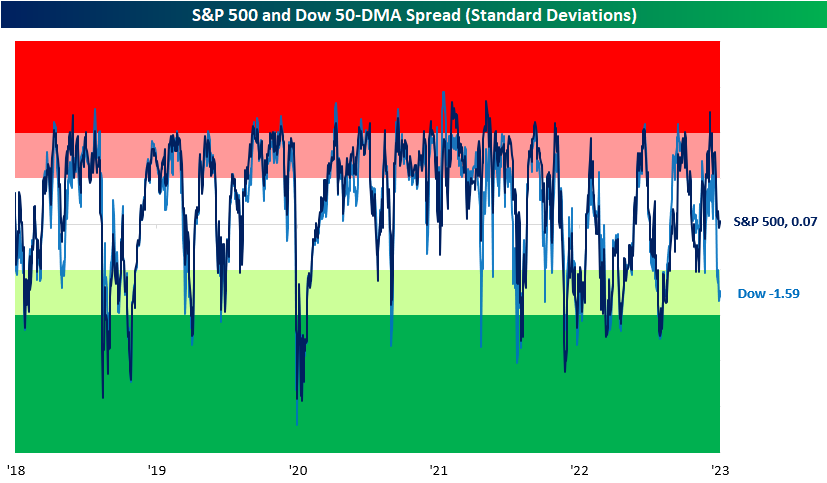
Although there have been other times in which the Dow and S&P’s overbought/oversold readings have deviated from one another, the current example is abnormally large. With a gap of 1.66 standard deviations between the two indices’ overbought/oversold readings versus their 50-DMA spreads, today’s spread ranks in the bottom 1% of all readings since 1952 when the five-day trading week began. Additionally, such low readings have been exceptionally rare in the past 20 years. Outside of June and September of 2021, August 2015 was the last instance of the spread falling this wide with the Dow underperforming. Looking back even further, 2004 was the only other instance of the past 20 years. Click here to learn more about Bespoke’s premium stock market research service.

Tech Relative Strength Still Negative
Each day in our Sector Snapshot, we provide updated charts of the relative strength lines of each sector versus the S&P 500. Outside of a brief period last summer, Technology, the largest sector in terms of market cap, has seen its relative strength line sit in negative territory for nearly the whole of the past year. In other words, the broader market has outperformed the Tech sector almost every day for a year straight. In the chart below, we show the one-year relative strength line of Tech versus the S&P going back to 1991. After some of the most dramatic underperformance of the past couple of decades, Tech rebounded, and the sector has now only underperformed the broader market by a little less than 3% in the past year. While Tech’s relative strength is not as weak as it once was and is closing in on the first positive readings since the mid-summer, today marks the 131st trading day of consecutive negative readings. That is handily the longest streak in nearly a decade and one of only six other times a streak has eclipsed 100 trading days.


The current streak has yet to come to a close, but in the chart below, we show the performance of Tech and the S&P 500 following the conclusion of each of those prior streaks of 100 or more days. Overall, performance does hold a positive bias with positive returns a vast majority of the time. That being said, the average size of those gains is not exactly impressive. In the case of Tech, the average and median gains are smaller than the norm across these time periods. One year out is the starkest difference with an average gain of less than 5% compared to what has typically been a gain that sits in the mid-teens. Likewise, the S&P 500 tends to underperform the norm one year later, but short to medium-term performance is stronger than the norm. Six-month returns, in particular, have been impressive with a move higher every time and an average gain that is more than double that of the typical six-month performance since 1991. Click here to learn more about Bespoke’s premium stock market research service.
