
3rd to Last Powell Fed Day
Today will be the 65th Fed Day (FOMC day) of Chair Powell’s tenure, dating back to early 2018 when he first took the helm. The US stock market has more than doubled since Powell became Fed Chair, so his tenure has been a big success in that regards even though stock market gains are not part of the Fed’s mandate.
When it comes to stock market performance on Fed Days specifically, however, Powell’s tenure has been the weakest of the “modern” Fed era.
The “modern” Fed began in February 1994 when they first began announcing policy decisions on the day of FOMC meetings. Before 1994, the Fed didn’t announce interest rate decisions until weeks after their meetings, which forced investors to monitor the Fed’s open market trading desk activity in the meantime for any policy adjustments.
There have only been four Fed Chairs in the modern era, beginning with Alan Greenspan, who was Chair when the Fed first began announcing policy decisions on FOMC days. After Greenspan came Ben Bernanke in 2006, Janet Yellen in 2014, and Jerome Powell in 2018.
Below we’ve created a chart that shows the S&P 500’s average intraday path on regularly scheduled Fed Days since 1994.
As shown, Bernanke saw the best stock market performance on Fed Days with an average one-day gain of 0.50%, followed by Greenspan at 0.26% and Yellen at 0.16%. Powell currently ranks last of the four with an average one-day gain of just 0.07% on Fed Days during his tenure.
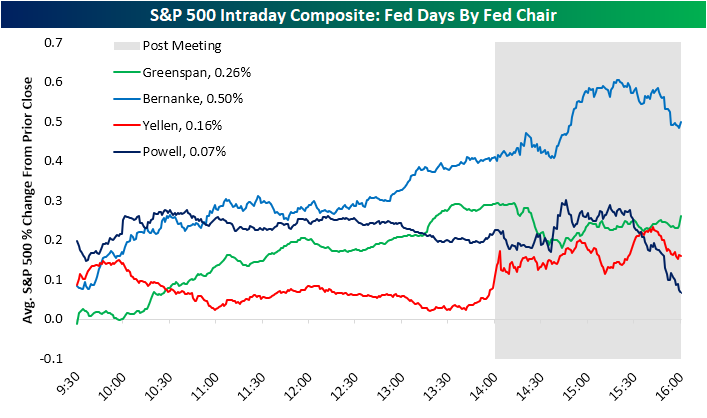
Notably, Powell has actually been the best Chair for the stock market in the first half-hour of trading on Fed Days. From there, though, the market has tended to trickle lower under Powell and then sell off sharply in the final hour of trading.
There have been many-a-Powell Fed Days that saw sharp market selloffs after Powell press conferences. Not every Powell Fed Day has seen a late-day selloff, of course, but the “average” tells the overall story.
Again, the stock market is up huge since Powell became Fed Chair, so buy-and-hold investors have nothing to complain about when it comes to late-day weakness on Powell Fed Days.
For short-term traders, though, the “post-Powell-presser-plunge” will soon become a distant memory once a new Chair takes the helm this spring.
Not a Bespoke client? We’d love for you to give our equity research platform, Bespoke Premium, a try. You can sign up for complimentary access for 14 days at this link to read our full 2026 Investor Sentiment report and start receiving our daily research emails today!

How Much More Precious Can They Get?
The moves in gold and silver have been getting crazy lately as the price charts of both precious (and getting more precious by the day) metals have turned parabolic in recent weeks. Through yesterday’s close, the SPDR Gold ETF (GLD) is already up over 20% YTD, while the iShares Silver ETF (SLV) has surged an unbelievable 62%. In normal times, these type of gains would be considered a great year!
The moves in GLD and SLV have left them extremely extended. GLD closed 38% above its 200-DMA yesterday, and SLV finished the session 137% above its 200-DMA. 137%!
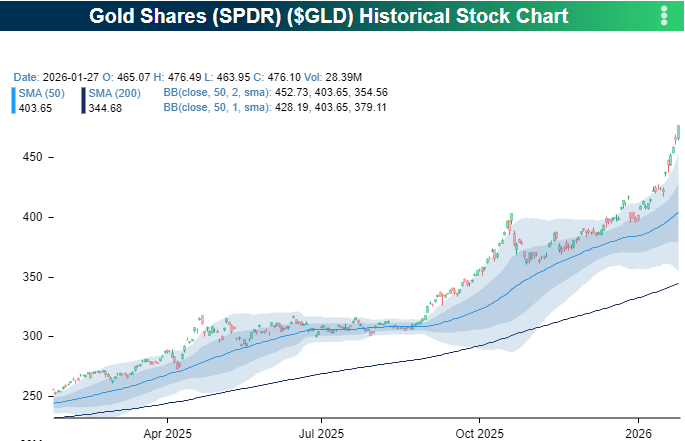
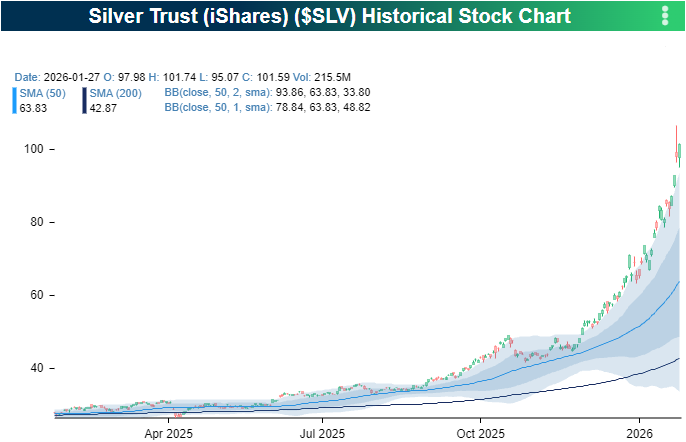
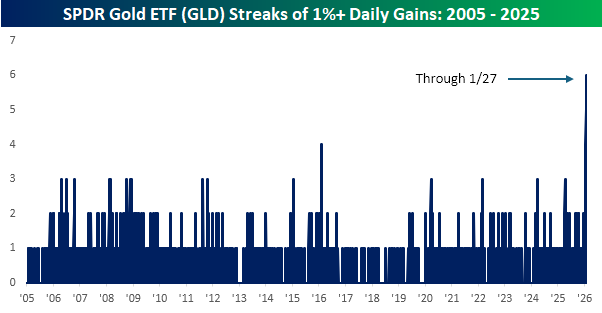
What makes the recent moves in both metals ETFs even crazier, though, is how persistent the gains have been. Through yesterday’s close, GLD traded more than 1% higher for six straight sessions. Before the current streak, the longest streak in the ETF’s existence since 2004 was only four days.
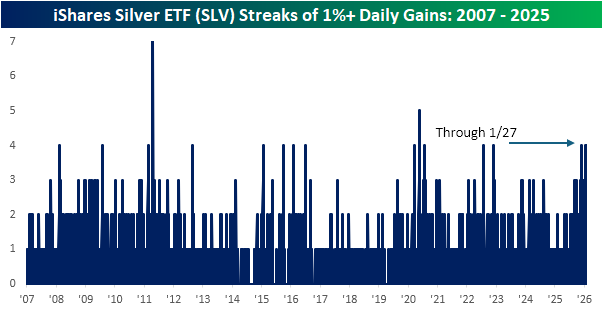
SLV’s streak of 1% daily moves has only been four trading days, and for a volatile commodity like silver, that’s peanuts. The current streak (through yesterday’s close) was actually the third four-day streak of 1%+ daily gains in the last two months! Since the ETF’s inception in late 2006, there have been several other four-day streaks, as well as a five-day streak that ended in 2020 and a seven-day streak ending in April 2011.
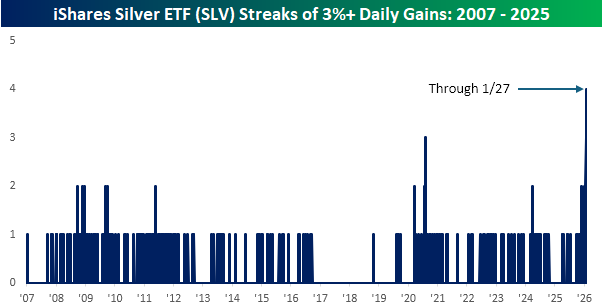
Silver (SLV) hasn’t just rallied 1%+ for four straight days, but rather 3%+ for four straight days. In SLV’s entire history, there was only one other streak that even lasted three trading days. If you own either of these ETFs or stocks exposed to them, it’s been a great ride, but just keep in mind that moves like these don’t last forever, and even if the ultimate peak for either metal is still on the horizon, the ride there won’t be smooth.
Not a Bespoke client? We’d love for you to give our equity research platform, Bespoke Premium, a try. You can sign up for complimentary access for 14 days at this link to read our full 2026 Investor Sentiment report and start receiving our daily research emails today!
Bespoke’s Morning Lineup – 1/28/26 – Broadening: The Word of 2026?
See what’s driving market performance around the world in today’s Morning Lineup. Bespoke’s Morning Lineup is the best way to start your trading day. Read it now by starting a two-week trial to Bespoke Premium. CLICK HERE to learn more and start your trial.
“The future doesn’t belong to the fainthearted; it belongs to the brave.” – Ronald Reagan, 1/28/1986

Below is a snippet of commentary from today’s Morning Lineup. Start a two-week trial to Bespoke Premium to view the full report.
US equity futures are modestly higher again this morning, with the S&P 500 indicated to open up 0.25% while the Nasdaq is looking much stronger, gaining 0.85% as positive earnings reports in the Technology sector drive the sector’s gains. Investors are selling treasuries as the 10-year yield pushes 4.25%.
Gold is surging again today after yesterday’s comments by the President regarding the dollar, and the SPDR Gold ETF (GLD) has already rallied at least 1% for six straight days! Silver is also strong this morning, and the Silver ETF (SLV) has rallied at least 3% for four straight days! Investors are in such a ‘buy anything mode’ that even Bitcoin is rallying more than 1%, taking it back above $90K.
In Asia overnight, most major indices were higher. Hong Kong led the way with a gain of more than 2.5%, and South Korea’s Kospi tacked on 1.7%. A 40-year JGB auction in Japan was met with strong demand as the bid-to-cover ratio came in at 2.76, which was the strongest since last March. As we said, they’re buying everything this morning!
Well, maybe investors aren’t buying everything. In Europe, stocks are lower across the board. The STOXX 600 is down 0.5% with France, Italy, and Spain both down over 1%. Luxury stocks are weighing on stocks in the region following earnings from LVMH after the close yesterday, which we covered in last night’s Closer.
Today in the US, there’s no economic data on the calendar, but at 2 PM, the Fed will announce its latest rate decision, and the market is basically pricing in 100% odds of no change in rates. After the close, though, we’ll get earnings from Meta (META), Microsoft (MSFT), and Tesla (TSLA).
Merriam-Webster’s word of 2025 was slop which described the unending stream of low-quality, computer-generated content that has inundated the internet and social media feeds over the last three years. As much as AI promises to change life for the better, some of the more immediate impacts have been less than compelling. You can’t get away from it!
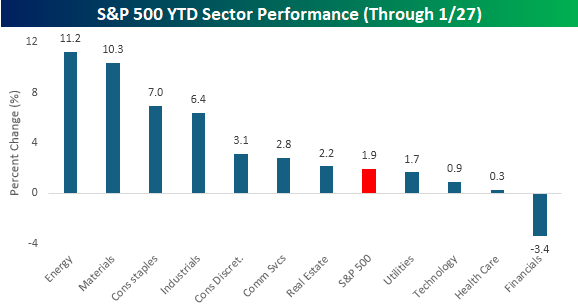
This is not even a month old, but if early indications are accurate, the term broadening could be a serious contender for the word of 2026. Looking at sector performance, the S&P 500 is up just under 2% YTD, but seven sectors have outperformed the index, including Energy and Materials, which are both up over 10%! Behind these two commodity-related sectors, Consumer Staples and Industrials are both up over 5%, while Consumer Discretionary, Communication Services, and Real Estate are all outperforming the index by a small degree.
On the right side of the S&P 500, Technology sticks out like a sore thumb with its gain of less than 1%. Along with Technology, Utilities, and Health Care are also up YTD but still underperforming, while Financials, which started the year off hitting all-time highs, is the only sector in the red for the year.
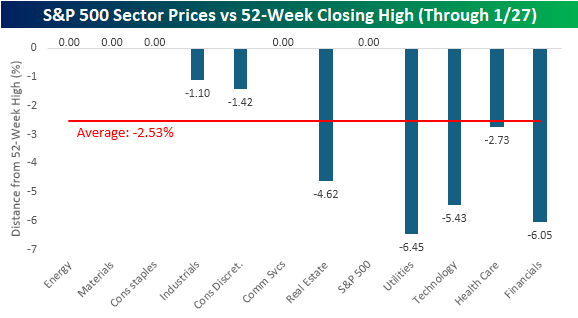
With the market broadening, we found it notable that, along with the S&P 500 yesterday, four sectors also closed at 52-week highs yesterday. Even many of the sectors that didn’t hit new highs yesterday aren’t far. Industrials and Consumer Discretionary are both within 2% of a 52-week high, while Utilities, Financials, and Technology are the only three sectors down more than 5%. The fact that the S&P 500 closed at a record high yesterday and its two largest sectors (Technology and Financials), which together account for nearly half of the entire index, are both down more than 5% from their highs is remarkable.
Regarding yesterday’s trivia, the five other schools to produce a Super Bowl winning QB and at least one US President are:
– Delaware: Biden/Flacco
– Miami (OH): Harrison/Big Ben
– Michigan: Ford/Brady
– Stanford: Hoover/Elway/Plunkett
– Navy: Carter/Staubach
Now to the bonus question. Of the 36 different head coaches to win a Super Bowl title, the school the college/university that has produced the most winning head coaches is Miami University of Ohio. The three Super Bowl-winning coaches who went there were Weeb Ewbank, John Harbaugh, and Sean McVay. Congratulations to everyone who got it right.
The Closer – Managed Care Pain, Dollar Drop, Homes – 1/27/26
Log-in here if you’re a member with access to the Closer.
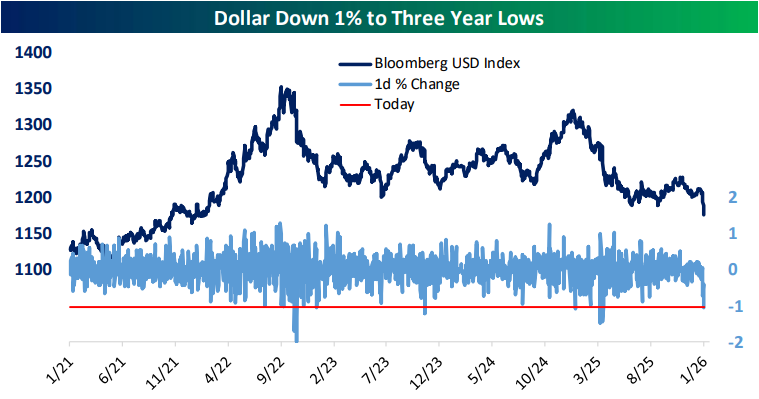
Looking for deeper insight into markets? In tonight’s Closer sent to Bespoke Institutional clients, we begin with a recap of some of the latest earnings and the pain in managed care stocks (page 1). We then review the new low and bad day for the dollar (page 2) including a look at performance when it hits a 52-week long alongside a 52-week high in US equities (page 3). We then round out tonight’s note with an update on Case-Shiller home prices, consumer confidence, and regional Fed manufacturing gauges (page 4).
See today’s full post-market Closer and everything else Bespoke publishes by starting a 14-day trial to Bespoke Institutional today!
Daily Sector Snapshot — 1/27/26
Q4 2025 Earnings Conference Call Recaps: Polaris (PII)
Bespoke’s Conference Call Recaps use AI to summarize lengthy earnings calls. The commentary below is AI-generated and then edited by Bespoke for quality control. As always, none of these summaries should be construed as recommendations to buy or sell any securities, and investors should do their own research and/or consult with a financial professional before making any investment decisions.
Our latest recap available to Bespoke subscribers covers Polaris’ (PII) Q4 2025 earnings call.

Polaris (PII) is a North American powersports manufacturer, producing off-road vehicles (ORVs like side-by-sides and ATVs under brands including RZR, Ranger, and XPEDITION), snowmobiles, motorcycles, three-wheelers (Slingshot), and marine products (pontoon boats under Bennington, Godfrey, and Hurricane). With approximately 2,000 dealers across North America, Polaris serves both recreational consumers and commercial customers in agriculture, ranching, and construction. PII had an exceptionally challenging 2025, facing $215 million in tariff headwinds, its largest obstacle since the pandemic, yet still gained market share across all segments. The company reduced China-sourced materials from 18% to 14% of COGS, targeting below 5% by 2027. However, consumer demand remains bifurcated. Utility segments show strength driven by commercial buyers benefiting from tax incentives, while recreational purchases stall due to elevated interest rates and macro uncertainty. The pending Indian Motorcycle separation, closing Q1 2026, will add $0.75-$0.80 to EPS. For 2026, Polaris guides to 1-3% sales growth (7-9% organic ex-Indian) despite $90 million in incremental tariffs. PII beat EPS and revenue estimates, though cut guidance and shares fell as much as 8.6% on 1/27…
Continue reading our Conference Call Recap for PII by becoming a Bespoke Institutional subscriber. You can sign up for Bespoke Institutional now and receive a 14-day trial to read our newest Conference Call Recap. To sign up, choose either the monthly or annual checkout link below:
Q4 2025 Earnings Conference Call Recaps: NextEra Energy (NEE)
Bespoke’s Conference Call Recaps use AI to summarize lengthy earnings calls. The commentary below is AI-generated and then edited by Bespoke for quality control. As always, none of these summaries should be construed as recommendations to buy or sell any securities, and investors should do their own research and/or consult with a financial professional before making any investment decisions.
Our latest recap available to Bespoke subscribers covers NextEra Energy’s (NEE) Q4 2025 earnings call.

NextEra Energy (NEE) is America’s largest electric utility company by market cap, operating Florida Power & Light (FPL), which serves over 12 million people across Florida, and NextEra Energy Resources, the world’s largest generator of renewable energy from wind and solar. The company has built more renewables, battery storage, and gas-fired generation than any competitor over the past two decades. NextEra provides insight into the intersection of data center power demand, grid modernization, and the economics of serving hyperscale loads while maintaining residential affordability. NextEra delivered $3.71 adjusted EPS (up 8% YoY) and guided to 8%+ annual growth through 2035. The call centered on explosive AI-driven power demand. Management disclosed 20 GW of data center interest in Florida (9 GW in advanced discussions) and a 30 GW nationwide backlog. The company is pioneering a “bring your own generation” (BYOG) model where hyperscalers fund infrastructure buildout, addressing the affordability crisis spotlighted by the White House’s January PJM framework. NextEra secured solar/battery supply through 2029 and 4 GW of gas turbine capacity with GE Vernova, while pursuing nuclear restarts and 1.7 GW of recontracting opportunities. Florida’s new 4-year rate agreement enables $90-100B in infrastructure investment while keeping bills 30% below the national average. Despite missing revenue estimates, NEE beat on EPS and the stock was up as much as 3.7% on 1/27…
Continue reading our Conference Call Recap for NEE by becoming a Bespoke Institutional subscriber. You can sign up for Bespoke Institutional now and receive a 14-day trial to read our newest Conference Call Recap. To sign up, choose either the monthly or annual checkout link below:
Five Years Since Meme-Stock Mania
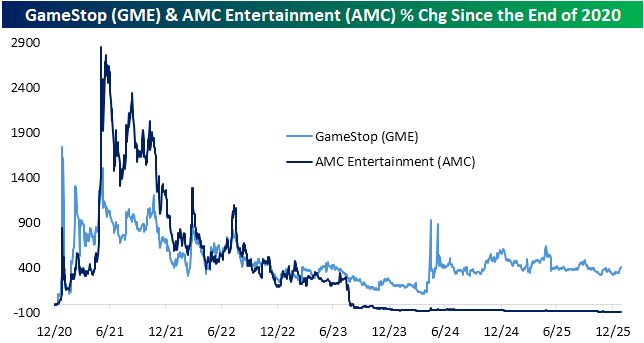
It has now been five years since the height of meme-stock mania. In January 2021, there was a surge in buying of crypto and NFTs, but perhaps the most in-vogue assets at the time were extremely high short interest names like GameStop (GME) and AMC Entertainment (AMC). These two stocks experienced enormous short squeezes led by the Reddit message board r/wallstreetbets. Remember Roaring Kitty?
Before the first month of 2021 ended, both GME and AMC were ten baggers.
As shown below, the years since haven’t seen these stocks hold onto gains. GameStop (GME) is still firmly in the green since the end of 2020 (with a gain of more than 400%), but it’s well off its peak from January 2021. Meanwhile, AMC is down 99% from its all-time highs and closely 90% since the end of 2020.
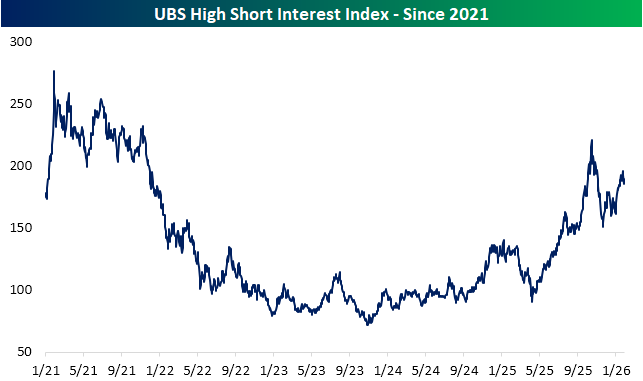
The index below from UBS tracks the 100 most highly shorted stocks with market caps above $1 billion and includes a monthly rebalancing. After shooting higher in January 2021, these stocks fell hard in the back half of 2021 and then plunged during the bear market of 2022. With that said, the index bottomed in late 2023 and has been on its way upwards ever since.
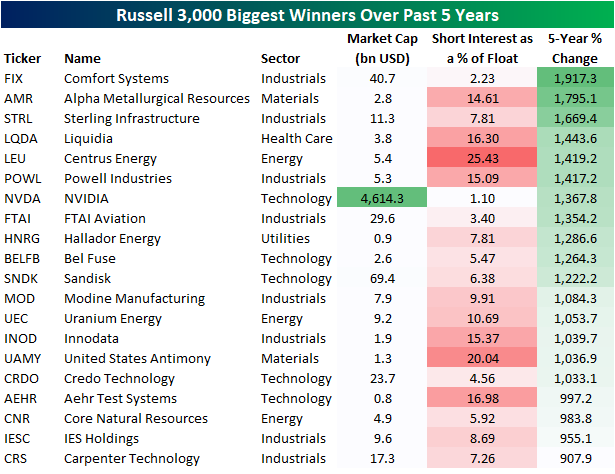
In the chart below, we show the individual performance of Russell 3,000 stocks since the peak of meme-stock mania on 1/27/21. Some of the most notorious meme stocks in early 2021 like AMC, BBBY, and GME are among the index’s worst performers since then. While opportunities for short squeezes may always be present, sometimes heavily shorted names are being bet against for good reason.
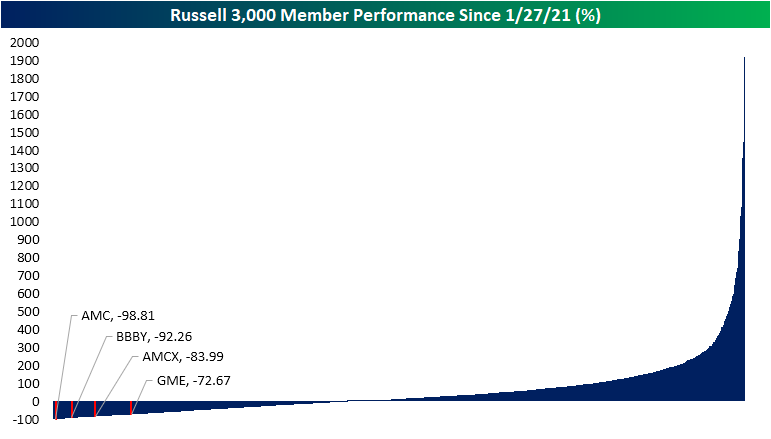
So which stocks have been the biggest winners in the five years since the peak of meme-stock mania? As you might expect, the emergence of AI means that among the biggest winners are AI headliners such as NVIDIA (NVDA), Comfort Systems (FIX), and Sandisk (SNDK); all up more than 1,000%.
Not a Bespoke client? We’d love for you to give our equity research platform, Bespoke Premium, a try. You can sign up for complimentary access for 14 days at this link to read our full 2026 Investor Sentiment report and start receiving our daily research emails today!
Home Prices vs. Stocks Long Term
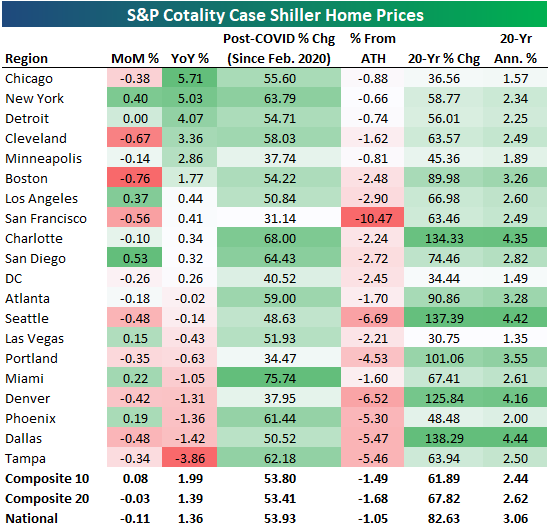
The latest Case Shiller home price data from S&P Cotality was published today and showed a small month-over-month decline of 0.11% at the national level. Home prices were up just 1.36% year-over-year nationally as well.
Across the twenty cities tracked, 13 saw small month-over-month declines, with Boston down the most at -0.76%. Of the six cities that were up on the month, San Diego (+0.53%) and New York (+0.40%) were up the most.
Six cities saw year-over-year gains of more than 1%, and they’re all in either the northeast or midwest: Chicago (+5.7%), New York (+5%), Detroit (+4.1%), Cleveland (+3.4%), Minneapolis (+2.9%), and Boston (+1.8%).
On the flip side, the five cities that are down over the last year are mostly in the Sunbelt: Miami (-1.1%), Denver (-1.3%), Phoenix (-1.4%), Dallas (-1.4%), and Tampa (-3.9%).
Below we show month-over-month and year-over-year home price changes from today’s data, along with a few additional stats like post-COVID change, % from all-time highs, and 20-year change.
Miami is up the most since COVID (February 2020) with a gain of 75.7%, while San Francisco is up the least at 31.1%. San Francisco is also down the most from all-time highs at -10.5%.
Unfortunately, not one city tracked made a new high in the latest data.
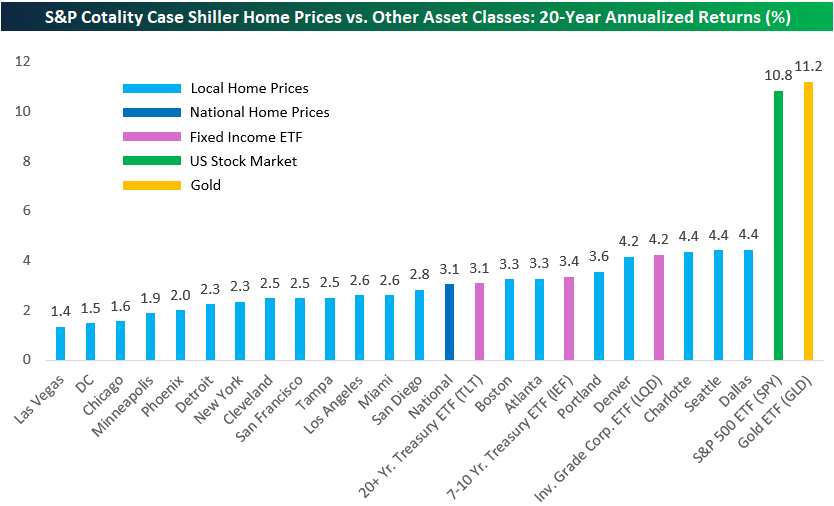
While it may seem like home prices have skyrocketed around the country, 20-year returns are actually pretty small and nowhere close to matching the returns of equities (or gold).
As shown below, most cities tracked have seen annualized home price gains of less than 3% over the last twenty years. That’s worse than the 3.1% annualized return for the long-term Treasury ETF (TLT).
Only three of the twenty cities have seen home prices gain more than the investment-grade corporate bond ETF (LQD): Dallas, Seattle, and Charlotte (4.4% annualized).
Compared to the S&P 500’s 10.8% annualized gains over the last twenty years and gold at 11.2%, home-price gains look puny.
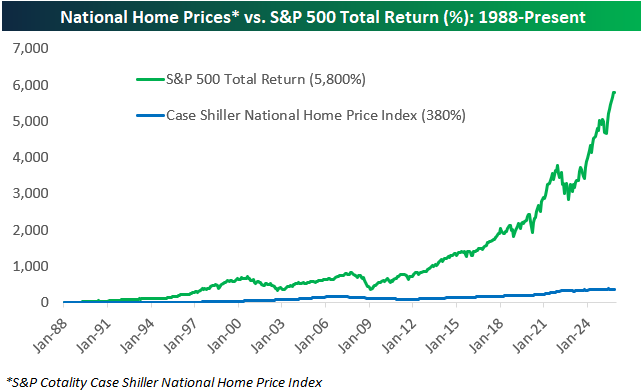
The National home price index tracked by Case Shiller goes back to the late 1980s, and as shown below, it’s up 380% since 1988 versus a total return of nearly 6,000% for the S&P 500.
While there are good reasons for homeownership that include the potential for price appreciation, it’s important to understand that excess capital has historically been better off put elsewhere.
Not a Bespoke client? We’d love for you to give our equity research platform, Bespoke Premium, a try. You can sign up for complimentary access for 14 days at this link to read our full 2026 Investor Sentiment report and start receiving our daily research emails today!
Country ETFs Crushing It
As domestic equities have struggled to hang onto gains so far this year, most country ETFs are already sitting on solid year-to-date returns.
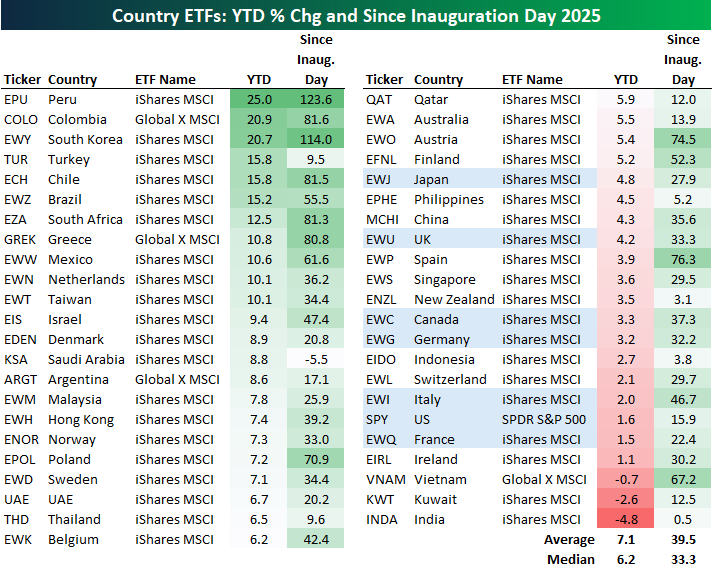
Below is a snapshot of more than forty country ETFs traded on US exchanges. The average year-to-date change of all these country ETFs is already above 7%, while eleven are already up 10%+ and three are up 20%+. Peru (EPU) is up the most at +25%, followed by Colombia (COLO) and South Korea (EWY) at just over 20%.
Note that all seven G7 country ETFs (highlighted in light blue) are up less than the overall YTD average, with Japan (EWJ) up the most of this small group at +4.8%. The US (SPY) ranks 2nd to last of the G7 with its 1.6% YTD gain in front of only France (EWQ) at 1.5%.
Three country ETFs are in the red so far this year: Vietnam (VNAM), Kuwait (KWT), and India (INDA).
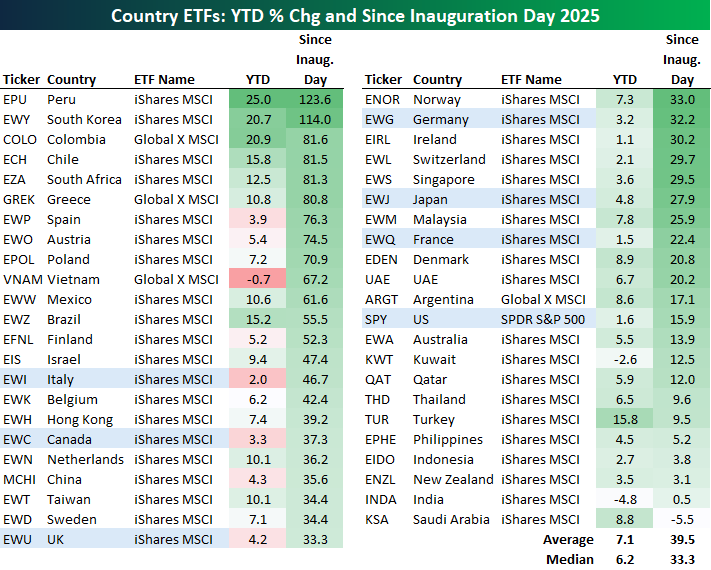
Along with strong outperformance versus US equities so far this year, country ETFs have outdone the US since Inauguration Day a little over a year ago as well. The 40+ country ETFs shown are up an average of 39.5% since President Trump’s 2nd term officially began last January, with Peru (EPU) and South Korea (EWY) leading the way with gains of 110%+. Colombia (COLO), Chile (ECH), South Africa (EZA), and Greece (GREK) rank 3rd through 6th with gains of just over 80%, while Spain (EWP), Austria (EWO), Poland (EPOL), and Vietnam (VNAM) round out the top ten.
Italy (EWI) has been the best performing G7 country since Inauguration Day 2025 with a gain of 46.7%, followed by Canada (EWC) at +37.3%. The US (SPY) has been the weakest G7 country over this time frame with a gain of just 15.9%.
Saudi Arabia (KSA) is the only country ETF that has seen a share-price decline (-5.5%) since Trump’s 2nd term began, while India (INDA) has done the second worst of the entire group with a gain of just 0.5%.
Not a Bespoke client? We’d love for you to give our equity research platform, Bespoke Premium, a try. You can sign up for complimentary access for 14 days at this link to read our full 2026 Investor Sentiment report and start receiving our daily research emails today!