Heavy into Metals
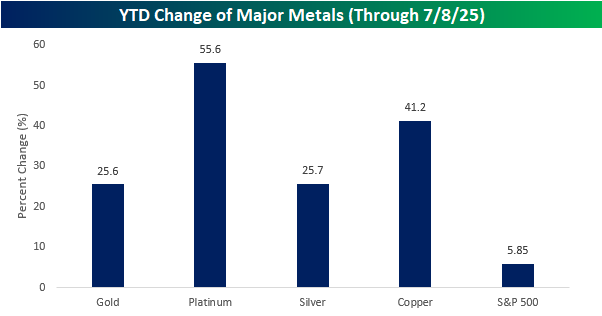
Earlier today in our Morning Lineup sent to clients, we noted the fact that major metals were all up sharply on the year. With copper’s surge on Tuesday, it was up an impressive 41.2% YTD, but still trailed platinum’s monster gain of 55.6%. While in any other year, the 25%+ gains in gold and silver would be impressive, but they look modest next to the gains in the other two, and the 5.85% gain for the S&P 500 almost looks pathetic.
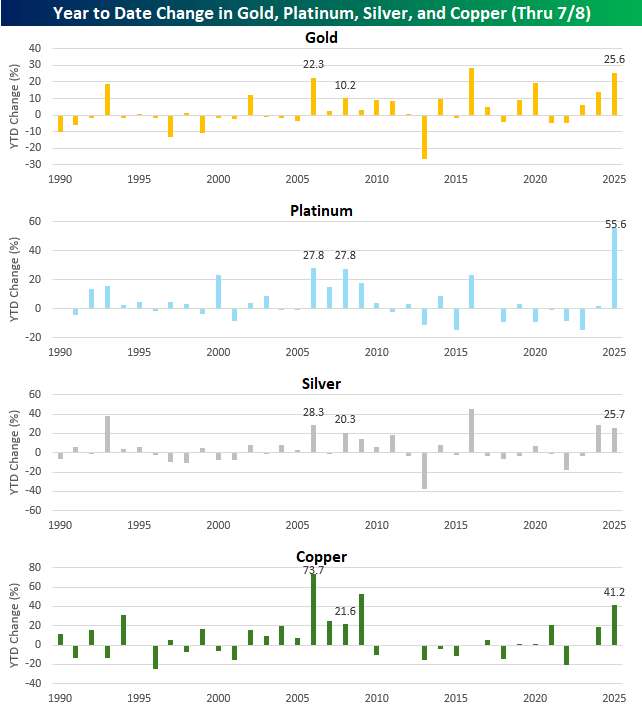
The charts below show the YTD change in all four metals through July 8th of each year since 1990.
Again, while gold is up less than any of the other four metals this year, through yesterday’s close, the only other year with a larger YTD gain was in 2016. The only other year it was up over 20% was in 2006 (22.3%).
Platinum’s 55.6% gain is easily a record through this point in the year. In fact, it’s double the prior record of 27.8% that was reached in 2006 and 2008. The only other year that platinum gained more than 20% YTD through 7/8 was in 2000 (23.6%) and 2016 (23.4%).
Silver and copper have both experienced 20%+ YTD gains through 7/8 more than gold and platinum. Silver had a larger YTD gain last year and has now had six 20%+ YTD gains since 1990. Copper’s 41.2% gain this year ranks as the best since 2009 (53.1%) and is the seventh time that the commodity has rallied more than 20% YTD.
While all four commodities have experienced other YTD gains of 25%+, this year is the first time all four have rallied 25%+ YTD through 7/8 in the same year. The only time they ever all simultaneously rallied 20%+ YTD was in 2006, and the only other year when all four were even up 10% YTD at this point in the year was in 2008. Other years since 1990 have seen big runs in the metals, but none of them have been quite like the 25%+ across the board gains in 2025.

Fossil (FOSL): From 8,000% to 6%
Fossil Group (FOSL) was one of the biggest post-financial crisis winners in the market, with its stock surging to a post-IPO gain of more than 8,000% at its highs in the mid-2010s. The company had built a dominant brand in watches, and investors rewarded it with a meteoric run that outpaced just about everything else at the time. But as the chart below shows, that entire move ultimately proved fleeting. Today, FOSL is up just 6% since its IPO in 1993, while the S&P 500 is up more than 2,500%. So what happened?
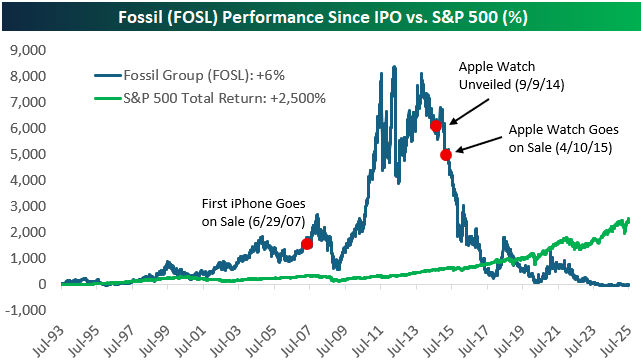
The turning point came in September 2014 when Apple unveiled the Apple Watch. At the time, the product hadn’t launched yet and there was still plenty of debate over whether consumers would embrace wearable tech. But investors didn’t wait to find out. FOSL’s stock started dropping almost immediately and has never recovered. As Apple’s ecosystem expanded, Fossil’s relevance shrank, and the stock followed.
Fossil wasn’t a company in obvious decline when the Apple Watch was announced. In fact, its fundamentals were still strong. But the market is forward-looking, and it doesn’t wait for earnings reports to adjust. Just the idea of a better product from a bigger competitor was enough to spark a mass exodus. While consumers were still deciding if they needed a smartwatch, Wall Street had already moved on.
That’s why this chart matters for today’s winners. Any of the stocks leading the market higher right now could be like Fossil in 2014. Massive runs, strong fundamentals, and dominant positions in a booming narrative. But disruption rarely announces itself in advance, and today’s leaders don’t have to stumble on their own to fall out of favor. All it takes is a shift in the landscape, whether it’s a better chip, a new platform, or a change in demand.
No one’s saying today’s market leaders are doomed, but Fossil’s chart is a reminder of how quickly things can turn, and how the market often sees it before the headlines do. Even an 8,000% gain can vanish if the narrative flips. It’s a good reason to stay humble and diversified and always think about what’s coming around the corner.
Bespoke’s Morning Lineup – 7/9/25 – Copper Glitters
See what’s driving market performance around the world in today’s Morning Lineup. Bespoke’s Morning Lineup is the best way to start your trading day. Read it now by starting a two-week trial to Bespoke Premium. CLICK HERE to learn more and start your trial.
“A great wind is blowing, and that gives you either imagination or a headache.” – Catherine the Great

Below is a snippet of commentary from today’s Morning Lineup. Start a two-week trial to Bespoke Premium to view the full report.
Looking at the quote above from Catherine the Great, isn’t that just the way you feel when it comes to AI? While the possibilities are endless, the pace of change and trying to keep on top of everything going on can be exhausting!
The S&P 500 has declined for two straight sessions, but futures are looking modestly higher this morning on little in the way of news. Investors will continue to monitor Washington for any tariff-related headlines, but the letters and policies released and announced this week have, broadly speaking, had little impact. It’s another quiet day for data as there are no economic reports on the calendar, but minutes from the last FOMC meeting will be released at 2 PM.
Speaking of the FOMC, the Wall Street Journal is reporting this morning that the President is currently leaning towards Kevin Hassett over Kevin Warsh to replace Fed Chair Powell. Warsh is reportedly falling out of favor for some of his past criticism of the Fed’s zero-interest rate policy and asset purchase programs.
In international markets, Asian stocks were mostly lower overnight following Trump’s comments that he wouldn’t extend his August 1st tariff deadline. The only major index to buck the negative trend was Japan, where the Nikkei rallied 0.33%. In Europe, the tone is much more positive with the STOXX 600 up over 0.7% as defense stocks lead the charge.
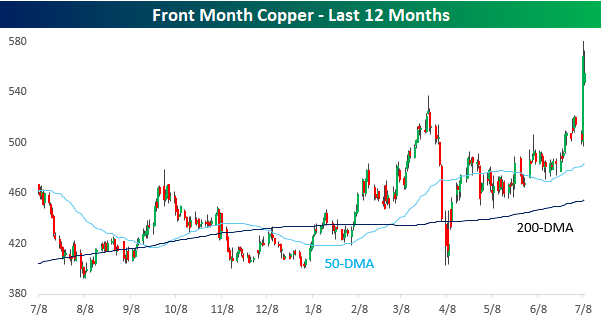
As mentioned above, the President’s various tariff policies announced this week haven’t had much impact on a macro basis, but for certain areas like copper, the impacts have been significant. After the year has already seen incredible rallies in the price of gold, platinum, and silver, yesterday, President Trump gave copper the boost it needed when he announced 50% tariffs on all copper imports. The news came just as copper was starting to pull back last week after testing its highs from earlier in the year. That resistance proved no match for the 50% tariff bazooka, and prices broke out to a record high, eclipsing $5.40 per pound, finishing up more than 13% on the day. Strength in copper is often considered a sign of economic strength, but we’re not sure a rally artificially propelled by trade policy would qualify.
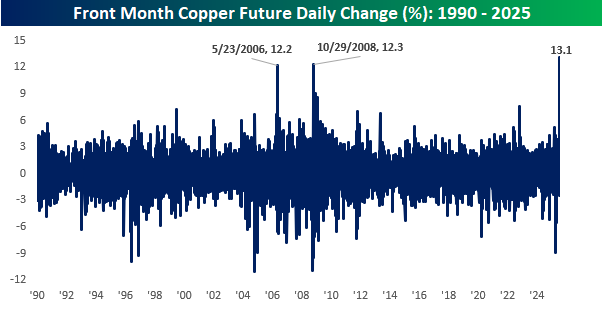
Yesterday’s 13.1% rally in copper was a record one-day gain for the commodity, eclipsing the prior record of 12.3% from October 2008. Since 1990, it was also only the third time the commodity rallied more than 10% in a single day.
The Closer – No Profits, Copper, Housing – 7/8/25
Log-in here if you’re a member with access to the Closer.
Looking for deeper insight into markets? In tonight’s Closer sent to Bespoke Institutional clients, we start with a look at the performance of stocks based on whether or not they turn a profit (page 1) followed by a look into the huge spread in performance between US and London traded copper futures (page 2). After that, we review the latest consumer credit figures (page 3), New York Fed consumer expectation data (pages 4 and 5), and Realtor.com housing figures (pages 6 and 7).

See today’s full post-market Closer and everything else Bespoke publishes by starting a 14-day trial to Bespoke Institutional today!
Daily Sector Snapshot — 7/8/25
Profit Taking and Discount Shopping
We’re just five trading days into the second half of 2025, but so far this month, the average stock in the large-cap Russell 1,000 is up a solid 1.84%. If you did well in the first half of the year, however, you’re likely seeing red, while those that lagged in the first half are finally seeing some green.
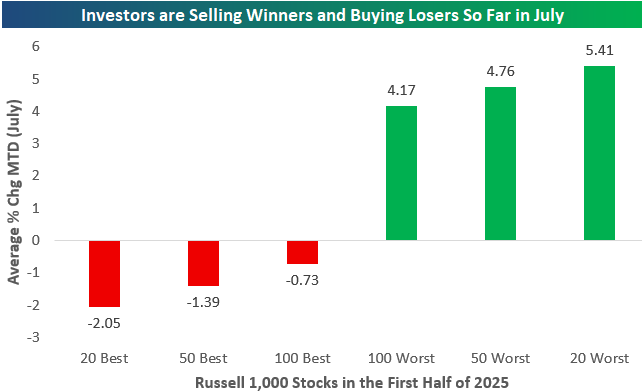
The chart below highlights a sharp reversal in investor behavior so far this month, with a clear rotation out of the first-half winners and into the biggest losers. Looking at average month-to-date returns for Russell 1,000 stocks, the 20 best-performing names from the first half are down an average of 2.05%, while the top 50 and 100 from the first half are also in negative territory this month. In contrast, the worst performers from the first half are seeing a surge in buying interest: the 20 worst names are up an average of 5.41% MTD, followed by the 50 worst at 4.76%, and the 100 worst at 4.17%. This pattern reflects classic mean reversion trading, where investors rotate into beaten-down names in hopes of a rebound, while locking in profits on stocks that have already had big runs. It also suggests that investors are bottom-fishing in laggards in search for value or speculative bounce plays. Whether this is a short-term rebalancing or the start of a more sustained shift in market leadership remains to be seen, but it’s interesting that we saw similar pullbacks in first-half market leaders in July 2023 and July 2024 as well.
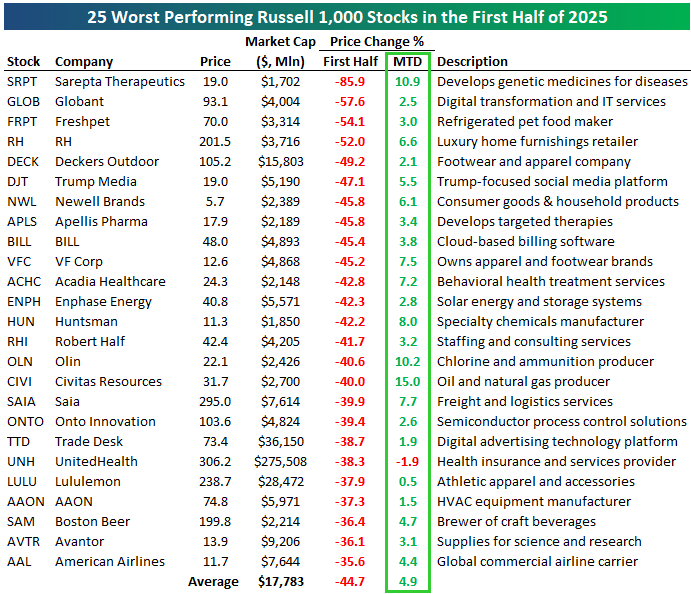
Of the 25 worst-performing Russell 1,000 stocks in the first half, all but one are up so far this month. On average, these stocks fell 44.7% in the first half, and they’re up 4.9% already in the first five trading days of July.
Take a look at the first-half losers below, of which you’ll likely be familiar with most.
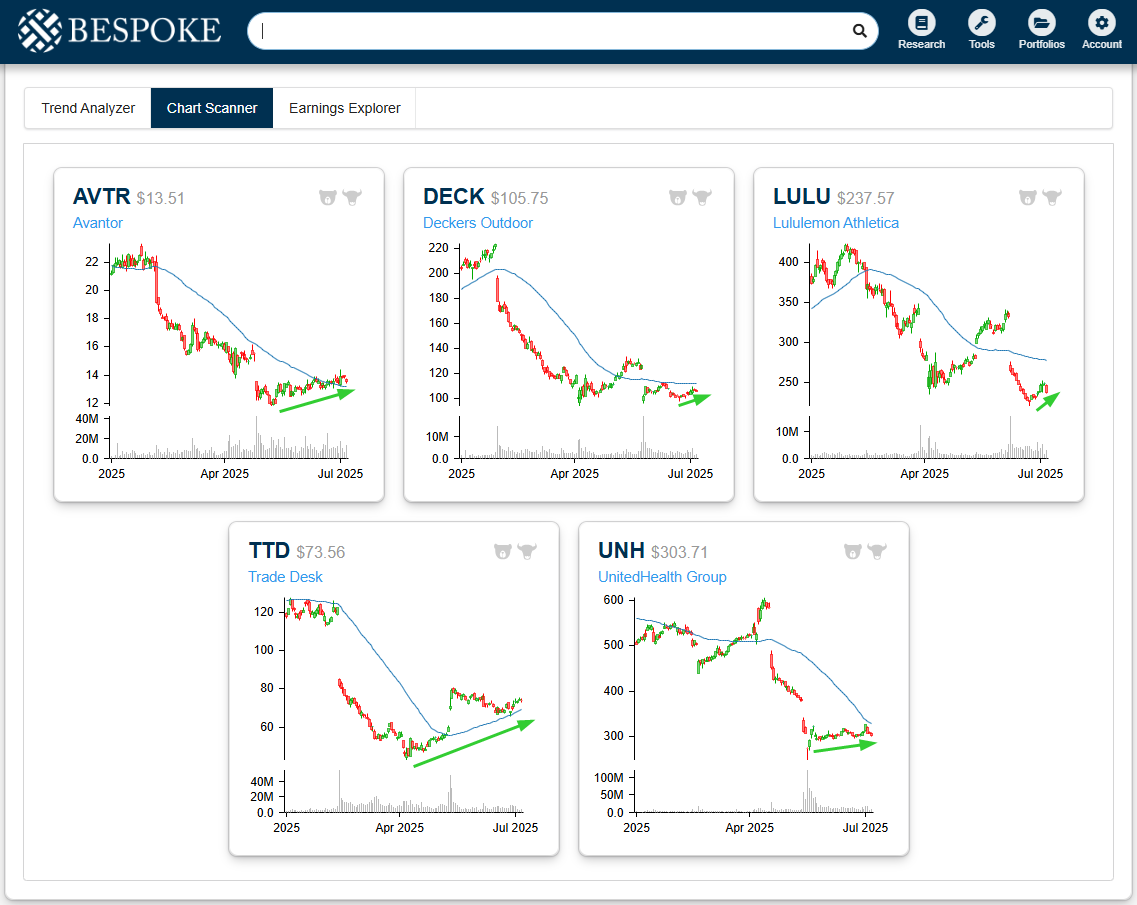
Below are price charts of the five biggest stocks on the list of first-half losers shown above: Avantor (AVTR), Deckers Outdoor (DECK), Lululemon (LULU), Trade Desk (TTD), and UnitedHealth (UNH). All five fell off a cliff at some point in the first half, but they’re currently attempting to round out a bottom. Trade Desk (TTD) has been trying to turn things around for the longest, as it bottomed back in April and now has a rising 50-day moving average again.
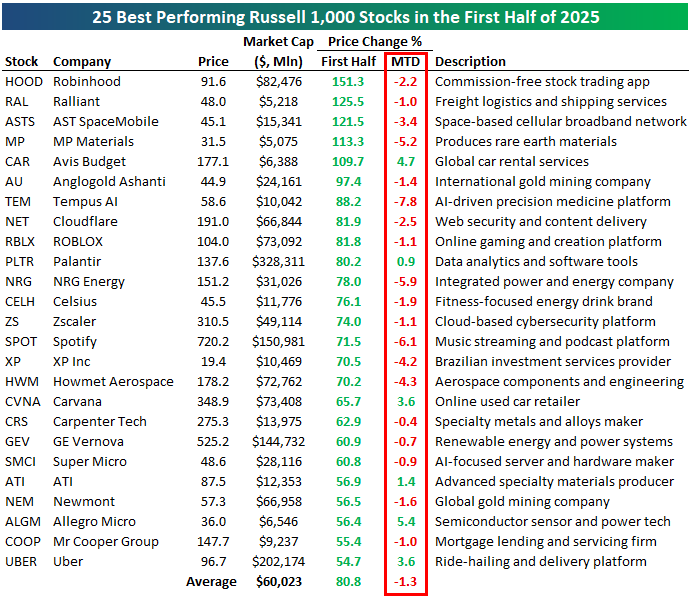
Of the 25 best performers in the first half, only six are in the green so far this month: CAR, PLTR, CVNA, ATI, ALGM, and UBER. On average, these stocks, which all gained at least 50% in the first half, are down 1.3% month-to-date. None are down more than 8%, though, so the selling hasn’t been that extreme.
With earnings season on the horizon, maybe some investors are cashing in on high-beta winners to try and avoid earnings blow-ups.
Small Business Foibles
Early this morning, the NFIB published their June report on small business sentiment. We discussed some details of the report in today’s Morning Lineup, but to recap, the headline reading came in slightly lower and inline with expectations at 98.6. As we often note, this survey is politically sensitive with a bias towards Republican administrations. As such, the index surged in the wake of the election, and after pulling back significantly earlier this year, it now remains in the middle of that range, which is also lower than it was for much of the first Trump administration.

In spite of the minor change to the headline number, there were some interesting findings throughout the rest of the report. Apart from the headline index, there are parts of the report with less political sensitivity and more economic importance that are concerning. Two such areas with notable weakness were employment and capital expenditures. As shown below, the indices tracking actual changes to those areas of business have fallen sharply in recent months. For employment, current levels are at the weakest since August 2022, and the equivalent index for capital expenditures is down to the lowest reading since August 2022. While those new lows do indicate weakness, the declines could also be in part due to seasonality, with similar summer slumps for both indices observed in the past few years.


Holding the caveat of potential seasonality aside, the report offers additional insights in the form of what firms are spending their capex on. As shown below, all categories have fallen significantly in the past few months, with particularly sharp declines in June. The worst declines have been for vehicles and equipment, which are the two largest categories for capex. Vehicles—which is a tariff-impacted area—is tied with the spring of 2020 for the lowest reading of the past decade. Also worth noting is that additional building or land spending is now at a record low in data going back to early 2014.

The report also includes a look at which problems firms claim to be their most important. In another concerning data point for economic activity, 10% reported poor sales as their biggest problem in what was the highest reading for this category since March 2021. On the bright side, inflation continues to be a less important problem, as it was cited by a still high but rapidly declining 11% of respondents.

The drop in inflation as the most important problem gives room for other issues to come to the forefront. With tariff concerns front and center, it should come as no surprise that taxes are now the single biggest concern for small businesses, accounting for 19% of answers. When combined with government red tape, the 28% reading is the highest since November 2021.

As noted earlier, the NFIB historically tends to be sensitive to politics, favoiing Republican administrations. That makes the turn higher in tax and red tape concerns more surprising. Other series in the report further indicate a turn away from those political biases, though. As shown below, when it comes to reasons for positive and negative expansion outlooks, fewer firms point to politics as a good reason to expand, and more point to that as a reason for a negative outlook.

Chart of the Day – The Worst Time of the Year
B.I.G. Tips – Amazon Prime Day 2025
Bespoke’s Morning Lineup – 7/8/25 – Subdued
See what’s driving market performance around the world in today’s Morning Lineup. Bespoke’s Morning Lineup is the best way to start your trading day. Read it now by starting a two-week trial to Bespoke Premium. CLICK HERE to learn more and start your trial.
“If your only goal is to become rich, you will never achieve it.” – John D. Rockefeller
Below is a snippet of commentary from today’s Morning Lineup. Start a two-week trial to Bespoke Premium to view the full report.
Subdued is the tone once again this morning as equity futures are little changed on either side of the unchanged line. Nasdaq futures are showing the biggest move with a gain of 0.25%. Crude oil is fractionally lower, just below $68 per barrel, while the 10-year yield is up 2 bp,s taking the yield back above 4.4%. Gold is slightly lower, while Bitcoin and Ethereum both are trading up about 1%.
In Asia overnight, most major indices were little changed, except for China, which was up 0.70% while Hong Kong’s Hang Seng was up just over 1%. The modest gains came even as President Trump sent letters to many countries in the region, including Japan and South Korea, informing them that their exports to the US would face tariffs of at least 25%.
European stocks are little changed in the early going this morning, with the STOXX 600 up 0.10% while Germany and the UK are up fractionally, while France is lower. The EU was one region of the world not to receive a letter on tariffs, and that has raised hopes that a deal with the bloc could be near. Reports this morning suggest that the base rate will be 10% with some exceptions for aircraft and parts, medical equipment, and spirits.
Today in the US, it’s another quiet day on the calendar. NFIB Small Business Optimism came in right in line with expectations at 98.6, which was down very slightly from last month’s reading of 98.8. The only other report on the calendar is the New York Fed’s Survey of Consumer Expectations, where 1-year inflation expectations are expected to come in at 3.2%.
With Elon Musk announcing the creation of the America Party over the weekend and the potential of a third party to hurt Republican majorities in the mid-term elections, investors headed into the new week with concerns that potential retribution from President Trump would hurt Tesla’s business. In response, the stock opened down over 6% yesterday and basically stayed there, finishing the day with a decline of nearly 7%.
Yesterday’s decline broke TSLA’s uptrend off the April lows, and that came after making a lower high in late June. All this came after the stock made a golden cross (50-day moving average cross above the 200-day moving average as both are rising) last week, which technicians consider a positive technical formation. Fitting for a stock like TSLA, the stock’s trading pattern has been sending mixed signals.
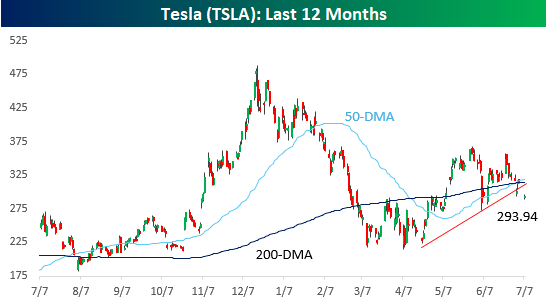
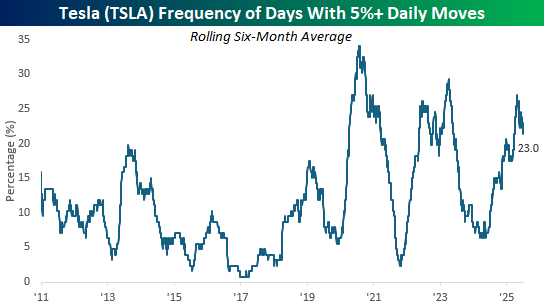
Normally, as companies become larger in terms of market cap, their share prices become less volatile, but that’s not the case with TSLA. Yesterday was the 29th daily gain or loss of 5%+ in TSLA over the last six months, which works out to 23% of all trading days. While the company went public in 2010, it wasn’t until 2020 that TSLA routinely started to see 5%+ daily moves on 20% or more of trading days over a rolling six-month period.