Q2 2025 Earnings Conference Call Recaps: Helen of Troy (HELE)
Bespoke’s Conference Call Recaps use AI to summarize lengthy earnings calls. The commentary below is AI-generated and then edited by Bespoke for quality control. As always, none of these summaries should be construed as recommendations to buy or sell any securities, and investors should do their own research and/or consult with a financial professional before making any investment decisions.
Our latest recap available to Bespoke subscribers covers Helen of Troy’s (HELE) Q1 2026 earnings call.

Helen of Troy (HELE) is a consumer products company across beauty, wellness, home, and outdoor categories. Its well-known brands include Hydro Flask, OXO, Drybar, Revlon (licensed), Braun (licensed), Osprey, Curlsmith, and Olive & June. The company serves global consumers through retail, direct-to-consumer, and international distribution channels. It offers insight into mid-tier consumer behavior, global trade exposure, and product development cycles for essential and discretionary goods. The company’s earnings call covered a challenging quarter marked by a 10.8% revenue decline, heavily impacted by tariff-related disruptions. About 8 percentage points of the decline stemmed from direct import cancellations, pull-forwards, and China softness. Consumer trade-down behavior intensified, with 3–4% average price compression. Despite headwinds, point-of-sale units rose in 8 of 11 key brands, and Olive & June grew faster than the category. Supply chain diversification remains a top priority, with exposure to China tariffs expected to fall to 25% of COGS by FY26-end. The stock fell as much as 30.7% on 7/10 after missing EPS and revenue estimates…
Continue reading our Conference Call Recap for HELE by becoming a Bespoke Institutional subscriber. You can sign up for Bespoke Institutional now and receive a 14-day trial to read our newest Conference Call Recap. To sign up, choose either the monthly or annual checkout link below:
Q2 2025 Earnings Conference Call Recaps: Delta Air Lines (DAL)
Bespoke’s Conference Call Recaps use AI to summarize lengthy earnings calls. The commentary below is AI-generated and then edited by Bespoke for quality control. As always, none of these summaries should be construed as recommendations to buy or sell any securities, and investors should do their own research and/or consult with a financial professional before making any investment decisions.
Our latest recap available to Bespoke subscribers covers Delta Air Lines’ (DAL) Q2 2025 earnings call.

Delta Air Lines (DAL) is one of the world’s largest global airlines, operating over 4,000 daily flights across a network that spans six continents. It provides passenger and cargo transportation services, with key revenue streams from domestic and international air travel, loyalty programs, and its industry-leading co-branded credit card with American Express. DAL reported $15.5 billion in revenue for the June quarter, up about 1% YoY and consistent with guidance. Premium cabin and loyalty revenue outperformed, while main cabin demand remained soft, especially on off-peak days. The airline is trimming domestic capacity in weaker time slots and noted improved booking curves as consumer confidence stabilizes. International travel trends are shifting toward shoulder-season (between peak and off-peak) demand, and DAL is adjusting its network accordingly. AI-powered pricing tools are expanding to more routes, and the Fly Delta app will soon launch a virtual assistant. On better-than-expected results, DAL shares rose over 10% on 7/10…
Continue reading our Conference Call Recap for DAL by becoming a Bespoke Institutional subscriber. You can sign up for Bespoke Institutional now and receive a 14-day trial to read our newest Conference Call Recap. To sign up, choose either the monthly or annual checkout link below:
Back-to-Back Bulls
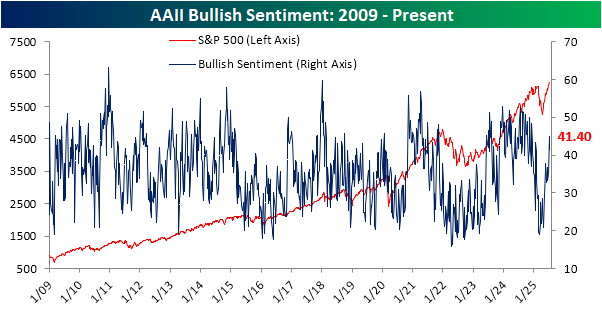
Albeit the move has been mostly recovered by now, the past week’s pullback from fresh all-time highs has resulted in investor sentiment shifting lower. The latest gauge from the weekly AAII survey showed 41.4% of respondents reporting as bullish, down from a 30-week high of 45.0% headed into the July 4th weekend.
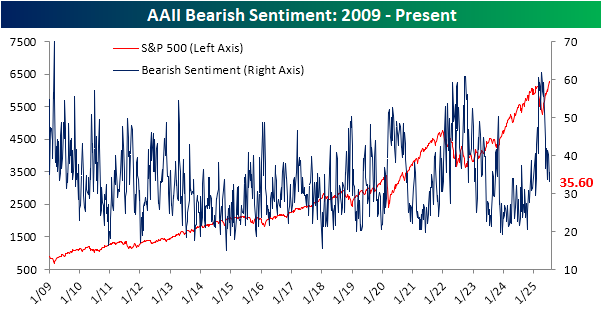
The drop in bullish sentiment meant that an increased share of responses shifted towards bearishness. 35.6% of respondents reported as bearish, up 2.5 percentage points week over week.
Given these readings, the predominant sentiment is still bullish as the bull-bear spread remains positive for a second week in a row at 5.8 points.
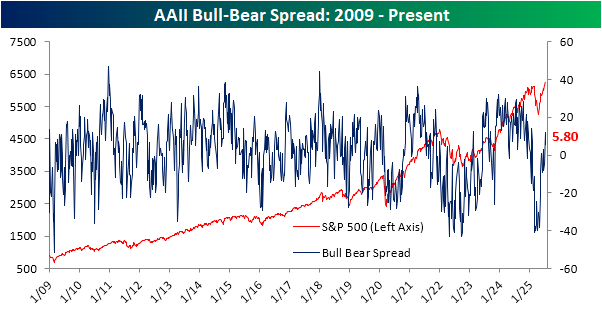
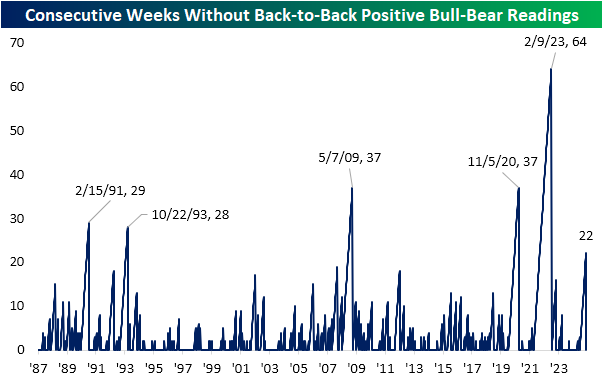
Even though the bull-bear spread was lower this week and current levels are far from earning any superlatives, the still positive reading did mark the first back-to-back positive readings in the spread since the last week of January. Alternatively, that snaps a 22-week-long streak without back-to-back weeks of positive bull-bear spreads. As shown below, such a streak has been uncommon. Throughout the history of the survey since 1987, there have only been five streaks that have gone on for longer.
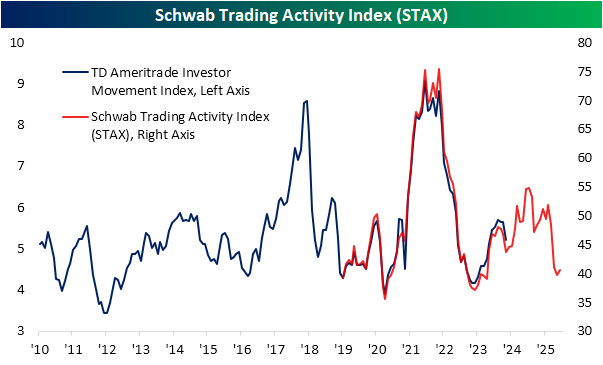
In addition to the usual weekly sentiment gauges, this week also saw an update in the Schwab Trading Activity Index (STAX). Formerly the TD Ameritrade Investor Movement index, before the merger between the two companies, the index differs from other sentiment gauges that tend to ask if an investor is bullish or bearish. Instead, this index uses a proprietary system to assign sentiment scores to retail investors based on their actual account activity. As shown, the June reading only indicated a modest improvement in sentiment after falling for three months in a row. In other words, since the April lows, retail investors had been fading the S&P 500’s recovery back up to record highs, with June only marking a minor shift back toward bullishness among this investor base.
The report also details a few anecdotes about single stocks popular among retail clients. This month’s report highlighted that—again contrary to the changes in these stocks’ prices—recent Tech favorites saw major net selling like NVIDIA (NVDA), Microsoft (MSFT), and Coinbase (COIN). On the other hand, other major Tech names like Tesla (TSLA) and Amazon (AMZN) were noted as seeing consistent purchases among retail investors.
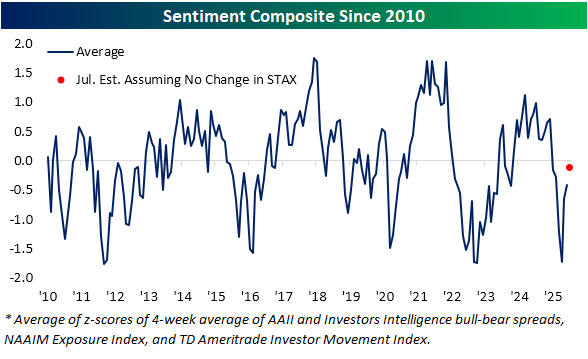
Putting sentiment readings together, below we aggregate this STAX index with the AAII survey and two other weekly sentiment readings: the NAAIM Exposure index and Investors Intelligence survey. Together and equally weighted, the average across these indicators pointed to continued improvements in sentiment in June, and readings for so far in July would point to further improvements down the road.

Bespoke’s Morning Lineup – 7/10/25 – Earnings Season Starts With a Thud
See what’s driving market performance around the world in today’s Morning Lineup. Bespoke’s Morning Lineup is the best way to start your trading day. Read it now by starting a two-week trial to Bespoke Premium. CLICK HERE to learn more and start your trial.
“If you don’t fail sometimes, you are not being ambitious enough.” – Sundar Pichai

Below is a snippet of commentary from today’s Morning Lineup. Start a two-week trial to Bespoke Premium to view the full report.
After several days with little in the way of economic or earnings data, this morning we’ll get reports on jobless claims, and we’ve already seen a handful of earnings reports. Of the four companies reporting earnings this morning, two reported better than expected EPS, three missed sales forecasts, and two lowered guidance. Maybe we would have been better off with no data! In response to the reports, we’ve seen some large moves. Helen of Troy (HELE), which reported a reverse triple play, is down over 20% while Conagra (CAG) and Simply Good Foods (SMPL) are both down over 4%. The only one of the four stocks trading higher in reaction to its report is Delta (DAL). That stock is flying over 13% in pre-market trading.
While these individual names have seen large reactions, overall, equity futures are up or down 0.05% or less, and treasury yields have barely budged. Crude oil is down less than 1% while gold, silver, copper, and platinum are all firmly higher.
Asian stocks were mixed, with Japan and India both down nearly 0.5% while China was up by a like amount. A former BoJ official made comments that there will likely be no more rate hikes until early 2026, while the Bank of Korea kept rates unchanged. In Europe, equities are moving higher as mining companies fuel a 0.6% rally in the STOXX 600 and a more than 1% rally in the FTSE 100.
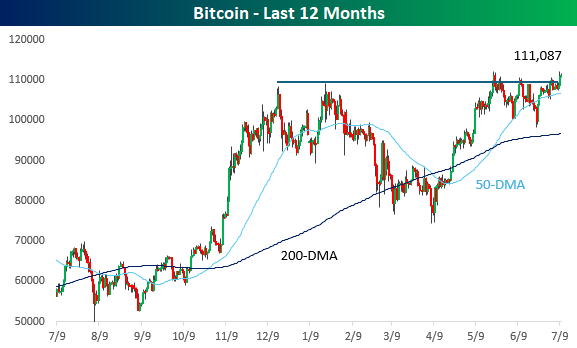
Yesterday, we highlighted some of the massive moves in various metals like gold this year. This morning, we’ll shift our focus to Bitcoin, aka digital gold, which has also been performing very well. While Bitcoin’s performance this year looks like more of a sideways move, it’s still up a respectable 18% YTD and hit a record high yesterday. This morning’s price, right around $111K, leaves Bitcoin right near the resistance it has been dealing with since late last year. A breakout above $112K would complete a cup and handle formation, setting the stage for a new leg higher.
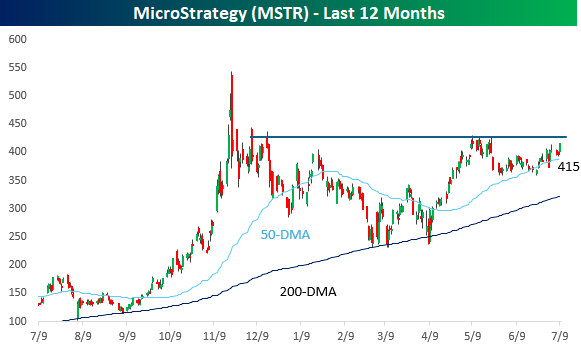
Just as bitcoin prices have been looking to break out from resistance, Bitcoin treasury company MicroStrategy (MSTR) has also been dealing with resistance right around $425 since late last year. Without getting into the valuation of the stock or the premium it trades at relative to its underlying crypto holdings, a move above $425 could set the stage for a new leg higher and a test of its post-Election highs from last year.
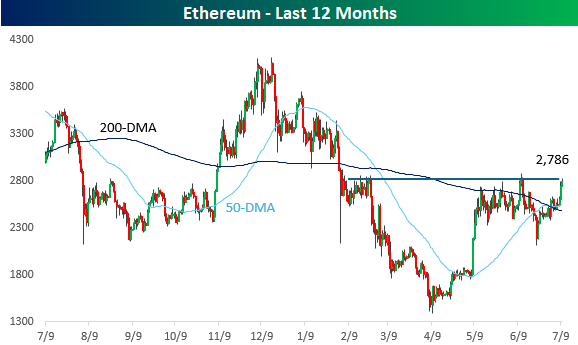
If Bitcoin is the ‘gold standard’ of the crypto space, Ethereum would be the silver standard, and price action has been much more subdued. While prices have rallied in recent weeks as digital tokens have gained in popularity, Ethereum remains more than 20% below its post-election highs. Prices are up over 7% in the last two days but remain below short-term resistance at the $2,800 level.
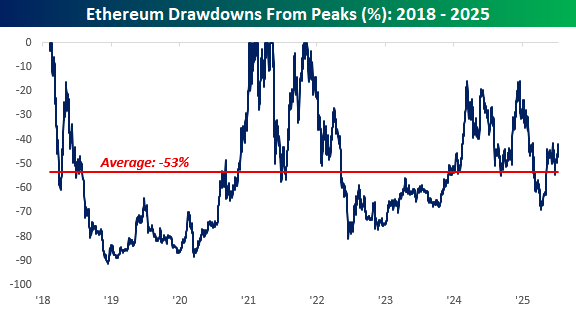
Throughout its history, Ethereum has been no stranger to large drawdowns. As shown in the chart below, since 2018, it has only been within 10% of a high on 6% of all days, and on average, it has traded in a drawdown of 53%! That means that the current 42% drawdown from its last record high in late 2021 is more modest than average! No one ever said the crypto space was an area of stability!
Cattle Futures and Cattle to Corn Ratio Hit Record Highs
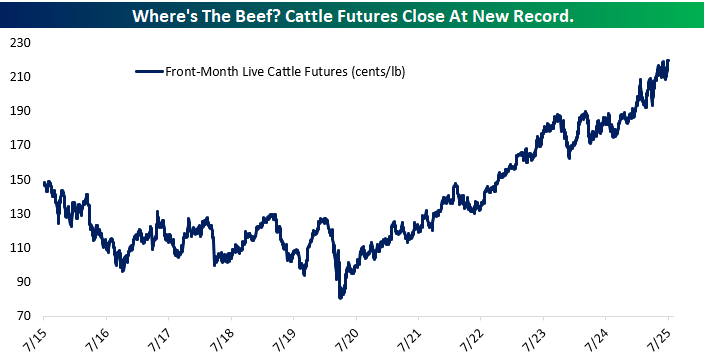
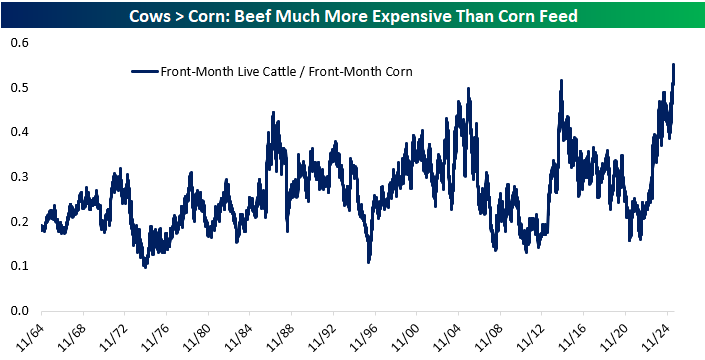
Beef prices continue to sizzle. Live cattle futures just closed at a new all-time high, climbing to $2.20 per pound after a multi-year rally that’s been quietly unfolding since mid-2020. While inflation has cooled in many parts of the economy, the beef market remains red-hot, driven by a combination of shrinking cattle herds, ongoing drought conditions in key ranching states, and steady consumer demand for beef across both retail and food service channels.
What makes this even more striking is how cheap corn, the primary feedstock for cattle, has remained in relative terms. A long-term chart of the cattle-to-corn ratio shows that beef has never been this expensive relative to feed costs, with the spread hitting its highest point in over six decades. For cattle producers, this is an extremely favorable setup: high output prices and low input costs translate into wide margins.
This divergence has interesting implications. Publicly traded meat processors could benefit from stronger margins. It also speaks to broader commodity cycles: while grain prices have cooled post-Ukraine shock, protein prices have marched higher. If you’re looking for margin tailwinds in the ag and food supply chain, the beef market is one to chew on.
The Closer – Meeting Minutes, Retail Risk, Corn & Cows – 7/9/25
Log-in here if you’re a member with access to the Closer.
Looking for deeper insight into markets? In tonight’s Closer sent to Bespoke Institutional clients, we lead off with a recap of the June FOMC meeting minutes and what some proxies of retail risk sentiment are showing (page 1). We then dive into commodity markets including a look at the steady rise of cattle prices and drops in cocoa and coffee (page 2). Next, we look at deflation in GPU costs (page 3) and “picks and shovels” plays for that space (page 4). We then finish with a note comparing the housing bubble to AI stock valuations in addition to some commentary on the rising economic importance of Prime Day (page 5).
See today’s full post-market Closer and everything else Bespoke publishes by starting a 14-day trial to Bespoke Institutional today!
Daily Sector Snapshot — 7/9/25
Chart of the Day – NVDA Tops Another Trillion
B.I.G Tips – “Golden” Indices
UPDATE: Biggest Winners and Losers Since the Release of ChatGPT
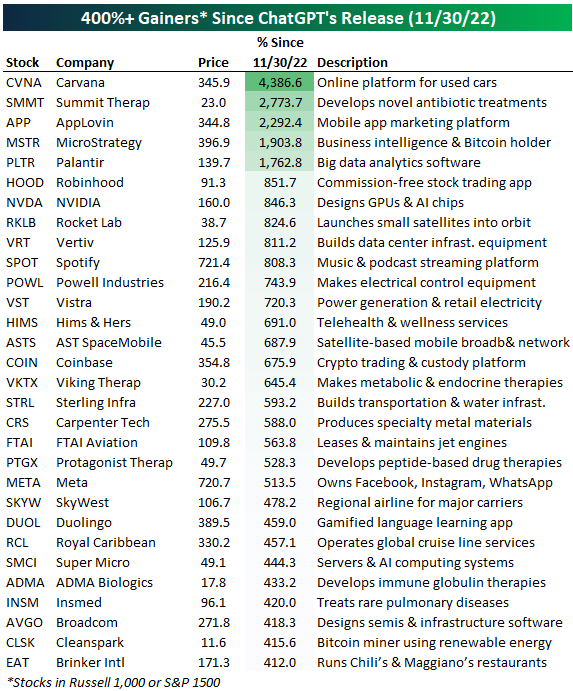
Since the launch of ChatGPT in November 2022, the stock market has seen an explosion of interest in companies exposed to artificial intelligence, digital transformation, and infrastructure innovation. While the average stock across the Russell 1,000 and S&P 1,500 is up roughly 50% since 11/30/22 when ChatGPT launched, there are 30 stocks that have gained more than 400%.
The list of 400%+ gainers since AI’s pivotal moment highlights several key themes driving outsized performance. At the top is Carvana (CVNA) with a staggering 4,386% gain, an example of a distressed digital-first business that rebounded sharply as cost-cutting, improved execution, and investor optimism around e-commerce platforms collided. Similarly, Summit Therapeutics (SMMT) and AppLovin (APP) reflect how early-stage biotech breakthroughs and ad-tech optimization powered by AI can supercharge investor enthusiasm, with both stocks up over 2,700%.
The AI boom itself is strongly represented: NVIDIA (NVDA), the GPU powerhouse enabling nearly all modern AI workloads, has surged 846%, while companies like Super Micro Computer (SMCI) and Vertiv (VRT) have ridden the infrastructure tailwinds, supplying AI servers and data center power/cooling systems. On the software side, Palantir (PLTR) and Meta (META) are capitalizing on surging enterprise demand for AI-driven insights and next-gen consumer experiences.
Beyond AI, this list captures a broader tech renaissance: MicroStrategy’s (MSTR) embrace of Bitcoin, Coinbase (COIN) benefiting from crypto’s resurgence, and Duolingo (DUOL) leveraging gamified ed-tech all reflect how tech adaptability is being rewarded. Meanwhile, healthcare and biotech have seen some stealth rallies too, with Hims & Hers (HIMS), Protagonist Therapeutics (PTGX), and ADMA Biologics (ADMA) riding innovation in drug delivery, telehealth, and immune therapies. Even travel and leisure names like Royal Caribbean (RCL) and SkyWest (SKYW) are enjoying massive comebacks as post-pandemic demand meets operating leverage.
In short, the market’s biggest winners since the AI boom began aren’t just about chips and chatbots. They span digital platforms, infrastructure enablers, health breakthroughs, and comeback stories, all unified by their exposure to innovation, scalability, and renewed investor confidence.
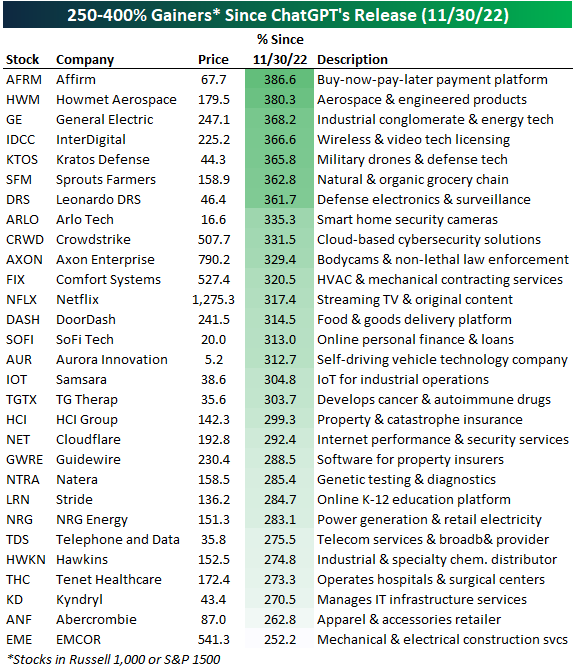
There are another 29 stocks up between 250% and 400% since ChatGPT’s release, which we show in the table below.
The list of 250% to 400% gainers since the launch of ChatGPT in November 2022 showcases a diverse group of companies benefiting from technological disruption, infrastructure tailwinds, and consumer trends. Leading the pack is Affirm (AFRM), up nearly 387%, as investors embrace the resurgence of digital lending and Buy-Now-Pay-Later platforms amid a growing shift in consumer payment behavior. Industrial heavyweights like Howmet Aerospace (HWM) and General Electric (GE) also made major strides, reflecting renewed investor interest in manufacturing, defense, and energy transition infrastructure.
On the software side, the gains in CrowdStrike (CRWD), Cloudflare (NET), and Guidewire (GWRE) highlight how enterprise IT security and insurance software remain core beneficiaries of the digital transformation. Consumer-facing names like Netflix (NFLX) and DoorDash (DASH) continue to outperform as scale, brand loyalty, and subscription models drive durable growth.
Altogether, many of these names may not have made headlines like the mega-cap AI leaders, but their gains reflect a broader, powerful undercurrent of digital acceleration and operational leverage across the economy.
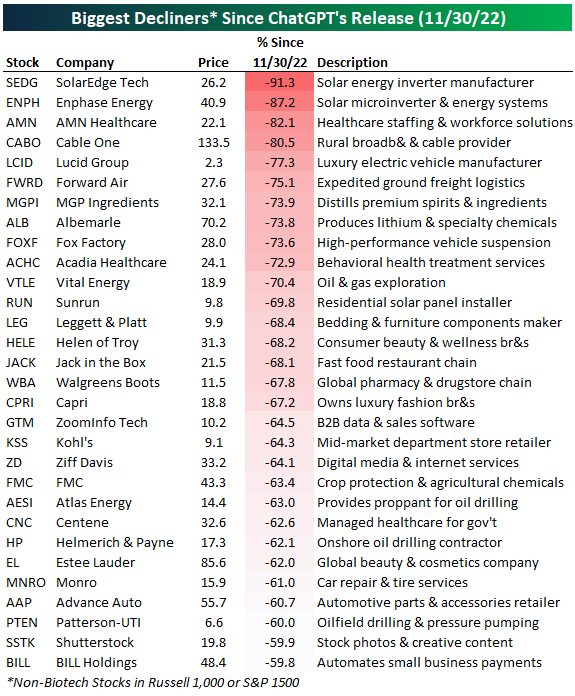
The list of biggest decliners since ChatGPT’s release in November 2022 paints a sobering picture of sectors and business models that have struggled to gain traction in a rapidly shifting market landscape. Solar energy names have been hit the hardest, with SolarEdge (SEDG) and Enphase Energy (ENPH) each down over 85%, victims of rising rates, margin compression, and a post-IRA (Inflation Reduction Act) hangover that failed to meet investor hype. These moves show how even long-term secular themes like clean energy can suffer during periods of tightening financial conditions and execution hiccups.
Other notable losers include AMN Healthcare (AMN) and Acadia Healthcare (ACHC), which struggled as labor costs and reimbursement pressures weighed on the post-pandemic healthcare sector. Consumer-facing brands like MGP Ingredients (MGPI), Helen of Troy (HELE), and Capri Holdings (CPRI) saw sharp drawdowns, reflecting broader concerns around slowing discretionary spending and inventory issues. On the industrial side, stocks like Lucid (LCID) and Forward Air (FWRD) highlight the risks of capital intensity and poor cost control, while ZoomInfo (GTM) and Ziff Davis (ZD) show how some B2B tech and digital media firms are being rerated lower in a more selective market for growth.