Bespoke’s Morning Lineup – 8/5/25 – Rates Contained
See what’s driving market performance around the world in today’s Morning Lineup. Bespoke’s Morning Lineup is the best way to start your trading day. Read it now by starting a two-week trial to Bespoke Premium. CLICK HERE to learn more and start your trial.
“History is a sequence of random events and unpredictable choices, which is why the future is so difficult to foresee.” – Neil Armstrong
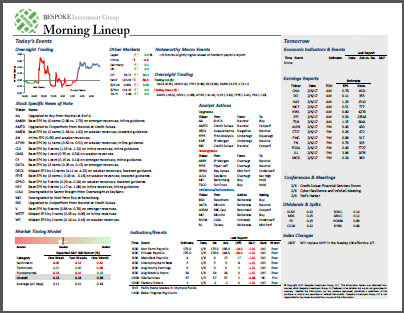
Below is a snippet of commentary from today’s Morning Lineup. Start a two-week trial to Bespoke Premium to view the full report.
There wasn’t much in the way of data to speak of at this time yesterday, but the pace of earnings has been strong since last night’s close, and futures are modestly higher ahead of the open with the S&P 500 indicated to open 0.26% higher while the Nasdaq is up 0.40%. The big earnings headliner overnight was Palantir (PLTR), which reported an earnings Triple Play and is trading up nearly 7%. Older economy stocks, however, aren’t faring as well this morning, with Caterpillar (CAT) trading down 3.6%.
The only reports on today’s economic calendar are the Trade Balance at 8:30 a.m. and the ISM Services report at 10:00 a.m. Economists expect the reading to bounce to 51.5, up from 50.8 last month.
Overnight and this morning, global equities have been broadly higher. In Asia, India’s Sensex was the only major index to finish the session lower, while China was up 1% and the Nikkei added 0.6%. Besides follow-through from Monday’s US session, stocks in the region were boosted by positive PMI readings. In Europe, the STOXX 600 was up 0.5% following a mixed batch of PMI readings for the Services sector.
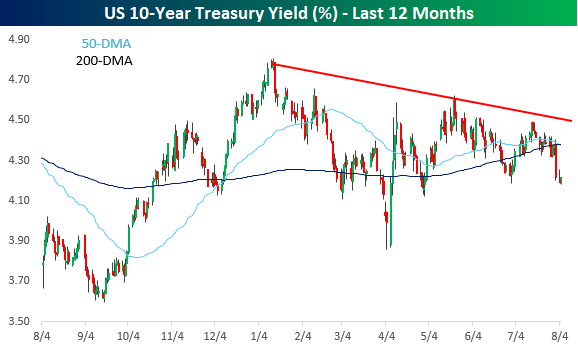
While the equity market reversed much of Friday’s losses on Monday, Treasury yields saw little to no reversal. Take the 10-year yield, for example. After closing at 4.37% last Thursday, the yield plunged to 4.22% on Friday after the jobs report, but on Monday, yields fell even further and finished the day below 4.2%. This morning, yields are slightly higher, but only at the level they closed out last week. At these levels, yields are right near their lowest levels since Liberation Day in early April. The trillion-dollar question for investors now is whether the drop in yields is due to the market pricing in lower inflation or lower economic growth, as they have very different implications for the direction of the equity market.
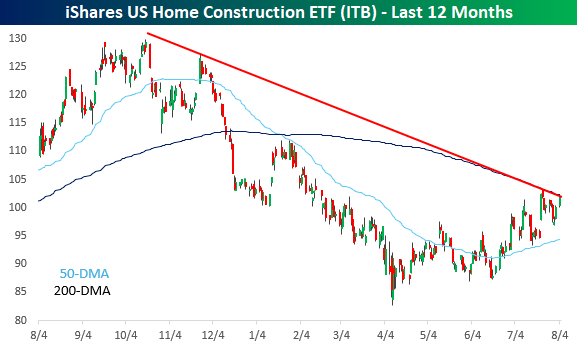
One sector that should benefit from lower yields is homebuilders. The iShares Home Construction ETF (ITB) has rallied 23% off its April lows, but it is still more than 20% off its 52-week high from last summer, so if the drop in yields was due to lower inflation, the group would presumably have plenty of room for more upside. From a technical perspective, ITB finds itself at an important juncture just below its downtrend that has been in place since last summer’s high, as well as the downward-sloping 200-day moving average. A rally in January failed at that level, but the ETF is heading into the latest test with a more established uptrend in place.
The Closer – Great Guidance, Sentiment, SLOOS – 8/4/25
Log-in here if you’re a member with access to the Closer.
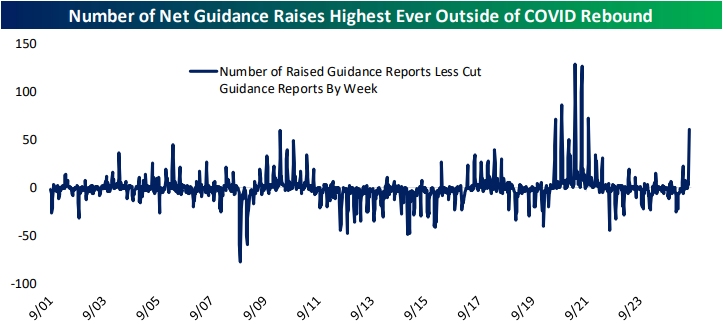
Looking for deeper insight into markets? In tonight’s Closer sent to Bespoke Institutional clients, we start by looking at the very strong pace at which companies are raising guidance (page 1) followed by a look into other details of recent earnings reports (page 2). Next, we dive into the latest sentiment findings from Schwab (pages 3 and 4). We cap off with a rundown of the latest Senior Loan Officer Outlook Survey (pages 6 and 7).
See today’s full post-market Closer and everything else Bespoke publishes by starting a 14-day trial to Bespoke Institutional today!
Q2 2025 Earnings Conference Call Recaps: Stryker (SYK)
Bespoke’s Conference Call Recaps use AI to summarize lengthy earnings calls. The commentary below is AI-generated and then edited by Bespoke for quality control. As always, none of these summaries should be construed as recommendations to buy or sell any securities, and investors should do their own research and/or consult with a financial professional before making any investment decisions.
Our latest recap available to Bespoke subscribers covers Stryker’s (SYK) Q2 2025 earnings call.

Stryker (SYK) is a medical technology company that designs and manufactures products across orthopedics, MedSurg, neurotechnology, and spine. It serves hospitals, ambulatory surgery centers, and surgeons with a portfolio that includes joint replacement implants, surgical equipment, robotics (notably the Mako system), and emergency medical devices like LifePak. Stryker delivered 10.2% organic sales growth and raised its full-year guidance despite tariff headwinds and the integration of Inari. Mako robotic installations hit a record high, with strong momentum for Gen 4 and new applications like Revision Hip, Spine, and Shoulder. Capital equipment demand remained strong with no slowdown in the ASC (Ambulatory Surgery Center) buildout, and LifePak 35 just received EU approval. Inari faced disruption from turnover in its salesforce and destocking, but the business is still on track for double-digit pro forma growth. Tariff impact was revised to about $175M, offset by operational efficiencies and pricing. AI initiatives like Blueprint are expanding, with deeper updates expected at its Investor Day. Despite the triple play, shares fell as much as 5.9% on 8/1…
Continue reading our Conference Call Recap for SYK by becoming a Bespoke Institutional subscriber. You can sign up for Bespoke Institutional now and receive a 14-day trial to read our newest Conference Call Recap. To sign up, choose either the monthly or annual checkout link below:
Best and Worst Historical S&P 500 August Performers
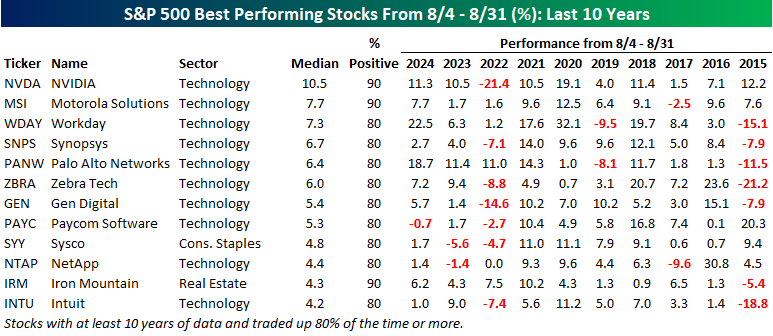
By now, you probably know that the market is currently in the early stages of what historically has been the weakest three-month period of the year for the S&P 500. Even in the weakest of periods, though, not every stock usually goes down. In what has historically been a weak period of time for the S&P 500, we screened our Seasonality Database for S&P 500 stocks that have historically performed the best from the close on 8/4 through the end of August.
The table below lists the dozen S&P 500 stocks that have experienced a median gain of at least 4% and traded higher at least 80% of the time from the close on 8/4 through 8/31. Topping the list, NVIDIA’s (NVDA) gain during this period has been 10.5% with gains 90% of the time. NVDA has become the face of AI since Chat GPT’s 2022 launch, but from 2015 through 2021, it also traded higher during this period each year. Along with NVDA, the only other stocks in the table that traded higher 90% of the time were Motorola Solutions (MSI) and Iron Mountain (IRM). What also stands out about the names on the table is that all but two of them are from the Technology sector.
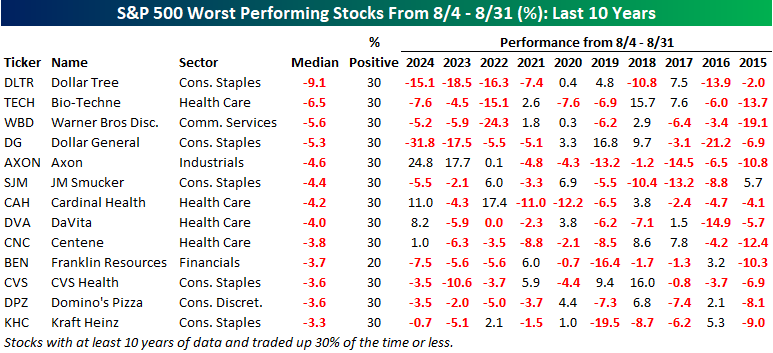
On the downside, the table below lists the thirteen stocks in the S&P 500 that have had a median decline of at least 3% from the 8/4 close through month-end, with gains 30% of the time or less. Topping the list of losers is Dollar Tree (DLTR) with a median decline of 9.1% and gains just 30% of the time. This has been an especially weak time of year for the stock over the last four years, as it has declined at least 7.4% each time. Axon (AXON) is another notable name on the list. Even with a median decline of 4.6%, it has been up during this period for three straight years with gains of 0.1%, 17.7%, and 24.8%, respectively. Unlike the list of winners, which was almost entirely Technology stocks, the list of losers is much more diverse, with six sectors represented, even as five are in the Consumer Staples sector.
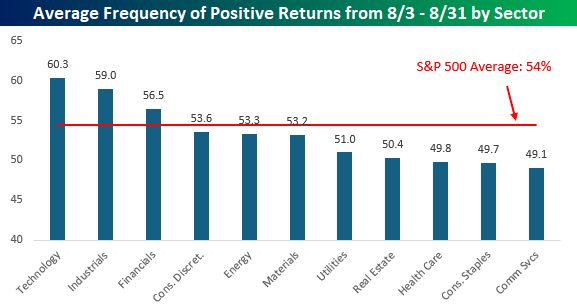
Just about all of the stocks listed on the table of best performing stocks from the close on 8/4 through month-end are from the Technology sector, and the chart below further illustrates the strength of the sector during this period. As shown, Tech-sector stocks have traded higher an average of 60.3% of the time from 8/4 through 8/31. Not far behind, stocks in the Industrials sector have traded higher an average of 59% of the time, followed by Financials with gains 56.5% of the time. These three sectors are also the only ones that have had a higher winning percentage than the S&P 500. To the downside, the only three sectors that have traded higher during this period less than half of the time are Communication Services, Consumer Staples, and Health Care.

Bespoke’s Morning Lineup – 8/4/25 – Stuck in Neutral
See what’s driving market performance around the world in today’s Morning Lineup. Bespoke’s Morning Lineup is the best way to start your trading day. Read it now by starting a two-week trial to Bespoke Premium. CLICK HERE to learn more and start your trial.
“If you have to ask what jazz is, you’ll never know.” – Louis Armstrong
Below is a snippet of commentary from today’s Morning Lineup. Start a two-week trial to Bespoke Premium to view the full report.
The hangover for bulls came before the weekend last week, and they’re looking to start the week in a party mood with futures on all three major averages in the green and indicated to open about 0.5% higher. That’s only enough to erase a third of Friday’s losses, but it’s better than the alternative. Overnight in Asia, stocks were also firmly higher, while Europe’s STOXX 600 is up 0.6%. There’s no real catalyst for the gains this morning, but there’s also little in the way of economic and earnings data, so there’s not a lot of conviction behind the move.
While equities are moving higher, energy prices are down across the board, with WTI crude oil trading down 2% following the OPEC+ announcement that it would proceed with its September output hike of 547K barrels. Metals are fractionally higher across the board, and treasury yields are unchanged to modestly higher. Given the bounce in equities, you would expect to see crypto also rebound; however, both Bitcoin and Ether are still trading right around where they were last Friday.
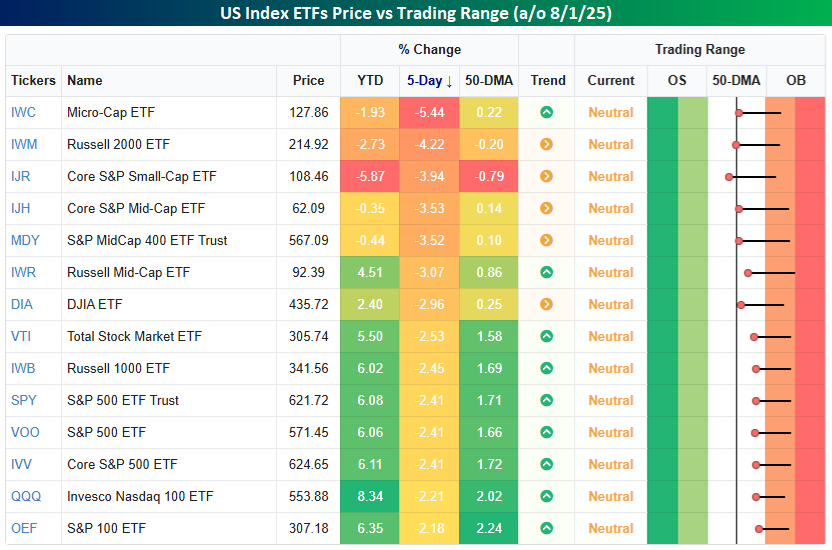
Right on cue, it seems, the typical late summer seasonal weakness has interrupted a market that had a consistent early summer bid. After a string of record highs, the S&P 500 sold off on an intraday basis every day last week. When the bell rang on Friday, the Nasdaq 100 (QQQ) and S&P 500 (SPY) were both down over 2% for the week, while the ne’er-do-well Russell 2000 (IWM) fell over 4%. As steep as the declines were, though, only two of the fourteen index ETFs shown below finished the week below their 50-day moving averages (DMA), and all fourteen were in neutral territory.
Brunch Reads – 8/3/25
Welcome to Bespoke Brunch Reads — a linkfest of some of our favorite articles over the past week. The links are mostly market-related, but there are some other interesting subjects covered as well. We hope you enjoy the food for thought as a supplement to the research we provide you during the week.
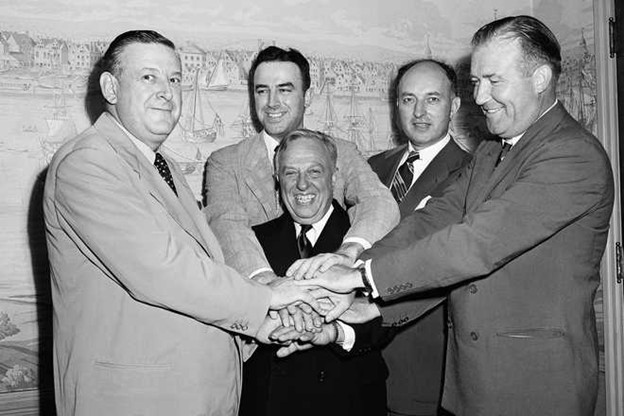
Hoops History: Before the NBA became the global force it is today, professional basketball in the US was fragmented. Two rival leagues, the Basketball Association of America (BAA) and the National Basketball League (NBL), were vying for talent, fans, and legitimacy. The BAA had the big-city arenas and a vision of professional sports entertainment, while the NBL had the basketball pedigree, with strong Midwestern roots and better talent. However, both leagues were hemorrhaging money and poaching players, and the post-war economy couldn’t support two competing professional leagues.
On August 3, 1949, in a modest meeting held in New York City, executives from both leagues agreed to a merger. The new league, formed from six surviving NBL teams and the ten BAA franchises, would be called the National Basketball Association (NBA). The name was simple. But it marked the formal birth of what would become a cultural juggernaut. Teams like the Minneapolis Lakers (with a young George Mikan), the Rochester Royals, and the Syracuse Nationals joined forces with the Boston Celtics, New York Knicks, and Philadelphia Warriors.
The NBA didn’t become a sensation overnight. Attendance was modest, teams folded, and some doubted it would last. Today, the NBA is a $10+ billion enterprise that rivals any sports league in the world. Its games draw millions of viewers annually. Player contracts routinely exceed $200 million, and the league’s next media rights deal is expected to surpass $70 billion over the next decade. Michael Jordan elevated the NBA to a global stage in the 1990s, turning basketball into a worldwide language. Kobe Bryant’s legacy helped cement the league’s popularity in places like China, while LeBron James has redefined the influence of athletes in the 21st century. The NBA now operates academies across multiple continents, hosts preseason games abroad, and boasts international stars like Giannis Antetokounmpo, Luka Dončić, and Victor Wembanyama.
Science & Space
Large-scale processing of within-bone nutrients by Neanderthals, 125,000 years ago (ScienceAdvances)
Neanderthals at a lakeside site in Germany were systematically hauling in fat-rich bones from horses, deer, and cattle-sized animals to crush and boil for grease. The remains, over 100,000 shattered fragments, show signs of deliberate butchery, marrow extraction, and fire use, all packed into a tight area that may have served as a kind of seasonal processing hub. This kind of organized, labor-intensive fat harvesting pushes the timeline way back on behaviors we usually associate with much later humans. [Link]
Continue reading our weekly Brunch Reads linkfest by logging in if you’re already a member or signing up for a trial to one of our two membership levels shown below! You can cancel at any time.

Top Quotes from Today’s Earnings Calls: 8/1/25
We sifted through earnings calls from the biggest companies that reported since last night’s (7/31) close, looking for some of the most interesting macro-related quotes from management teams that may serve as broader signals about the state of the economy, consumers, and markets. Below are twenty of the most revealing quotes that we pulled from this batch of calls, offering a window into what executives are seeing across industries and geographies right now.
- Amazon (AMZN): “What we can tell you is what we’ve seen so far in the first half of the year, we just haven’t seen diminished demand. And we haven’t seen any kind of broad-scale ASP increases. And so that could change in the second half. There are a lot of things that we don’t know, but that’s what we’ve seen so far.” – Andy Jassy, CEO
- Apple (AAPL): “You are going to see an increase in CapEx. We also, from time to time, have other investments in facilities, in toolings, but I would say a significant portion of the driver of growth that you’re seeing now is really driven by some of our AI-related investments.” – Kevan Parekh, CFO
- Clorox (CLX): “At the same time that you see this value seeking and you see this uncertainty behavior from consumers… you also see this really made accentuated trend right now on convenience and experiences. Consumers are still buying things and experiences they like. You’re still seeing them do things outside their home, go back to eat, et cetera. We’re seeing significant move to convenience. We’re seeing all these dynamics of consumers having to manage the uncertainty, which is meaning they’re moving their dollars in their wallet across different places and they’re doing it very, very dynamically.” – Linda Rendle, CEO
- Eastman Chemical (EMN): “There are unfair trade practices around the world, and there is aggressive dumping by some countries, especially overcapacity out of China and transshipping to avoid tariffs… But those, while very serious, need a strategic approach, and the challenge… is that trade strategy applying to all countries in the world at the same time may create more economic harm than what’s necessary… You’ve got a lot of volatility of imports going up, private inventories dropping, there are people who are moving product all over the world to try and get ahead of tariffs… It’s really chaotic to try and understand what’s really going on in end-market demand.” – Mark Costa, CEO
- Lumen Technologies (LUMN): “The global AI race is a matter of economic development and national security for the United States. We are pleased with the administration’s AI action plan and recent tax legislation, which not only reduces regulatory barriers and helps accelerate our current network build-out, it also provides us with additional capital to invest in our nation’s digital infrastructure.” – Kathleen E. Johnson, CEO
- Magna (MGA): “Most of the policy impacts are secondary impacts, right, like the EV credits going away, and therefore, the consumers may be not buying as many EVs… But on the other hand, if it increases hybrid and ICE vehicle sales, then we are part of the equation there… If the BEVs come back… the investment is behind us, and we would see that as a tailwind going forward.” – Seetarama Kotagiri, CEO
- World Kinect Corporation (WKC): “The power business, we all know the electrification of the economy [is improving]. That’s going to continue to grow at 50% or more… And then sustainability within carbon, that is something that has been highly politicized, but it’s not going away. I mean there is going to be a continuing market for that. You’ve got mandates that are coming through regardless of what certain countries are doing or certain parts of the world. States have got different activities. It’s complicated the carbon accounting.” – Michael Kasbar, CEO
- DXC Technology (DXC): “We are in the era of experimentation. All of us are trying it in many ways. There is no way to learn other than doing. So curiosity is king here… this isn’t a plug-in and just accelerate an existing process. This will be rethinking every process using AI to replicate human functions, using AI to augment human intensity by lowering operational intensity.” – Raul Fernandez, CEO
- KLA Corporation (KLAC): “This environment is new to our industry and the long-term tariff situation remains unclear… we’re now facing the likelihood of higher structural tariffs… there are some business processes as it relates to how we move parts around, how do we leverage free trade zones… if it drives structural cost increase, then that’s something that we’ll have to deal with… if you add in the economic cost of incremental tariffs, all of a sudden, some of those issues rise up the priority scale.” – Bren Higgins, CFO
- Paramount Global (PARA): “Live sports are more valuable today than ever before, across both platforms. This year’s Final Four was the most watched in eight years, and CBS’s sports golf coverage in 2025 is up 13% year-over-year. It’s best performance in seven years.” – Chris McCarthy, CEO of Showtime
- Stryker (SYK): “[Ambulatory Surgical Centers are] not going to stop because it actually lowers the cost of health care. It’s a pleasurable experience for the surgeons. It’s a pleasurable experience for the patients. And I could see that healthy patients like to go to a place like this where there aren’t sick people. And so I absolutely see this trend continuing… I think you’ll see it across all specialties.” – Kevin Lobo, CEO
- Arthur J. Gallagher (AJG): “Within the US, we are seeing continued job growth, just not quite at the robust levels we saw during 2024. Additionally, trends from health insurance carriers continue to indicate ongoing increases in medical utilization and treatment costs. Our benefit professionals are well positioned to guide employers through these many challenges.” – J. Patrick Gallagher, CEO
- Colgate-Palmolive (CL): “I think one of the things we’re seeing both in the US and around the world is the inflation has hit food a little bit quicker than it’s hit other products. And as a result of that, consumers are spending more money on their food choices and as a result, perhaps be more cautious in other categories right now.” – Noel Wallace, CEO
- Telus (TU): “At some point, the market has to shift from irrational to rational… it’s just not sustainable to have that level of irrationality leading to negative NPV outcomes… Eventually, given the amount of capital that we deploy within our industry, I think economics have to drive our pricing decisions.” – Darren Entwistle, CEO
- CNH Industrial (CNH): “There is another conversation that hasn’t yet really revealed much detail and that is the trade deal between China and the US. We have recently observed on our side that China has removed some 600 extensions for tariff reductions from their import policy and that could go both ways. This could mean that there will be a trade deal between China and the US coming soon also including commodities. But it will also mean that this is not anymore possible for the US to import commodities to China. So, we don’t know really how that will play. And both has obviously impact on the Brazilian farmers who will improve, I think, their financial health next year and who will continue to purchase maybe at higher levels also next year their machines. But we need these certainties, particularly Brazil, US and China, US when it comes to commodity imports and exports.” – Gerrit Marx, CEO
- WW Grainger (GWW): “We do believe that market demand’s going to be relatively muted, and we’ve taken that down as well, and that’s just a reflection of what we think tariff price increases are likely to do for the market. We also think that’s temporary.” – D.G. Macpherson, CEO
- Edison (EIX): “We know the state knows that the underlying wildfire risk, again, broadly for the state, not just utility ignitions, but wildfire risk is only going to increase with climate change. I remind you that the adapting for tomorrow, white paper that we put out… said, that by 2050, California is [could see] as much as 3 feet of average sea level rise and 7x more the kind of hot days that today are in the top 1% and more floods and more droughts. And importantly, the risk of 20% more wildfire ignitions across all causes. So it’s imperative to this state be able to prepare for that risk that we know is coming and it’s going to be made worse by climate change.” – Pedro Pizarro, CEO
- Kimberly-Clark (KMB): “I do see purchasing power under pressure, for consumers. And frankly, we don’t really see a catalyst for that dynamic to change in the near to medium term… demand remains resilient and the categories continue to demonstrate durable growth, and that’s kind of a big deal.” – Mike Hsu, CEO
- Fluor (FLR): “Over the past couple of months, we’ve seen more clients continue to take a wait-and-see approach due to a variety of reasons, including ongoing trade policy discussions and developments, cost escalation and interest rates. In a few cases, we’ve seen project cancellations or extended deferrals.” – James Breuer, CEO
- LPL Financial (LPLA): “The primary driver [of lower client cash balances]… is just the denominator growing, right? We’ve got a strong equity market… almost $100 billion on average for the last several quarters in a row. So you just have the denominator growing. Cash balances themselves have been pretty stable around $5,000 per account for quite some time.” – Matthew Audette, CFO
The Bespoke Report – 8/1/25 – It’s a Two Way Street
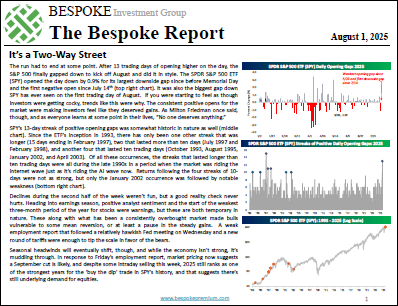
To read our weekly Bespoke Report newsletter and access everything else Bespoke’s research platform offers, start a two-week trial to Bespoke Premium. In this week’s report, we cover the market running out of steam after a relentless rally, a lackluster response to earnings season, and much more.
Jobs Day In Four Charts
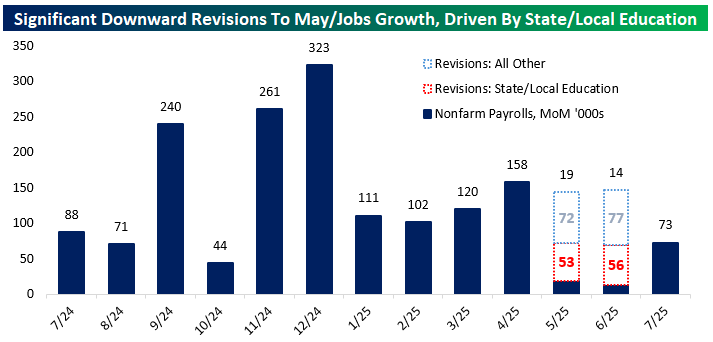
While payrolls announced by the BLS for July missed (+73k versus +104k estimated), the bigger story was revisions. A combined 258k jobs were revised out of May and June numbers, taking those months’ NFP prints to +19k and +14k respectively. Almost half of the revisions lower came from state and local government education, which accounts for less than 7% of total employment.
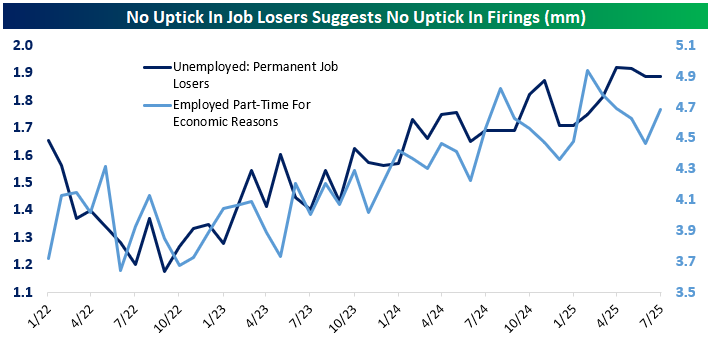
While jobs growth has slowed, there’s been no major uptick in unemployment due to job loss or more workers only part-time because they can’t find full-time work.
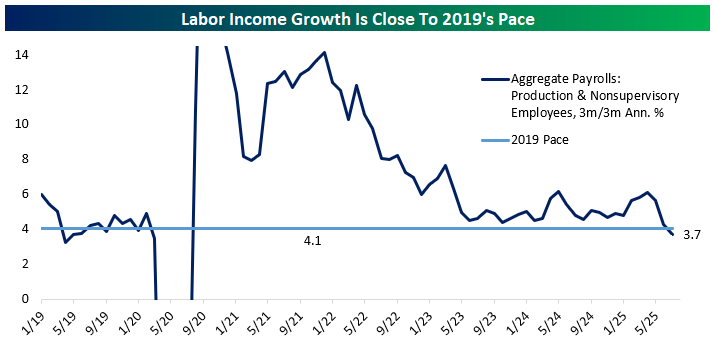
Labor income (employment times wages times hours) was also up over 7% annualized on the month and is up at 3.7% annualized on a 3m/3m basis that is similar to 2019’s nominal growth rate. Labor income has certainly slowed, but it’s not cratering in a way that would drive sharp pullbacks in spending despite the slow jobs growth.
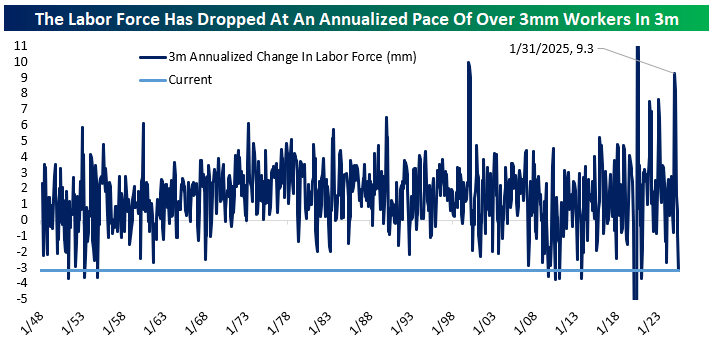
Since the Global Financial Crisis, labor market data has broadly been viewed as an insight to the demand side of the labor market. But the current context is quite different: unemployment remains low, while labor supply is falling. The last 3 months saw a 3.3mm annualized decline in the labor force, driven by immigration policy and to a lesser extent demographics. As a result, slow job creation is much less concerning than when labor supply is rising.
Like this analysis? Read more in this week’s Bespoke Report newsletter. Click here to start a trial to one of our three membership levels for access.
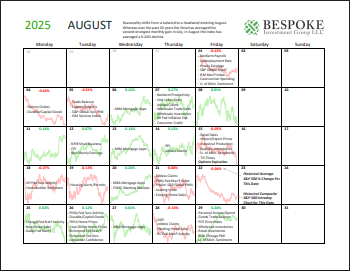
Bespoke Market Calendar — August 2025
Please click the image below to view our July 2025 market calendar. This calendar includes the S&P 500’s historical average percentage change and average intraday chart pattern for each trading day during the upcoming month. It also includes market holidays and options expiration dates plus the dates of key economic indicator releases. Click here to view Bespoke’s premium membership options.