
The Closer – Quarterly Banking Profile, FOMC Dealmaking – 11/24/25
Log-in here if you’re a member with access to the Closer.
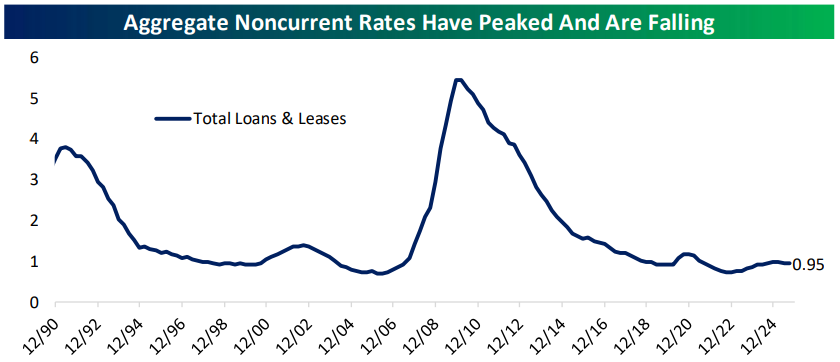
Looking for deeper insight into markets? In tonight’s Closer sent to Bespoke Institutional clients, we dive deep into the FDIC’s quarterly snapshot of the aggregate balance balance sheet for the US banking sector (pages 1-5). We then close out with a review of Fedspeak that suggests a deal has been struck between Governor Waller and Chair Powell (page 5).
See today’s full post-market Closer and everything else Bespoke publishes by starting a 14-day trial to Bespoke Institutional today!
Q3 2025 Earnings Conference Call Recaps: Walmart (WMT)
Bespoke’s Conference Call Recaps use AI to summarize lengthy earnings calls. The commentary below is AI-generated and then edited by Bespoke for quality control. As always, none of these summaries should be construed as recommendations to buy or sell any securities, and investors should do their own research and/or consult with a financial professional before making any investment decisions.
Our latest recap available to Bespoke subscribers covers Walmart’s (WMT) Q3 2026 earnings call.

Walmart (WMT) is the world’s largest retailer, serving millions of households across income levels through a massive physical footprint of supercenters, Sam’s Clubs, and expanding eCommerce. Known for its everyday low prices, Walmart provides groceries, general merchandise, health and wellness services, and an enormous third-party marketplace. Walmart delivered another strong quarter with 6% revenue growth, 27% eCommerce growth, and continued market share gains in grocery, apparel, and general merchandise. Higher-income households drove much of the momentum, while lower-income customers showed modest pressure. Delivery speeds hit records, with 35% of US digital orders arriving in under three hours, and automation now supports 50%+ of fulfillment center volume, lowering shipping costs. International strength was notable: China up 22%, and Flipkart’s Big Billion Days (BBD) generated over 700 orders per second at peak. Management was generally confident in its value proposition and growing alternative profit streams like advertising and membership, despite some discussion around tariffs. On better-than-expected results, WMT shares climbed 6.5% on 11/20…
Continue reading our Conference Call Recap for WMT by becoming a Bespoke Institutional subscriber. You can sign up for Bespoke Institutional now and receive a 14-day trial to read our newest Conference Call Recap. To sign up, choose either the monthly or annual checkout link below:
Q3 2025 Earnings Conference Call Recaps: NVIDIA (NVDA)
Bespoke’s Conference Call Recaps use AI to summarize lengthy earnings calls. The commentary below is AI-generated and then edited by Bespoke for quality control. As always, none of these summaries should be construed as recommendations to buy or sell any securities, and investors should do their own research and/or consult with a financial professional before making any investment decisions.
Our latest recap available to Bespoke subscribers covers NVIDIA’s (NVDA) Q3 2026 earnings call.

NVIDIA (NVDA) designs the world’s most powerful accelerated computing hardware and software, best known for its GPUs, networking platforms, and full-stack AI systems used in data centers, autonomous vehicles, robotics, and high-performance computing. The company sits at the center of the global AI infrastructure boom, supplying hyperscalers, sovereign governments, pharmaceutical companies, automakers, and millions of developers worldwide. NVIDIA posted another blowout quarter with $57B in revenue, up 62% YoY, as demand for AI infrastructure remained well above supply, and hyperscaler CapEx expectations rose to roughly $600B for 2026. Data center revenue hit $51B (+66% YoY), driven by the GB300 Blackwell platform and explosive growth in networking (+162% YoY). The company announced 5 million GPUs’ worth of new AI factory projects, including xAI’s gigawatt-scale Colossus 2 and Lilly’s drug-discovery supercomputer. Management also highlighted soaring momentum from frontier model builders: OpenAI reaching 800M weekly users, Anthropic hitting a $7B run rate, and both expanding compute commitments. Despite geopolitical limits in China, NVIDIA expects Q4 revenue of $65B and sees multi-year leadership ahead with the Rubin architecture ramping in 2026. NVDA shares rose more than 5% after hours on 11/19 in reaction to its triple play earnings report, but fell in the tech-led market reversal to close down 3% on 11/20…
Continue reading our Conference Call Recap for NVDA by becoming a Bespoke Institutional subscriber. You can sign up for Bespoke Institutional now and receive a 14-day trial to read our newest Conference Call Recap. To sign up, choose either the monthly or annual checkout link below:
Bespoke’s Morning Lineup – 11/24/25 – Rebound Continues
See what’s driving market performance around the world in today’s Morning Lineup. Bespoke’s Morning Lineup is the best way to start your trading day. Read it now by starting a two-week trial to Bespoke Premium. CLICK HERE to learn more and start your trial.
“No man becomes rich unless he enriches others.” – Andrew Carnegie

Below is a snippet of commentary from today’s Morning Lineup. Start a two-week trial to Bespoke Premium to view the full report.
Following a Friday rebound on the back of comments from NY Fed President John Williams that he was open to a rate cut at the December meeting, the week is starting on a positive note. S&P 500 futures have rallied 0.5% while Nasdaq futures point to a gain of 0.76% as shares of Alphabet (GOOGL) trade up another 3% following comments from Marc Benioff saying how much better Gemini 3 is than ChatGPT and that he’s ‘not going back’.
Japanese stocks were closed for a holiday, but Hong Kong stocks surged 2% while South Korean stocks declined modestly in what was a generally quiet session to start the week. European stocks are generally off to a quiet start this week as well. The STOXX is basically unchanged, while Germany (0.5%) leads and Italy (-1.0%) lags. One major weakness in the region, though, is the defense sector, as a potential end to fighting in the Ukraine war has that sector selling off. In terms of data, it’s been quiet. The only report was German Business confidence from ifo, which showed an unexpected decline from October, falling from 88.4 to 88.1 versus forecasts for an uptick to 88.6.
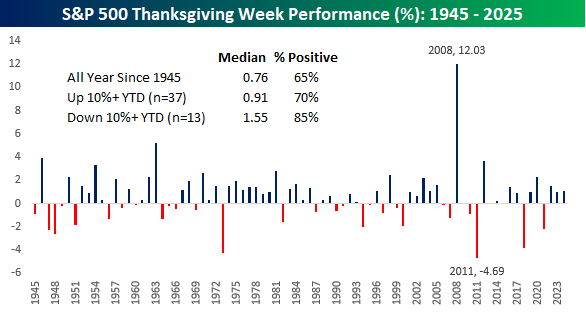
With the market only open for trading three-and-a-half days this week, it’s one of the shortest trading weeks of the year. With many on Wall Street usually taking Friday off, it’s only a three-day work week for many. It may be short, but Thanksgiving week has historically been strong. Since 1945, the S&P 500’s median performance during the week has been a gain of 0.76% with gains 65% of the time.
This year is the 38th time since 1945 that the S&P 500 was up by double-digit percentages heading into the week, and in the 37 prior years, the S&P 500’s median gain for Thanksgiving week was even stronger at 0.91% with positive returns 70% of the time. There have also been 13 years when the S&P 500 was down by double-digit percentages heading into Thanksgiving week. While you wouldn’t expect that investors would have had much to be thankful for in those years, the S&P 500’s median gain during the holiday week was a gain of 1.55% with positive returns 85% of the time.
As shown in the chart below, recent Thanksgiving week performance have also been positive. In the last three years, the S&P 500 rallied more than 1% in each Thanksgiving week, and it’s been positive during this week in eleven out of the last 13 years.
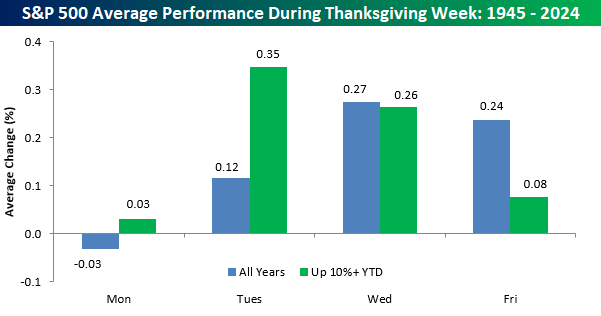
Looking at day-to-day returns, the chart below shows the S&P 500’s average performance during each day of Thanksgiving week for all years since 1945 and years when the S&P 500 was up 10%+ YTD. For all years since 1945, the strongest days of the week have been Wednesday and Friday (maybe you want to reconsider taking Friday off!), but in years when the S&P 500 was already up by double-digits, Tuesday and Wednesday were the best days of the week. One constant trend for Thanksgiving week? Monday was the weakest in terms of performance for all years and just years when the S&P 500 was already up 10%. What would you expect for a Monday?
Brunch Reads – 11/23/25
Welcome to Bespoke Brunch Reads — a linkfest of some of our favorite articles over the past week. The links are mostly market-related, but there are some other interesting subjects covered as well. We hope you enjoy the food for thought as a supplement to the research we provide you during the week.
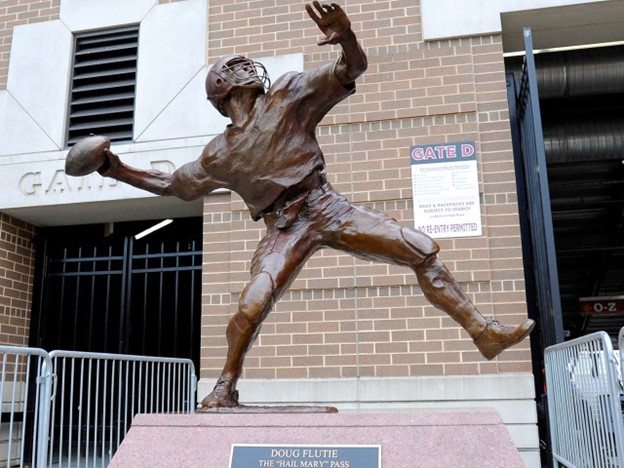
A Hail Mary on the Hurricanes: On November 23, 1984, Doug Flutie etched his name into college football history books with a single throw. Boston College was locked in a Thanksgiving-week shootout against the Miami Hurricanes, a national powerhouse. BC trailed 45–41 in the final moments of the fourth quarter, sitting 48 yards from the end zone with time for one last snap. Everyone in the Orange Bowl expected a desperation heave.
Flutie took the snap, scrambled back against a strong Miami rush, and uncorked a Hail Mary that traveled more than 60 yards in the air, dropping just behind two defenders into the waiting arms of wide receiver Gerard Phelan, Flutie’s roommate and closest friend on the team. Touchdown. Ballgame. Instant legend.
It changed Flutie’s life and solidified his Heisman trophy bid. It also gave Boston College one of the most iconic moments in its sports history. For a program without many national headlines, the Miracle in Miami became a forever highlight.
Click the image below to watch the clip on YouTube.
AI & Technology
He’s Been Right About AI for 40 Years. Now He Thinks Everyone Is Wrong. (WSJ)
Yann LeCun, one of AI’s most influential researchers, is drifting away from Meta as the company doubles down on large language models he thinks are a dead end. He’s been open about his belief that future AI will come from “world models” that learn through perception, not text prediction, and he’s been laying the groundwork for a startup built around that idea. Inside Meta, his old research group has lost influence while newer teams chase rapid, product-focused breakthroughs. [Link]
Continue reading our weekly Brunch Reads linkfest by logging in if you’re already a member or signing up for a trial to one of our two membership levels shown below! You can cancel at any time.

The Bespoke Report – Marty Zweig’s Rules – 11/21/25
To read our weekly Bespoke Report newsletter and access everything else Bespoke’s research platform offers, start a two-week trial to Bespoke Premium.
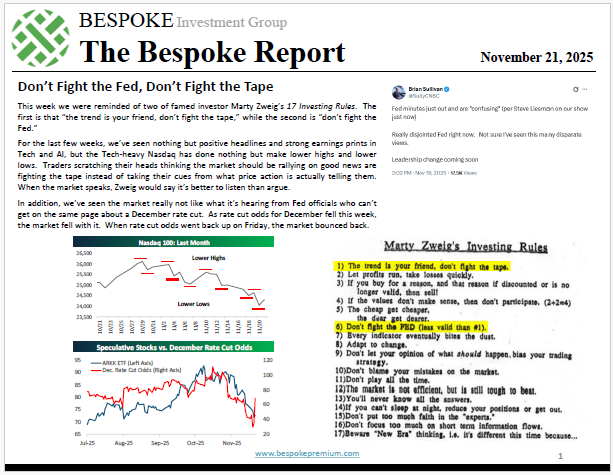
Two of famous investor Marty Zweig’s Investing Rules are “don’t fight the tape” and “don’t fight the Fed.” Both of these rules came into focus this week, which we cover in detail in this week’s Bespoke Report newsletter. Give the full report a read by starting a trial here.
Tracking Data Center Debt
Bespoke applies a cross-asset perspective to understanding financial markets and the economy. Below is one example published last week looking at the issuance of data center-backed securitizations and how they differ from the mortgage securitizations that drove the subprime meltdown and the Global Financial Crisis.
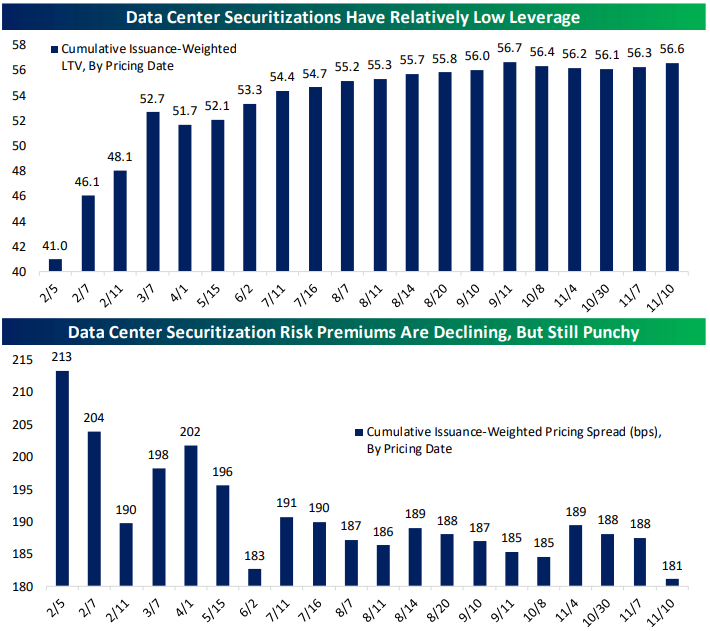
One common way that data centers borrow is via the asset-backed securities market. 26 of these deals have priced this year, but they’re relatively small in the grand scheme of things: just $17.5bn of face value. That’s two orders of magnitude smaller than investment grade corporate bond issuance. It’s also noteworthy that they’re relatively low leverage, with an LTV only slightly above 50 on a weighted average basis. The combination of ample current cashflows and modest leverage means this debt can absorb a lot of decline in data center demand without leading to defaults. To be sure, risk premiums aren’t huge, but these deals all priced at spreads significantly wider than, for instance, where Oracle (ORCL) spreads sit. In other words, this securitization is much smaller and priced more conservatively than subprime MBS ever were.
To be clear, there are absolutely credit risks swirling in the data center and AI infrastructure universe. The extreme complexity of the Beignet transaction is a good example. Meta (META) is forming a joint venture with funds controlled by Blue Owl (OWL) that also receive debt funding from PIMCO funds (via the RPLDCI 6.581 05/30/49 bond which is the single largest-ever corporate bond issue). That bond amortizes over time based on cash flows from META itself, which serves as a development partner, cross-guarantor, and tenant of the completed data center. That allows what amounts to debt financing (with some de-risking via the JV with OWL funds) without an impact on the META parent credit rating. These sorts of complex transactions aren’t necessarily a sign of bad things to come, but they do indicate risk.
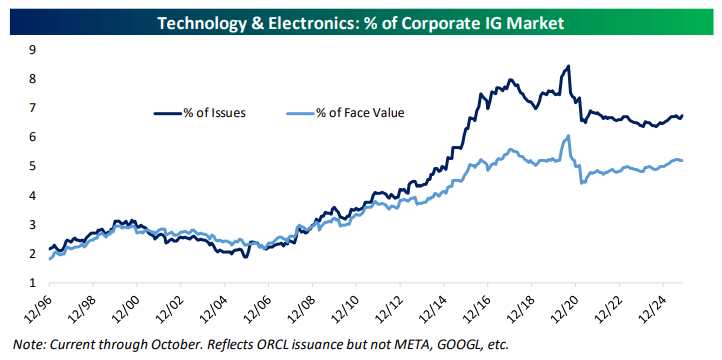
Looking at the IG bond market, we just haven’t seen the sort of sustained debt binge that is the hallmark of historical, financial system-threatening blow-ups like the subprime mortgage debacle was. That’s evidenced by relatively low Tech share of IG credit outstanding, or the relatively modest size of data centers in securitized transactions. If the AI trade does melt away and leave an investment bust, a debt crisis looks relatively unlikely without years more extreme investment rates funded by debt.

Bespoke’s Morning Lineup – 11/21/25 – Looking to Regroup
See what’s driving market performance around the world in today’s Morning Lineup. Bespoke’s Morning Lineup is the best way to start your trading day. Read it now by starting a two-week trial to Bespoke Premium. CLICK HERE to learn more and start your trial.
“To expect the unexpected shows a thoroughly modern intellect.” – Oscar Wilde
Below is a snippet of commentary from today’s Morning Lineup. Start a two-week trial to Bespoke Premium to view the full report.
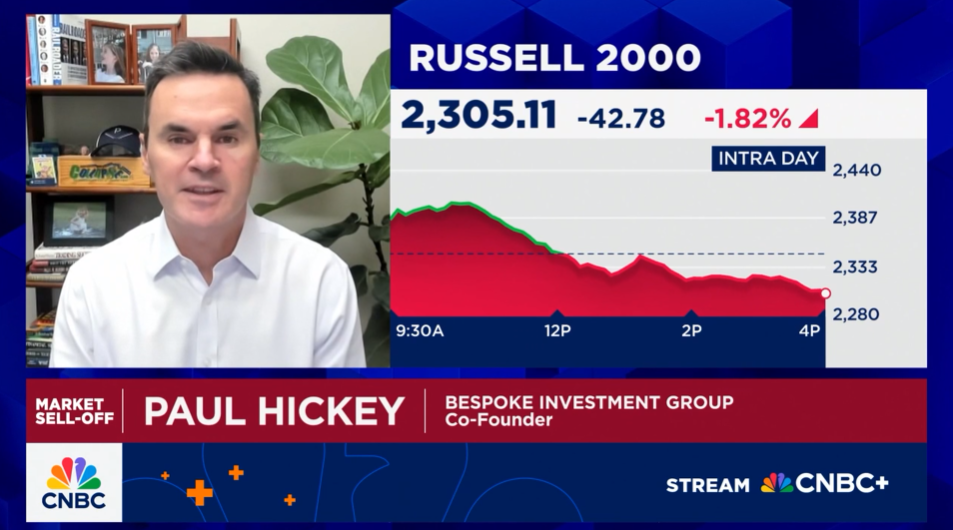
To view yesterday’s CNBC segment discussing yesterday’s sell-off and Nasdaq 5% pullbacks, in general, click on the image below.
After trading lower overnight, equity futures are higher across the board this morning following comments from New York Fed President John Williams, who says the Fed has room to lower rates in the short-term as weakness in the labor market poses a bigger risk than inflation. In response, S&P 500 futures are up 0.5% while Nasdaq futures are up slightly less. For both indices, the rebound is nowhere near enough to make up for yesterday’s declines, let alone getting us anywhere near the intraday highs from less than 24 hours ago.
Crude oil and 10-year yields are both lower, gold is basically flat, and crypto is seeing steep losses with Bitcoin and Ether both down about 4% while less ‘blue-chip’ coins in the space are down even more.
After yesterday’s weakness, it should come as no surprise that Asian stocks were creamed overnight, putting them all deep in the red for the week. European stocks are also lower, but not by the same degree, as the STOXX 600 is down 0.8%, but all major indices on the continent are on pace for weekly losses of at least 2%.
What started out yesterday as a Dr. Jekyll moment yesterday quickly turned into a Mr. Hyde event as the S&P 500, led by tech, turned a gain of nearly 2% into a decline of over 1.5%. Bulls started off the day strutting their stuff, got a little nervous as they headed out to lunch, and then came back ready to throw up.
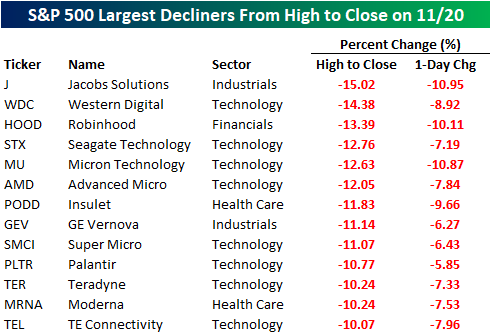
Within the S&P 500, there were some major reversals. 13 stocks in the index closed more than 10% lower than their intraday high, which is nearly unheard of for large-cap stocks unless there’s a stock-specific event causing the move. Looking at the list of the biggest intraday reversals, not only were eight of them from the Technology sector, but most of the ones that aren’t were still AI-adjacent stocks.
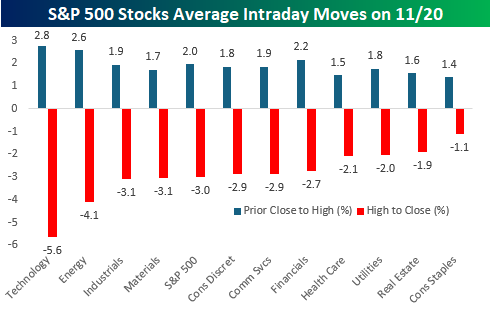
While tech led the reversal, it wasn’t solely about Tech. Within the S&P 500, 420 stocks traded down from the open to close, and the average stock in the S&P 500 finished the day down more than 3% from its intraday high. The chart below shows the average change of individual stocks yesterday from Wednesday’s close through the intraday high and then the intraday high to the close.
Tech stocks rallied the most initially, with an average gain of 2.8% and then reversed an average of 5.6% from the open to close. Besides Technology, though, the only two sectors where the average decline from the intraday high to the close was less than 2% were Consumer Staples (-1.1%) and Real Estate (-1.9%). In three sectors besides Technology (Energy, Industrials, and Materials), the average decline was more than 3%. So, again, Tech led the way but it had plenty of company.
The Closer – Reversals and Rejections – 11/20/25
Log-in here if you’re a member with access to the Closer.
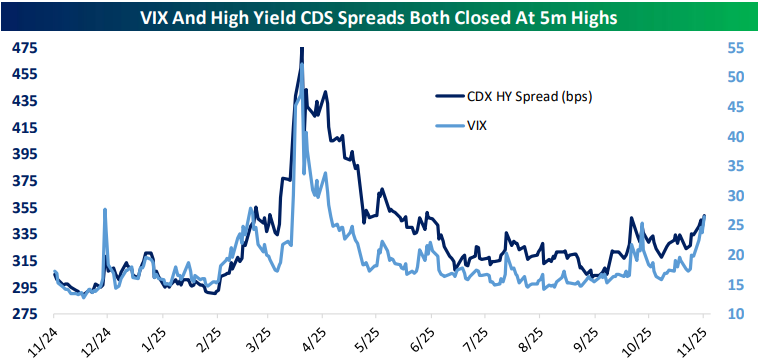
Looking for deeper insight into markets? In tonight’s Closer sent to Bespoke Institutional clients, we start with a review of the latest earnings and rise in credit spreads and the VIX (page 1). We then review the huge intraday reversals in the S&P 500 (page 2). We then finish by providing a look into the latest employment statistics (pages 3 – 5).
See today’s full post-market Closer and everything else Bespoke publishes by starting a 14-day trial to Bespoke Institutional today!
The Triple Play Report — 11/20/25
An earnings triple play is a stock that reports earnings and manages to 1) beat analyst EPS estimates, 2) beat analyst sales estimates, and 3) raise forward guidance. You can read more about “triple plays” at Investopedia.com where they’ve given Bespoke credit for popularizing the term. We like triple plays as an indication that a company’s business is firing on all cylinders, with better-than-expected results and an improving outlook. A triple play is indicative of positive “fundamental momentum” instead of pure fundamentals, and there are always plenty of names with both high and low valuations on our quarterly list.
Bespoke’s Triple Play Report highlights companies that have recently reported earnings triple plays, and it features commentary from management on triple-play conference calls, company descriptions and analysis, and price charts. Bespoke’s Triple Play Report is available at the Bespoke Institutional level only. You can sign up for Bespoke Institutional now and receive a 14-day trial to read this week’s Triple Play Report, which features 23 new stocks. To sign up, choose either the monthly or annual checkout link below:
Bespoke Institutional – Monthly Payment Plan
Bespoke Institutional – Annual Payment Plan
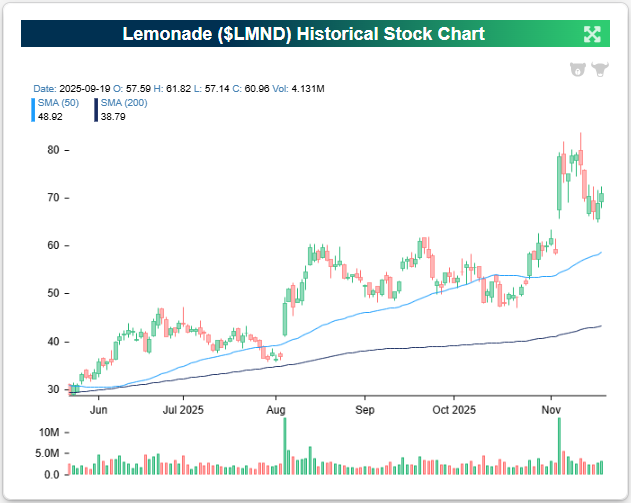
Lemonade (LMND) is an example of a company that recently reported an earnings triple play before the opening bell on 11/5. In reaction to the strong earnings results, LMND shares surged 34.2% that day. After that move, the stock hit its highest level since the summer of 2021. The stock has had a great year thus far, up 93.4% YTD.
Here’s how AI describes the company: Lemonade (LMND) is a fully digital, AI-driven insurance company that sells renters, homeowners, pet, and car policies directly through its app and website rather than through agents or legacy systems. The company’s entire model is built around automation: AI guides the majority of its marketing spend, prices policies in real time, detects risk patterns, and handles most customer support and claims without human intervention. This approach allows Lemonade to operate with a much smaller workforce than traditional insurers while providing instant quotes and often instant claim payments. Because its technology platform collects detailed customer and behavioral data, Lemonade continually updates pricing, underwriting, and fraud models, and it uses reinsurance partners to manage volatility as it grows. The long-term strategy is to use AI and automation to offer lower prices, expand into more insurance categories, and eventually compete at scale with the largest consumer insurers in the market.
Lemonade delivered one of its strongest quarters to date, with a total book of insurance that reached $1.16 billion, up 30% from last year, and revenue jumped 42% to $195 million. That faster revenue growth came partly from keeping a larger share of premiums in-house instead of passing them to reinsurance partners, which means Lemonade now earns more money on each customer it already serves. Gross profit doubled to $80 million thanks to fewer claims relative to premiums and continued efficiency gains from automation. The company added more than 176,000 customers, and car insurance remained a major growth engine, rising about 40% with over half of new car policies coming from existing Lemonade users who cost little to acquire and tend to be more profitable. Europe performed especially well, growing about 170% as Lemonade expanded renters and home insurance and adjusted prices more quickly than it could in the US. The company also highlighted meaningful cost improvements from AI, including a drop in claims-handling expense to 7%, even though overall claim volume has increased.
Diving more in-depth into car insurance, Lemonade discussed a new direct integration with Tesla that lets the insurer pull driving data straight from Tesla vehicles, with customer permission, rather than relying on a phone app or plug-in device. This gives Lemonade far more detailed information about how the car is actually being driven, including things like seatbelt use and precise trip patterns, which helps the company price car insurance more accurately and settle claims faster. Management said this level of “car-native” data becomes increasingly important as cars take over more driving functions on their own, because insurers need to distinguish between miles driven by humans and miles handled by the vehicle’s autopilot or full self-driving systems. While Lemonade did not share updates on its goal of offering very low-cost coverage for autonomous miles, the company said this integration is a crucial building block for that future, allowing it to learn directly from Tesla’s systems and design pricing that reflects how quickly autonomy is developing.
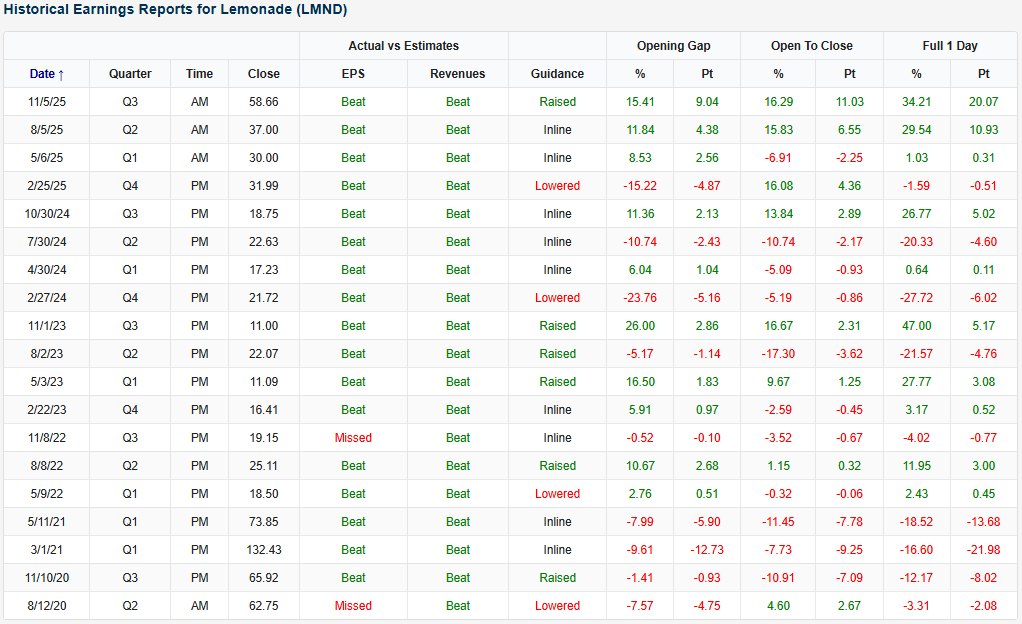
Looking at the snapshot below from our Earnings Explorer, Lemonade (LMND) has found success on earnings since it’s 2020 IPO. The company has beaten EPS and revenue estimates 89% and 100% of the time, respectively, with a running twelve straight quarters of top and bottom-line beats. Despite that consistency, the most recent report was LMND’s first triple play since a back-to-back-to-back string of them back in 2023. The moves for the stock in reaction to earnings have been somewhat of a mixed bag when looking back. After struggling in the first year after becoming a publicly traded company, the stock has seen some very positive, and very negative moves following earnings releases. The company’s last two reports, though, have been overwhelmingly positive in terms of how the stock has rallied.
You can read more about LMND and the 22 other triple plays we covered in our newest report by starting a Bespoke Institutional trial today.
Bespoke Investment Group, LLC believes all information contained in these reports to be accurate, but we do not guarantee its accuracy. None of the information in these reports or any opinions expressed constitutes a solicitation of the purchase or sale of any securities or commodities. This is not personalized advice. Investors should do their own research and/or work with an investment professional when making portfolio decisions. As always, past performance of any investment is not a guarantee of future results. Bespoke representatives or clients may have positions in securities discussed or mentioned in its published content.