
The Triple Play Report: 2/25/26
An earnings triple play is a stock that reports earnings and manages to 1) beat analyst EPS estimates, 2) beat analyst sales estimates, and 3) raise forward guidance. You can read more about “triple plays” at Investopedia.com where they’ve given Bespoke credit for popularizing the term. We like triple plays as an indication that a company’s business is firing on all cylinders, with better-than-expected results and an improving outlook. A triple play is indicative of positive “fundamental momentum” instead of pure fundamentals, and there are always plenty of names with both high and low valuations on our quarterly list.
Bespoke’s Triple Play Report covers what each company does, what this quarter’s results say about their growth outlooks, and their histories of delivering triple plays. Bespoke’s Triple Play Report is available at the Bespoke Institutional level only. You can sign up for Bespoke Institutional now and receive a 14-day trial to read today’s Triple Play Report. To sign up, choose either the monthly or annual checkout link below:
Bespoke Institutional – Monthly Payment Plan
Bespoke Institutional – Annual Payment Plan
Bespoke Investment Group, LLC believes all information contained in these reports to be accurate, but we do not guarantee its accuracy. None of the information in these reports or any opinions expressed constitutes a solicitation of the purchase or sale of any securities or commodities. This is not personalized advice. Investors should do their own research and/or work with an investment professional when making portfolio decisions. As always, past performance of any investment is not a guarantee of future results. Bespoke representatives or clients may have positions in securities discussed or mentioned in its published content.
NVDA Down Again on Earnings; AI Mentions Also Down
NVIDIA (NVDA) is down 5% today following yet another earnings triple play after the close yesterday. Barring a massive turnaround in the last hour of trading, this will be the seventh straight quarter where NVDA shares fell from the open to the close of trading on the day after it reports earnings.
Below is a snapshot of NVDA quarterly earnings versus estimates since ChatGPT’s release at the end of 2022. Out of 13 total quarterly reports, NVDA has reported ten triple plays (beat EPS, beat sales, raised guidance).
In its first six earnings reports following the release of ChatGPT, NVDA shares averaged a one-day gain of 10% on its earnings reaction day. Following its last seven reports, though, shares have averaged a decline of 3% for an overall average of 3.2%.

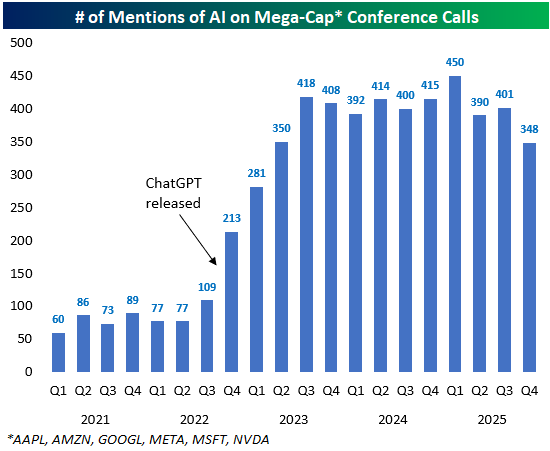
Now that NVDA has reported and completed its conference call, we can update our chart of “AI” mentions from the mega-cap hyperscalers this earnings season. Across the conference calls of Apple (AAPL), Amazon (AMZN), Alphabet (GOOGL), Meta (META), Microsoft (MSFT), and NVIDIA (NVDA), “AI” was mentioned 348 times this quarter. As shown below, that’s down quite a bit from the 401 “AI” mentions last quarter, and it’s 102 fewer than the peak “AI” reached during the Q1 2025 earnings season.
Below is a breakdown of “AI” mentions by stock going back to 2001.
This quarter, Amazon (AMZN) and Apple (AAPL) were the only two that mentioned “AI” more on conference calls, with AMZN mentioning it a record 61 times.
META mentioned AI just 45 times, the lowest since Q4 2023, while NVDA’s 82 mentions was the lowest since the last earnings season before ChatGPT’s release!


Bespoke’s Morning Lineup – 2/26/26 – To the Moon!
See what’s driving market performance around the world in today’s Morning Lineup. Bespoke’s Morning Lineup is the best way to start your trading day. Read it now by starting a two-week trial to Bespoke Premium. CLICK HERE to learn more and start your trial.
“Bang! Zoom! To the moon, Alice!” – Jackie Gleason

Below is a snippet of commentary from today’s Morning Lineup. Start a two-week trial to Bespoke Premium to view the full report.
Equity futures have moved fractionally into positive territory off their overnight lows as shares of Nvidia (NVDA) turned positive with a gain of nearly 1%. The 10-year yield is down 1 bps to 4.04% while crude oil trades down 2% to $64 per barrel. Gold prices are also down by about 0.5%, while silver plunges nearly 5% and Bitcoin drops over 1% to just over $68K.
Asia was mostly positive overnight. The Nikkei finished higher by a modest 0.3%, and Hong Kong declined more than 1%. South Korean stocks, however, continued to surge as the KOSPI rallied 3.7%, taking its YTD gain to 49.7%! Nearly 50%! Japanese PM Takaichi nominated two dovish candidates for roles within the BoJ, and the yen is weakening as markets now price the odds of a rate hike in April down to just 50%. This comes even as Leading Indicators in Japan came in better than expected.
European stocks are positive again this morning, with the STOXX 600 up 0.2%, with France’s 0.9% gain leading the way higher. February Business and Consumer Confidence unexpectedly declined, although Confidence in Italy bounced.
In the US this morning, the only reports on the calendar are Jobless Claims at 8:30, followed by the KC Fed Manufacturing report at 11. At 10 AM Eastern, Fed Governor Bowman will also testify in front of a Senate panel.
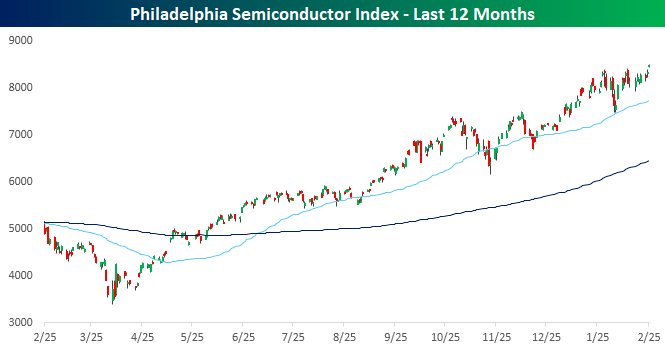
Jackie Gleason, best known as the hot-tempered bus driver Ralph Kramden from the 1950s sitcom The Honeymooners, would have turned 110 years old today. Ralph’s most iconic line from the show was “To the moon, Alice”, and that’s the way things seem to be going for semiconductor stocks. While Nvidia’s (NVDA) stock price, despite surging profits and revenues, has been rangebound for months now, the Philadelphia Semiconductor Index (SOX) hit another record high yesterday, taking its YTD gain to just under 20%.
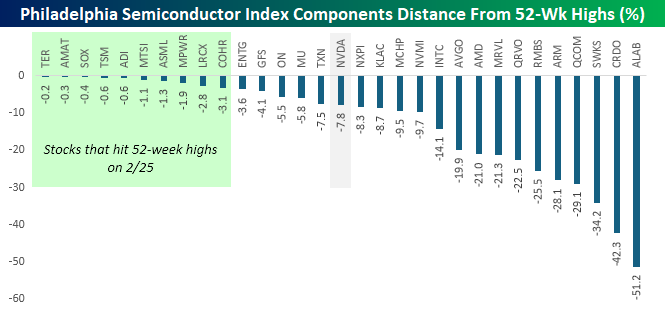
Along with the index itself, breadth in the sector has also been strong. Yesterday alone, nine of the index’s 30 components hit 52-week highs, even as NVDA closed nearly 8% below its respective high.
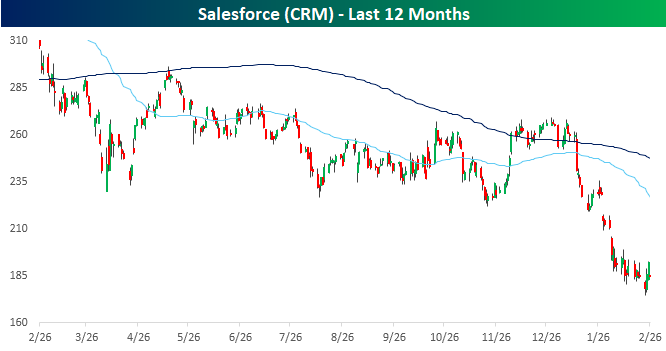
While semis have been strong, software stocks continue to try digging out from the AI-pocalypse. The latest setback for the sector was earnings from Salesforce (CRM) last night. CRM exceeded EPS forecasts on inline revenues. Guidance was mixed with the company raising Q1 EPS forecasts while keeping full-year forecasts in line with expectations. Despite a somewhat positive report at the surface, CRM is down more than 2% in the pre-market.
As software stocks have been cratering in recent weeks, investors have been asking where company managements are with respect to purchasing their stocks. If the declines were a major overreaction, as CRM CEO Benioff and others say, shouldn’t they be buying back stock hand over fist?
CRM addressed that last night when the company announced a $50 bln buyback. CRM’s market cap is $180 billion, so $50 billion represents more than a quarter of the company’s entire market cap. Ideally, investors would like to see company executives putting their own actual money where their mouths are, but a $50 billion stock buyback is a step in the right direction.
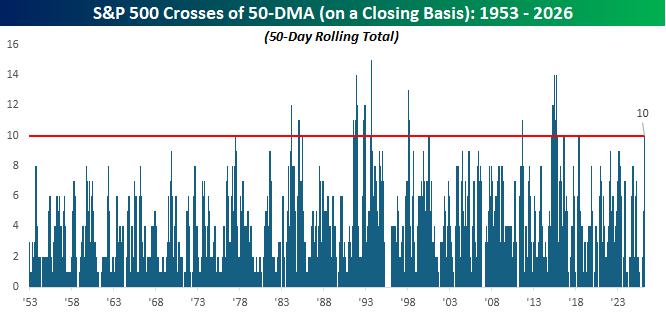
Semis and software are two of the market’s largest sectors, and each one moving in the opposite direction has contributed to the ping pong action at the overall index level. As we noted on X yesterday, the S&P 500 has now crossed its 50-day moving average on a closing basis ten times in the last 50 trading days. That’s the longest streak since March 2018 and one of only a handful of periods with that many crosses in such a short period of time. As we’ve all said to someone close to us multiple times, make up your mind already!
The Closer – Factors and Baskets – 2/25/26
Log-in here if you’re a member with access to the Closer.
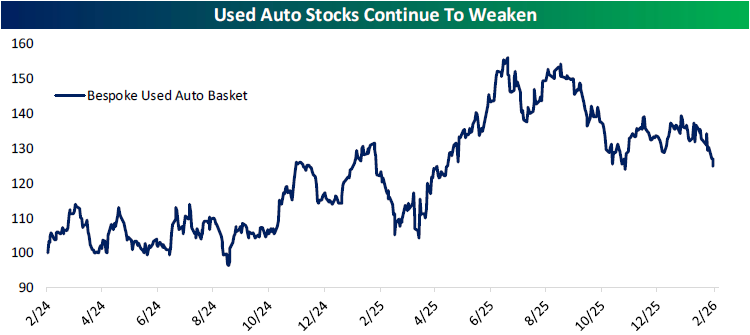
Looking for deeper insight into markets? In tonight’s Closer sent to Bespoke Institutional clients, we provide a rundown for a number of thematic moves recently including the relationships between growth, value, and momentum (page 1). We also show the performance of baskets like AI Picks and Shovels, Durable Goods, Autos, and more (pages 2-4).
See today’s full post-market Closer and everything else Bespoke publishes by starting a 14-day trial to Bespoke Institutional today!
Q4 2025 Earnings Conference Call Recaps: Lowe’s (LOW)
Bespoke’s Conference Call Recaps use AI to summarize lengthy earnings calls. The commentary below is AI-generated and then edited by Bespoke for quality control. As always, none of these summaries should be construed as recommendations to buy or sell any securities, and investors should do their own research and/or consult with a financial professional before making any investment decisions.
Our latest recap available to Bespoke subscribers covers Lowe’s (LOW) Q4 2025 earnings call.
Lowe’s (LOW) is the second-largest home improvement retailer in the world, operating approximately 1,700 stores across the United States. The company serves both do-it-yourself homeowners and professional contractors, offering everything from appliances and building materials to installation services. Lowe’s delivered Q4 comparable sales growth of 1.3% and full-year sales of $86.3 billion, but management struck a cautious tone for 2026, guiding comparable sales of flat to up 2% against a home improvement market they expect to be roughly flat. The central headwind remains elevated mortgage rates and the lock-in effect, suppressing housing turnover, though rates briefly dipped below 6% this week. Big-ticket discretionary DIY spending continues to be deferred. Pro customer growth was a standout, with the Pro extended aisle exceeding expectations and new AI-powered tools improving sales interactions. LOW shares fell as much as 5.7% on 1/25 despite beating EPS and revenue estimates…
Continue reading our Conference Call Recap for LOW by becoming a Bespoke Institutional subscriber. You can sign up for Bespoke Institutional now and receive a 14-day trial to read our newest Conference Call Recap. To sign up, choose either the monthly or annual checkout link below:
Q4 2025 Earnings Conference Call Recaps: CAVA (CAVA)
Bespoke’s Conference Call Recaps use AI to summarize lengthy earnings calls. The commentary below is AI-generated and then edited by Bespoke for quality control. As always, none of these summaries should be construed as recommendations to buy or sell any securities, and investors should do their own research and/or consult with a financial professional before making any investment decisions.
Our latest recap available to Bespoke subscribers covers CAVA’s (CAVA) Q4 2025 earnings call.

CAVA (CAVA) is a fast-casual Mediterranean restaurant chain that has become a category leader, serving customizable bowls, salads, and pitas. With 439 locations across 28 states at year-end 2025, the company crossed $1 billion in annual revenue for the first time and is targeting at least 1,000 restaurants by 2032. CAVA delivered 22.5% full-year revenue growth and 4% same-restaurant sales growth in 2025, though Q4 comps slowed to 0.5%. Management guided 2026 same-restaurant sales of 3%–5%, noting Q1 is tracking above that range but embedding macro caution for the balance of the year. CAVA raised menu prices just 1.4% in January, kept its base bowl price unchanged, and has consistently taken far less pricing than competitors, underpricing inflation by over 10% in recent years. The company is launching pomegranate-glazed salmon, its first seafood protein, which tested better than chicken shawarma but carries a roughly 100bp margin headwind. Tariffs contributed to a 50bps food cost increase in Q4. After posting better-than-expected results, CAVA shares were up 24% on 2/25…
Continue reading our Conference Call Recap for CAVA by becoming a Bespoke Institutional subscriber. You can sign up for Bespoke Institutional now and receive a 14-day trial to read our newest Conference Call Recap. To sign up, choose either the monthly or annual checkout link below:
The Triple Play Report: 2/24/26
An earnings triple play is a stock that reports earnings and manages to 1) beat analyst EPS estimates, 2) beat analyst sales estimates, and 3) raise forward guidance. You can read more about “triple plays” at Investopedia.com where they’ve given Bespoke credit for popularizing the term. We like triple plays as an indication that a company’s business is firing on all cylinders, with better-than-expected results and an improving outlook. A triple play is indicative of positive “fundamental momentum” instead of pure fundamentals, and there are always plenty of names with both high and low valuations on our quarterly list.
Bespoke’s Triple Play Report covers what each company does, what this quarter’s results say about their growth outlooks, and their histories of delivering triple plays. Bespoke’s Triple Play Report is available at the Bespoke Institutional level only. You can sign up for Bespoke Institutional now and receive a 14-day trial to read today’s Triple Play Report. To sign up, choose either the monthly or annual checkout link below:
Bespoke Institutional – Monthly Payment Plan
Bespoke Institutional – Annual Payment Plan
Bespoke Investment Group, LLC believes all information contained in these reports to be accurate, but we do not guarantee its accuracy. None of the information in these reports or any opinions expressed constitutes a solicitation of the purchase or sale of any securities or commodities. This is not personalized advice. Investors should do their own research and/or work with an investment professional when making portfolio decisions. As always, past performance of any investment is not a guarantee of future results. Bespoke representatives or clients may have positions in securities discussed or mentioned in its published content.
Bespoke’s Morning Lineup – 2/25/26 – Stuck to the 50-DMA
See what’s driving market performance around the world in today’s Morning Lineup. Bespoke’s Morning Lineup is the best way to start your trading day. Read it now by starting a two-week trial to Bespoke Premium. CLICK HERE to learn more and start your trial.
“To devastate is easier and more spectacular than to create.” – Anthony Burgess
Below is a snippet of commentary from today’s Morning Lineup. Start a two-week trial to Bespoke Premium to view the full report.
Equity markets are looking to build on yesterday’s turnaround Tuesday gains and are on pace to erase much of Monday’s losses, but whether these gains stick through the end of the week could depend on Nvidia’s (NVDA) report after the close. It’s widely assumed that the results will be strong, but will they be strong enough? And ff they’re too strong, will that also be interpreted as further future disruption in the software space?
Crude oil is higher this morning, trading just above $66 per barrel, even as Reuters reports that OPEC+ is considering a 137K barrel increase to daily production. Gold is also fractionally higher, back above $5,200 per ounce as silver surges 4% and platinum spikes 8%. Even bitcoin, yes bitcoin, is higher by more than 2%.
Asian stocks finished the day higher across the board, with the Nikkei up over 2% and South Korea up just under 2%. Chinese stocks also traded higher even as the Ministry of Commerce threatened to impose countertrade measures in response to the new tariff policies of the Trump Administration.
In Europe, stocks are also broadly higher but at a more restrained pace. The STOXX 600 is up 0.5%, led higher by 1% gains in Italy and the UK. Eurozone GDP fell more than expected (-0.6% vs -0.5% forecast) and German GDP was in line with expectations, growing 0.3% q/q.
Besides some important earnings reports after the close from NVDA and Salesforce (CRM), it’s a quiet day for data, but we will hear from many Fed speakers, including Barkin, Schmid, and Musalem.
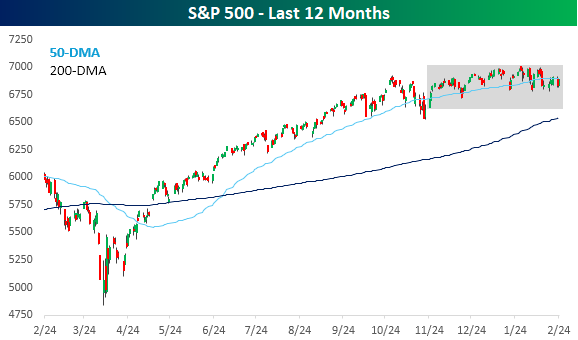
Given the ongoing weakness we have seen in certain areas of the market, which investors now think will be devastated by AI, it’s still hard to believe how range-bound the S&P 500 has been. Yesterday, the S&P 500 closed less than 0.1% below its 50-day moving average. You can’t get much closer than that! And it wasn’t just yesterday. The rangebound morass has been going on for months now, as there hasn’t been a day in the last three months where the S&P 500 closed more than 2.5% above or below its 50-day moving average.
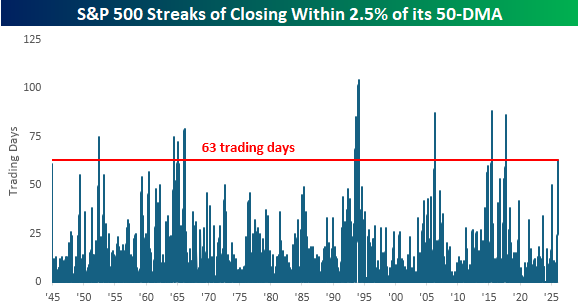
Periods where the S&P 500 has been so closely anchored to its 50-DMA haven’t been all that common throughout history. The chart below shows streaks when the S&P 500 closed within 2.5% of its 50-DMA (above or below), and the current streak, which reached three months (63 trading days) yesterday, is the longest since the first Trump administration in August 2017. Since WWII, there haven’t been many other extended periods where price was consistently so close to its 50-DMA.
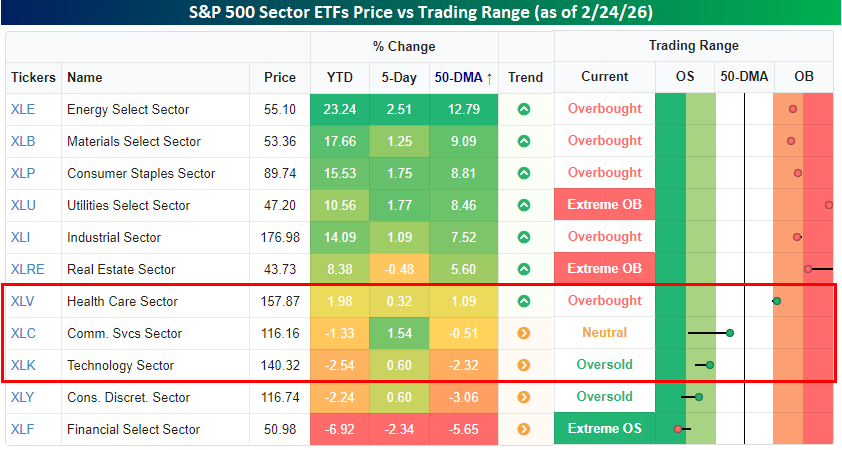
What makes the current streak even more incredible is that most sectors haven’t been showing the same pattern. As of yesterday’s close, just three of eleven S&P 500 sector ETFs – Health Care (XLV), Communication Services (XLC), and Technology (XLK) – closed within 2.5% of their 50-DMAs, and most sectors aren’t even close. Six are more than 5% above their 50-DMAs, and another is more than 5% below its 50-DMA. Like a sleeping volcano, the S&P 500 looks placid from above, but underground, the molten lava bubbles.
The Closer – AI Doom, ADP, Earnings – 2/24/26
Log-in here if you’re a member with access to the Closer.
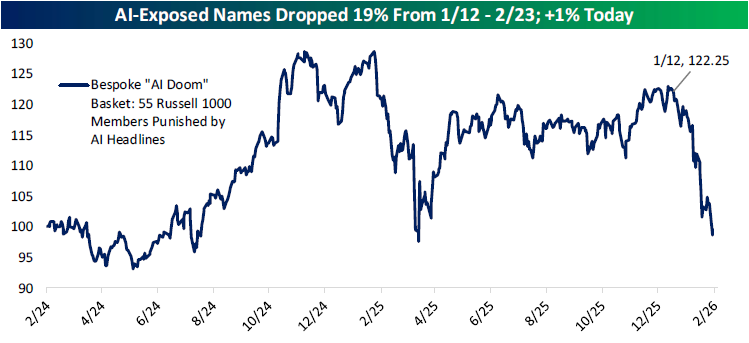
Looking for deeper insight into markets? In tonight’s Closer sent to Bespoke Institutional clients, we kick off with a review of the latest Fedspeak in addition to all the further pain in software names (pages 1 – 3). Next up, we show where some outperformers were today in addition to an update on regional Fed indices (page 4). After that, we provide a review of the latest positioning data (pages 5 & 6).
See today’s full post-market Closer and everything else Bespoke publishes by starting a 14-day trial to Bespoke Institutional today!
The Triple Play Report: 2/23/26
An earnings triple play is a stock that reports earnings and manages to 1) beat analyst EPS estimates, 2) beat analyst sales estimates, and 3) raise forward guidance. You can read more about “triple plays” at Investopedia.com where they’ve given Bespoke credit for popularizing the term. We like triple plays as an indication that a company’s business is firing on all cylinders, with better-than-expected results and an improving outlook. A triple play is indicative of positive “fundamental momentum” instead of pure fundamentals, and there are always plenty of names with both high and low valuations on our quarterly list.
Bespoke’s Triple Play Report covers what each company does, what this quarter’s results say about their growth outlooks, and their histories of delivering triple plays. Bespoke’s Triple Play Report is available at the Bespoke Institutional level only. You can sign up for Bespoke Institutional now and receive a 14-day trial to read today’s Triple Play Report. To sign up, choose either the monthly or annual checkout link below:
Bespoke Institutional – Monthly Payment Plan
Bespoke Institutional – Annual Payment Plan
Bespoke Investment Group, LLC believes all information contained in these reports to be accurate, but we do not guarantee its accuracy. None of the information in these reports or any opinions expressed constitutes a solicitation of the purchase or sale of any securities or commodities. This is not personalized advice. Investors should do their own research and/or work with an investment professional when making portfolio decisions. As always, past performance of any investment is not a guarantee of future results. Bespoke representatives or clients may have positions in securities discussed or mentioned in its published content.