The Closer – Steepener, GSEs, Silver Superlatives – 1/12/26
Log-in here if you’re a member with access to the Closer.
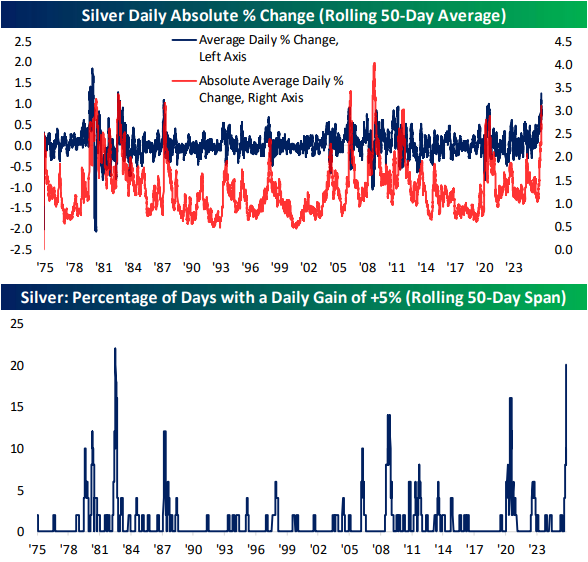
Looking for deeper insight into markets? In tonight’s Closer sent to Bespoke Institutional clients, we begin with some further commentary surrounding Powell vs. the administration and a trade idea from this situation’s impacts on the yield curve (page 1). We then jump into the recent moves in housing related areas of the market (page 2) before finishing out with a dive into some superlatives that the moves in silver have earned (page 3).
See today’s full post-market Closer and everything else Bespoke publishes by starting a 14-day trial to Bespoke Institutional today!
Bespoke’s Morning Lineup – 1/12/26 – Never a Dull Moment
See what’s driving market performance around the world in today’s Morning Lineup. Bespoke’s Morning Lineup is the best way to start your trading day. Read it now by starting a two-week trial to Bespoke Premium. CLICK HERE to learn more and start your trial.
“Maintain a firm grasp of the obvious at all times.” – Jeff Bezos

Below is a snippet of commentary from today’s Morning Lineup. Start a two-week trial to Bespoke Premium to view the full report.
As of early Sunday afternoon, it looked as though the news surrounding the anti-regime protests in Iran or the President’s call for a one-year cap on credit card interest rates at 10% would be the major news catalysts for trading to kick off the week. Then, last night, news broke that the Department of Justice had opened a criminal investigation into Federal Reserve Chair Jerome Powell related to the $2.5 billion renovation of the Federal Reserve’s headquarters. Powell responded that the investigation was “a consequence of the Federal Reserve setting interest rates based on our best assessment of what will serve the public, rather than following the preferences of the President.” He went on to add that this investigation will determine “whether the Fed will be able to continue to set interest rates based on evidence and economic conditions — or whether instead monetary policy will be directed by political pressure or intimidation.”
The President (as you would expect) denied any involvement in the investigation, and while it obviously looks political, the reality is that, provided he did nothing wrong, which we have no reason to believe he did, Powell should have nothing to worry about. The bigger question, in our mind, is who in their right mind would ever want Powell’s job? If I’m one of the Kevins, or any of the other people that prediction markets have as succeeding Powell, I’d be cheering every time my odds went down!
S&P 500 futures are down 0.5% leading up to the opening bell, while the Nasdaq is down 0.75%. Treasury yields are slightly higher, with the 10-year yield up 2 bps to 4.19%, while the dollar is lower. Crude oil is fractionally lower while gold is surging more than 2.5%. All these moves suggest a possible return of the ‘sell America’ trade; at this point, the moves are much too modest to suggest that it is a real concern.
Despite the weakness in US futures, Asian stocks kicked off the week on a positive note. While Japan was closed for a holiday, both onshore and offshore Chinese stocks were up over 1% while South Korea rallied 0.8%. India and Australia were also higher by about 0.5%. South Korea export data showed that while overall exports in the first ten days of January were down 2.3% y/y, chip exports increased over 45%!
In Europe, equities have started the week in a more muted fashion than Asia. The STOXX 600 is slightly lower, while German stocks buck the trend with a gain of 0.5%. There hasn’t been a lot of news specific to the continent this morning, but Sentix Investor Confidence for January did come in less weak than expected.
Before the Powell headlines broke yesterday, news earlier in the weekend about the President calling for a one-year cap of 10% on credit card interest rates looked like it would be the biggest news story heading into the new week. While the President can’t directly force the credit card issuers to cap interest rates, he can make life difficult for them through the bully pulpit of his Truth Social account and the various regulatory agencies that the issuers fall under the purview of.
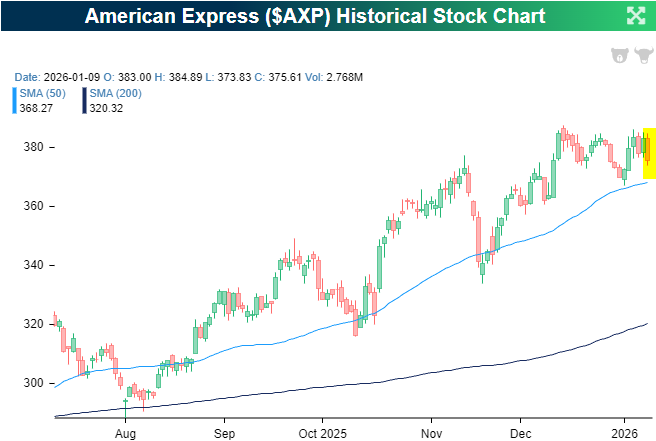
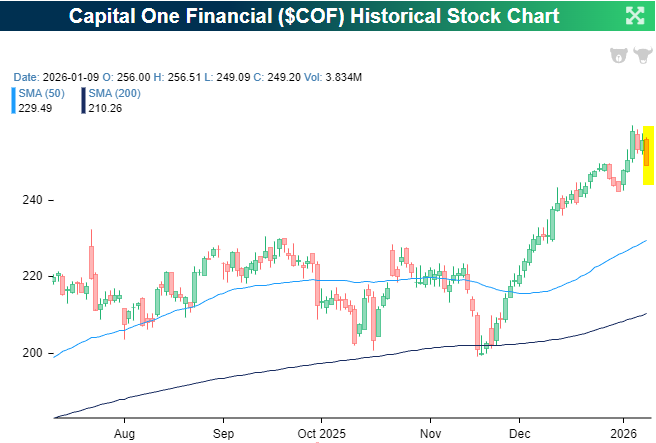
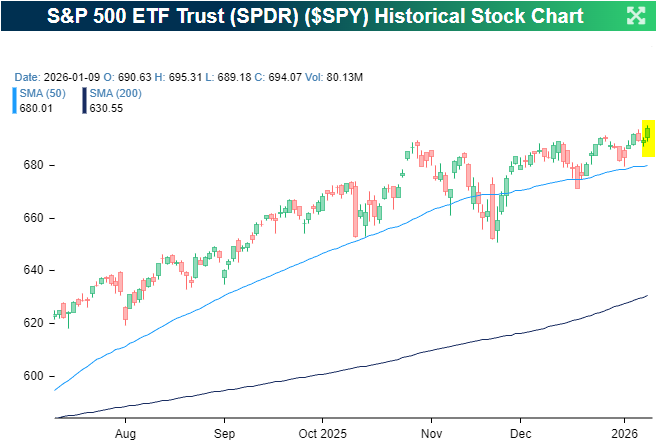
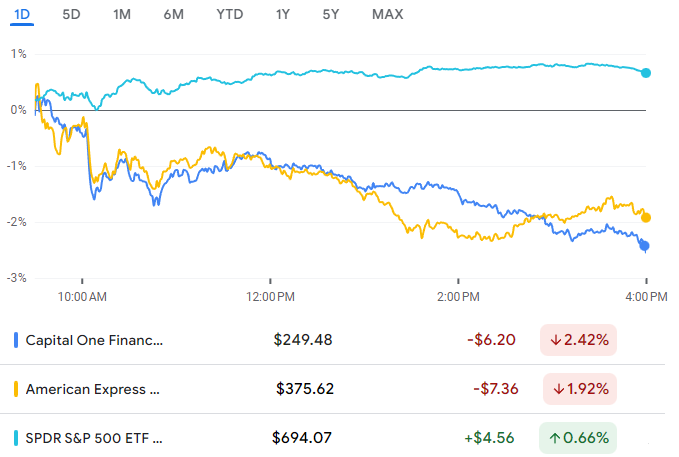
In response to the President’s comments over the weekend, American Express (AXP) and Capital One (COF), two of the biggest pure-play credit card issuers, are trading sharply lower. AXP is down over 4% while COF is down twice that, with a loss of over 8%. The Financial sector and banks, in general, are also weak today, but nowhere nearly as much as AXP or COF. The weakness in both stocks comes after they finished last week right near 52-week highs. Looking at the price charts of both stocks, though, you can see that they closed near their lows of the day last Friday (top two charts) while the S&P 500 finished the week right near its highs of the day.
The intraday performance of all three shows the divergence even more clearly. As the S&P 500 rallied intraday, both AXP and COF drifted lower all day. It’s hard to look at this chart and not think that someone knew something.
Brunch Reads – 1/11/26
Welcome to Bespoke Brunch Reads — a linkfest of some of our favorite articles over the past week. The links are mostly market-related, but there are some other interesting subjects covered as well. We hope you enjoy the food for thought as a supplement to the research we provide you during the week.
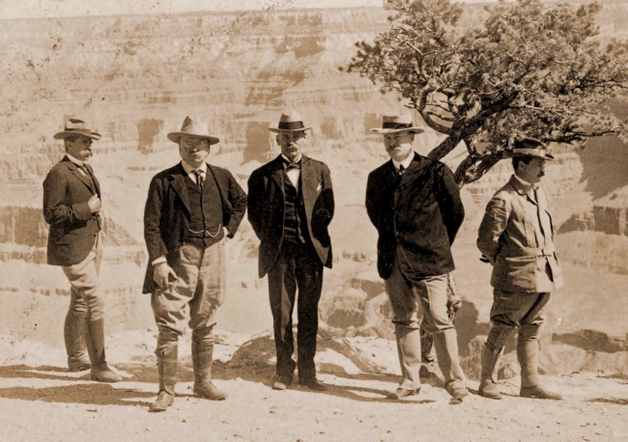
Teddy’s Territory: On January 11, 1908, Theodore Roosevelt used the Presidency to declare the Grand Canyon National Monument by executive proclamation. Roosevelt already knew the canyon well. He had visited it years earlier and famously warned Americans not to “improve” it. That meant no buildings, no fences, no gimmicks. In his mind, the canyon wasn’t scenery to be developed but rather a geological marvel carved over millions of years that no generation had the right to tamper with. When mining and commercial interests continued pressing in northern Arizona, Roosevelt decided waiting on Congress wasn’t an option.
So, he acted unilaterally, invoking the Antiquities Act of 1906, a young and largely untested law that allowed presidents to protect federal land deemed historically or scientifically important. With a single signature, Roosevelt placed more than 800,000 acres under federal protection, which was an enormous and controversial move at the time. Critics accused him of executive overreach.
The Grand Canyon’s monument status laid the groundwork for its eventual designation as a National Park in 1919, but it also proved that the Presidency could be used to defend land from permanent loss. By the time Roosevelt left office, he had protected over 230 million acres of public land, more than any President before or since.
Markets & Investing
A Mystery Trader Made $400,000 Betting on Maduro’s Downfall (WSJ)
An anonymous trader made a small fortune on Polymarket by piling into low-odds bets that Nicolás Maduro would lose power, just hours before a US military operation triggered explosions in Caracas. The timing and concentration of the wagers have fueled suspicions that nonpublic information may have been used, highlighting how prediction markets lack the guardrails that exist in traditional financial markets. [Link]
Continue reading our weekly Brunch Reads linkfest by logging in if you’re already a member or signing up for a trial to one of our two membership levels shown below! You can cancel at any time.

The Bespoke Report – 1/9/26 – Still Crazy After All These Years
To read our weekly Bespoke Report newsletter and access everything else Bespoke’s research platform offers, start a two-week trial to Bespoke Premium.
Ever since the Covid outbreak shutdown the US and global economy in early 2020, it’s been hard to look at a lot of trends and policies (especially in retrospect) and not think the world lost its mind. Even now, five years later, you can still walk into some stores and see the stickers on floors for where patrons are supposed to stand so that they keep proper distance from others. In some parts of the world, curfews were put in place after dark to help limit the spread of Covid, even though it was obviously not a nocturnal virus. Who can forget the policies early on where golf courses were closed, but liquor stores were deemed essential and could remain open (not that we thought liquor stores should be closed)? Then there were the vaccine cards which became “get out of jail” cards. If you had one, you could return to a normal life, but without one, there were significant limits in the activities you were allowed to do and where you could work.
In the financial markets and economy, Covid also caused widespread policies and trends which would have made most people dumbfounded if they occurred prior to 2020. From a fiscal standpoint, remember the multiple rounds of ‘stimmy checks’? How about the super-sized unemployment benefits which, for many people, made it more rational to stay at home and collect $600/week than it was for them to go to work? How much fraud do you think there ultimately was with the PPP loan program? From a monetary perspective, zero interest rate policies around the world and massive QE pushed interest rates on many global debt instruments below zero!
Equity markets provided no escape. Remember SPACs? How about meme stocks? GameStop (GME), the OG meme stock, can see its market cap swing by billions of dollars a day based on X-posts from “Roaring Kitty”. There’s even ETFs where the sole investment strategy is to find and invest in meme stocks.
As crazy as some of these policies were, or at least seem in hindsight, at the time some were justified, especially early on when there was so much uncertainty, and no one knew what to expect. Our point here is not to judge their necessity but just to highlight them. Five years later, we’re thankful to be back in a much more normal environment. As much as things have improved, though, we’re still quite a way from the way things were before Covid. A recent example of the markets remaining more than a little bit crazy is the insane volatility in metals and memory stocks to start 2026. Time always marches forward, so we’ll never get back to the way things were – for better or worse. The reality is that markets are made up of people, so they’ve always been and always will be a little crazy. That’s one thing that won’t change (or maybe when robots control everything, even that will change too).
For an escape, there’s always sports, or at least that’s what we thought. Then last night as we watched the Miami Hurricanes, a team that many experts argued shouldn’t have even been in the college football playoff, knock Ole Miss out and earn a spot in the championship, commentator Chris Fowler commented that Miami QB “Carson Beck is in his seventh year of eligibility”. Comments like that remind us that even in sports, Covid has left its mark, so there’s no escape. Fowler was incorrect in his comment. Carson Beck is actually “only” in his sixth year of college, but since when was a college career six years! If Miami doesn’t win the championship on January 19th will that mean, in the words of Bluto Blutarsky in Animal House, that it was “Seven Six years of college down the drain”? Maybe the market is one of the more rational escapes after all!
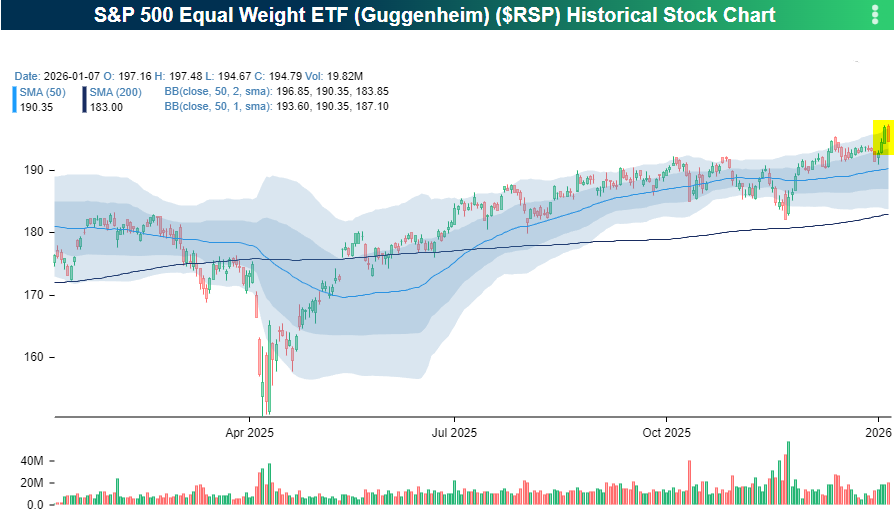
What’s also crazy is how strong of a start the market has gotten off to this year for the S&P 500, and more specifically, both the equal-weight index as well as the Russell 2000.
This week’s Bespoke Report is packed with interesting market trends, so give the full report a read by starting a trial here.
Biggest Risks to the Market?
In mid-December, we sent Bespoke’s client base a survey to capture the current thinking of experienced investors on markets, the economy, policy shifts, and portfolio positioning heading into 2026 and beyond. Last week, we published our 2026 Investor Sentiment report with a detailed summary of the survey’s results. If you aren’t currently a client, you can start a trial here to view the full report and start receiving everything else we publish on a daily basis.
A bubble in AI has been discussed over and over again across financial media over the last year or so as that area of the market saw outsized gains. But is froth in the AI trade really the biggest concern among investors heading into 2026, or are there other issues that are just as worrisome?
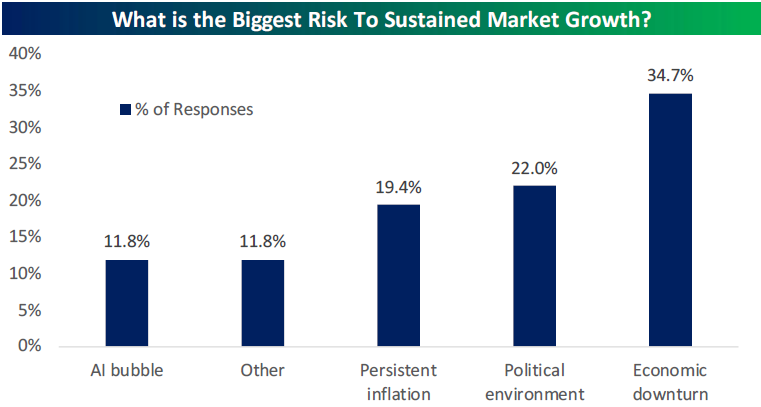
In a survey of investors (using Bespoke’s large client base) at the end of 2025, we asked participants what the biggest risk is to sustained market growth in 2026 and beyond. As shown in the chart below, an “AI bubble” actually ranked as the least concerning issue of the various options provided. The answer that received the most votes at 34.7% was actually an “economic downturn,” followed by the “political environment” at 22% and “persistent inflation” at 19.4%. “Other” received 11.8% of the vote, which was the same response rate that an “AI bubble” received.
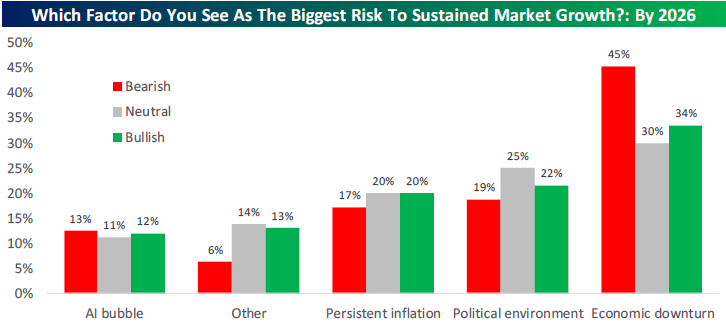
Below we’ve broken out the response rates to our question on the biggest risk to sustained market growth by whether the survey participant is bullish or bearish on the stock market in 2026.
Notably, those that are bearish on the market were even more concerned about an economic downturn at 45%.
Just this week we’ve gotten a number of releases on the US trade balance and productivity that caused the Atlanta Fed’s GDPNow reading to pop up to 5.1% for Q4 2025. If this trend continues, worries about an economic downturn are likely to subside, which could cause bears to decide to increase their risk exposure. This would likely translate into higher share prices and potentially a broadening of the bull market into areas that aren’t solely based on the AI trade.
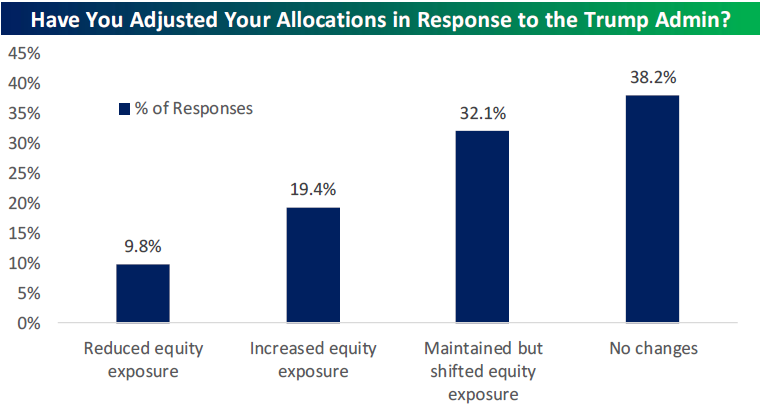
Another question we asked investors in our 2026 survey is how they have adjusted their equity allocations in response to the Trump Administration. We always urge investors to not let their politics impact their investment decisions, because historically, it would have been very unwise to try and jump in and out of the market based on who controls the White House or Congress. However, of course there are investors out there that have either gotten out of the market or increased exposure because of their opinions about President Trump.
What we found, though, is that while most investors have either made no changes or merely maintained but shifted equity exposure due to the Trump Administration, a considerably higher percentage (19.4%) said that they’ve increased equity exposure than those that said they’ve reduced exposure (9.8%). This suggests to us that regardless of whether you like Trump or not, the admin should remain a tailwind rather than a headwind for the market at least for another year or so. Again, jumping in or out of the market based on who’s President is not recommended.
Not a Bespoke client? We’d love for you to give our equity research platform, Bespoke Premium, a try. You can sign up for complimentary access for 14 days at this link to read our full 2026 Investor Sentiment report and start receiving our daily research emails today!

Trillion Dollar Market Cap Changing of the Guard
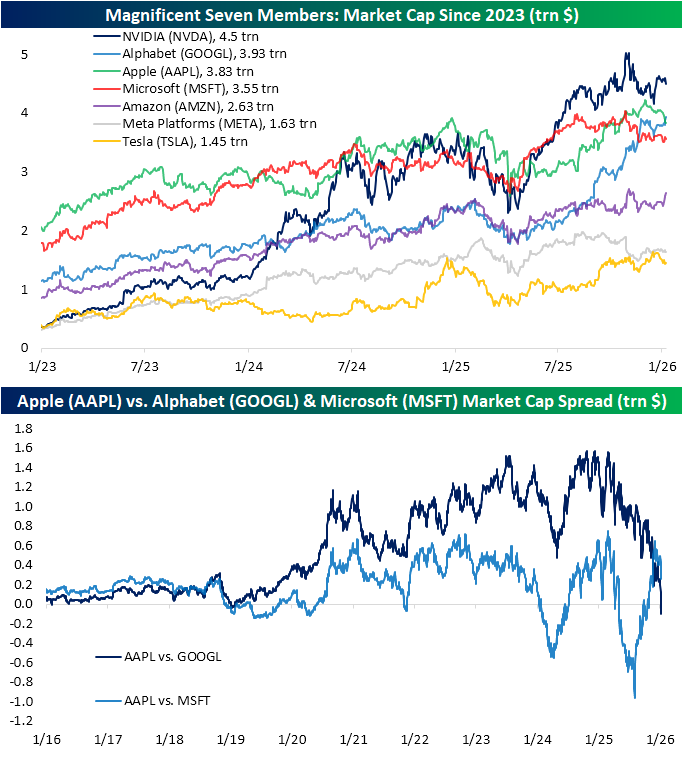
For the past several months, NVIDIA (NVDA) has held the title of the world’s largest stock by market cap. While NVDA has pulled back from a peak market cap just above $5 trillion in late October/early November to $4.5 trillion today, there’s still a significant gap versus the next largest stock: Alphabet (GOOGL).
GOOGL in the #2 spot is a new development. As shown below, it has typically been either Apple (AAPL) or Microsoft (MSFT) holding that position in recent years, however, both of those stocks have pulled back as GOOGL has pressed to new highs. As shown in the second chart below, this is the first time that AAPL is smaller than GOOGL since January 29, 2019. Additionally, we would note that AAPL is currently larger than Microsoft (MSFT), but that gap has also been narrowing. In the past several years, the two stocks have repeatedly gone back and forth for the larger market cap of the two.

Bespoke’s Morning Lineup – 1/9/26 – Here Comes the Data
See what’s driving market performance around the world in today’s Morning Lineup. Bespoke’s Morning Lineup is the best way to start your trading day. Read it now by starting a two-week trial to Bespoke Premium. CLICK HERE to learn more and start your trial.
“When the President does it, that means that it is not illegal.” – Richard Nixon
Below is a snippet of commentary from today’s Morning Lineup. Start a two-week trial to Bespoke Premium to view the full report.
Asian stocks finished the week on a positive note, and, in most cases, extended their gains for the week. Japan was up 1.6% to finish the week up 3.2%, while China was up even more as its 0.9% rally took the weekly gain to 3.8%. The real action, though, was in South Korea, where the KOSPI rallied 0.8% to finish the week up 6.4%. It’s now up an incredible 8.8% YTD and has traded higher on all six trading days this year. For some perspective on the KOSPI’s gain, it’s now up more YTD than its median annual performance!
Like Asia, European stocks are higher to close out the week, finishing an already positive week on a good note. The STOXX 600 is up 0.6% and nearly 2% on the week, while Germany is on pace to finish the week up 2.8%. Spain is the only major European country lower on the day (-0.4%), and it’s also the biggest laggard for the week. That underperformance, though, comes after it was the best-performing major country in the region last year. This morning’s strength in Germany comes after industrial production in the country unexpectedly grew 0.8% versus expectations for a decline of 0.6%.
In the US, equity futures are on hold with very modest gains ahead of a busy slate of economic data coming at 8:30 with non-farm payrolls, building permits, and housing starts. Then, at 10 AM, we’ll get an update on sentiment from UMich. We’ll also be on the lookout later today for a possible SCOTUS decision related to the Trump tariffs. The consensus view is that they will be struck down in some form, but echoing the sentiment of Richard Nixon, President Trump hopes that since he did it, the court will find the tariffs to be legal.
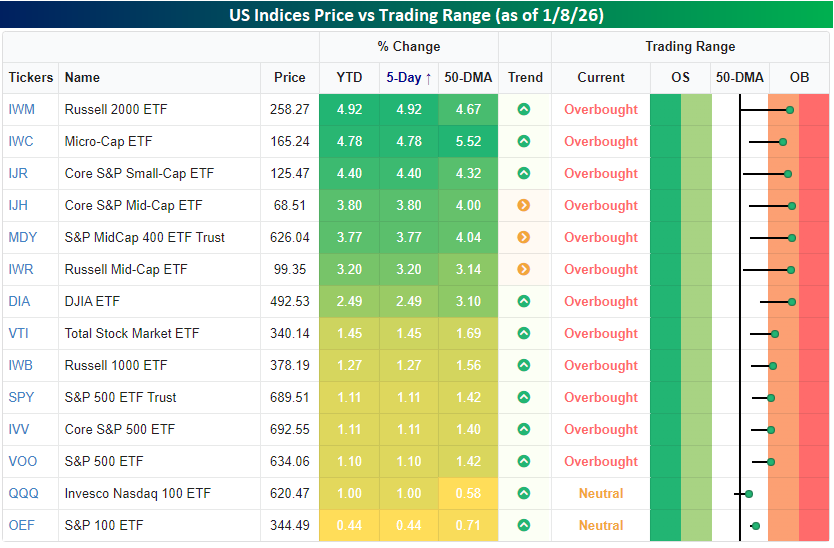
Today is a fun day when it comes to our Trend Analyzer tool, as the YTD performance numbers match the 5-day performance numbers. Interestingly enough, though, since most US indices closed out last year right near their 50-DMAs, the spreads are also very similar to the performance numbers! As things stand after the first full-week of trading, every major index ETF is up YTD, and all but two are overbought. The only outliers are the S&P 500 (OEF) and the Nasdaq 100 (QQQ). At least in the early going, 2026 isn’t the year of the Megacaps. Small caps have been the leaders early on in the year as the Russell 2000 is already up close to 5%.
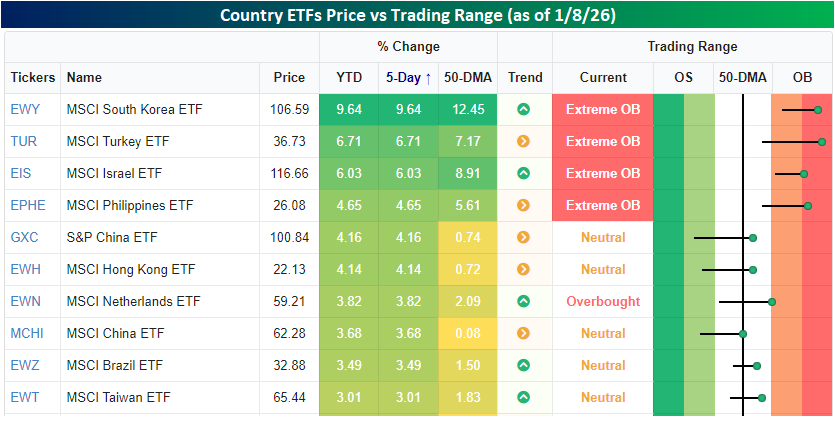
Outside of the US, the ten best country ETFs are listed in the table below. As mentioned above, South Korea has been a standout performer this year, and the MSCI South Korea ETF (EWY) is already up close to 10% YTD. Not surprisingly, the strong gains to start the year have put the ETF into extreme overbought territory, along with Turkey (TUR), Israel (EIS), and the Philippines (EPHE).
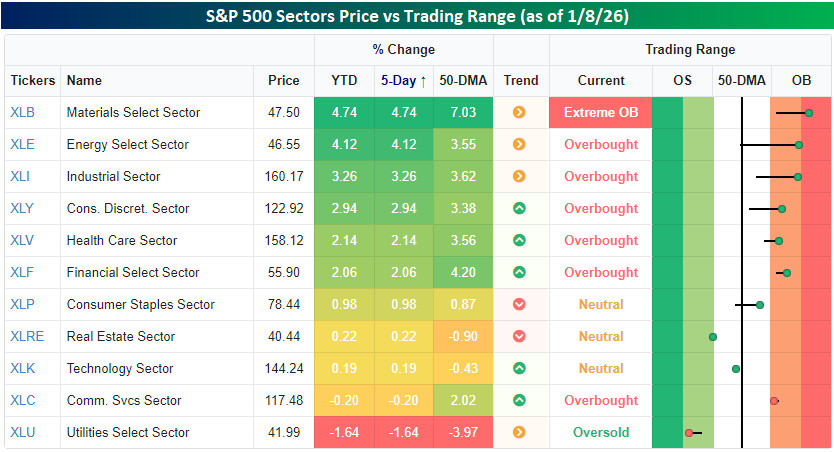
Shifting focus back to the US, this year’s rally so far has been led by commodities as Materials (XLB) and Energy (XLE) have both already rallied over 4%, followed by Industrials (XLI) and Consumer Discretionary (XLY) with gains of over 2.5%. On the downside, Utilities (XLU) have been a major laggard. After a 1.6% YTD decline, it’s the only oversold sector in the S&P 500, and one of just three sectors – Technology (XLK) and Real Estate (XLRE_ being the other two- below its 50-DMA.
The Closer – Productivity, Consumer Strength and Worry – 1/8/26
Log-in here if you’re a member with access to the Closer.
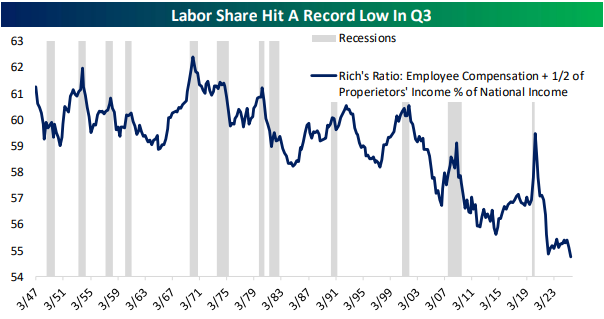
Looking for deeper insight into markets? In tonight’s Closer sent to Bespoke Institutional clients, we take an in depth dive into the unusually strong mid-cycle strength of productivity (pages 1 – 3). We then checkup on the latest trade data (pages 3 and 4) before pivoting into claims data and some corporate headlines regarding consumer strength (page 5). After that, we review the New York Fed’s Survey of Consumer Expectations (pages 6 and 7) before closing out with a rundown on some housing data from Realtor.com (pages 8 and 9).
See today’s full post-market Closer and everything else Bespoke publishes by starting a 14-day trial to Bespoke Institutional today!
Q4 2025 Earnings Conference Call Recaps: Constellation Brands (STZ)
Bespoke’s Conference Call Recaps use AI to summarize lengthy earnings calls. The commentary below is AI-generated and then edited by Bespoke for quality control. As always, none of these summaries should be construed as recommendations to buy or sell any securities, and investors should do their own research and/or consult with a financial professional before making any investment decisions.
Our latest recap available to Bespoke subscribers covers Constellation Brands’ (STZ) Q3 2026 earnings call.

Constellation Brands (STZ) is a leading US beverage alcohol company best known for its high-end imported beer, including Modelo, Corona, and Pacifico, which together make it the largest beer supplier by dollar sales in the US. The company primarily serves US consumers, with an outsized connection to Hispanic drinkers. Beyond beer, the company retains optionality through its equity stake in Canopy Growth (a Canadian cannabis company) and exposure to evolving regulatory dynamics around cannabis and alternative beverages. This quarter’s call to discuss its quarter ending 11/30 centered on margin resilience and consumer pressure. Beer operating margins beat expectations despite volume declines, helped by cost-savings initiatives, pricing actions, and a temporary depreciation benefit. Management flagged margin headwinds from higher aluminum tariffs, mix shifting further toward cans, and seasonally weaker volume. Demand remains soft, especially among Hispanic consumers, with management citing widespread socioeconomic anxiety and state-by-state volatility tied to immigration policy. Pricing remains disciplined at 1–2%, supported by value-oriented pack architecture like seven-ounce formats, while major events like the 2026 World Cup are viewed as meaningful consumption catalysts. Despite a 9.8% YoY revenue decline, EPS and revenue estimates beat expectations, sending shares as much as 6.5% higher on 1/8…
Continue reading our Conference Call Recap for STZ by becoming a Bespoke Institutional subscriber. You can sign up for Bespoke Institutional now and receive a 14-day trial to read our newest Conference Call Recap. To sign up, choose either the monthly or annual checkout link below:
Bespoke’s Morning Lineup – 1/8/26 – Another Whiff
See what’s driving market performance around the world in today’s Morning Lineup. Bespoke’s Morning Lineup is the best way to start your trading day. Read it now by starting a two-week trial to Bespoke Premium. CLICK HERE to learn more and start your trial.
“Tomorrow belongs to those who can hear it coming” – David Bowie
Below is a snippet of commentary from today’s Morning Lineup. Start a two-week trial to Bespoke Premium to view the full report.
It looks like a negative start to the Thursday session for equities, as the S&P 500 and Nasdaq both decline between 0.2% and 0.3%, while Treasury yields tick higher with the 10-year yield up to 4.16%. Oil prices bounced 1.5%, but WTI still trades below $57 per barrel. In the metals space, there’s broad-based weakness with gold down about 1%, copper down fractionally, while silver and platinum both fall 4%. After a rally to start the year that took its price over $90K, Bitcoin is back down below $90K. The only data on the economic calendar today are jobless claims at 8:30, along with Nonfarm Productivity and Unit Labor Costs at the same time.
The weakness in US futures follows a weak session in Asia, where Japan, Hong Kong, and India were all down 1%. Despite the declines, South Korea managed to outperform again, finishing unchanged on the session as Samsung Electronics reported better than expected results.
In Europe, stocks are also lower with the STOXX 600 trading down 0.4%, with Spain the only positive outlier. December Business and Consumer Confidence pulled back modestly more than expected as the headline index fell from 97.1 down to 96.7, versus forecasts for a level of 97.0.
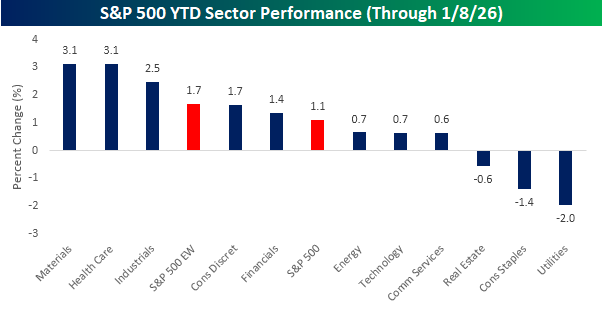
We’re four trading days into the year, and already there have been some big individual stock winners. Within the S&P 500, 22 stocks are already up over 10% YTD, while none are down 10%, and only 25 are down by 5% or more. In total, breadth in the market has been positive as 316 of the index’s 500 components are up YTD. The positive breadth is also illustrated by the fact that the equal-weight S&P 500 index is up 1.7% YTD compared to a gain of 1.1% for the cap-weighted index.
At the sector level, five are outperforming the index YTD, while six lag. Leading the way to the upside, Materials and Health Care are both up 3.1%, followed by Industrials with a gain of 2.5%. Technology’s 0.7% gain modestly trails the index, and three sectors – Utilities, Consumer Staples, and Real Estate are all down after four days of trading.
Before yesterday, breadth in the market was even stronger, but while the S&P 500 had a modest decline of 0.34%, the equal-weight index fell more than 1%. That decline also erased nearly all of what was looking like a breakout in the equal-weight index after a multi-month period of sideways trading. Every time it seems like the rally will broaden, Lucy goes in and swipes the football away.