
Bears Shrug Off a Rally
Even though the S&P 500 has moved decisively higher over the past week, sentiment has entirely shrugged off price action. The percentage of respondents reporting as bullish to the AAII’s weekly sentiment survey dropped back below 25% versus a reading of 29.3% last week. Bullish sentiment has now dropped for three straight weeks, having fallen 15.7 percentage points in that span for the largest three-week decline since August 24th. That has also resulted in the lowest bullish sentiment reading since May 18th.

That was matched with a rise in bearish sentiment back above 50%. That was the first time a majority of respondents reported as bearish since last December. As shown in the second chart below, the 44 consecutive weeks weeks without such a reading is sizeable, but far from any sort of record.


With new near-term lows in bulls and highs in bears, the spread between the two widened to 26 points in favor of bears. That is the most negative bull-bear spread reading since March

Other sentiment surveys echoed that negative tone among investors. The NAAIM Exposure Index was actually slightly higher week over week, although it continues to show low levels of long equity exposure. Meanwhile, like the AAII Bull-Bear spread, the Investors Intelligence survey also indicated the most bearish reading since March. Put together, our sentiment composite is now back below -1. That means the average sentiment reading is a full standard deviation more bearish than its historical average for the weakest reading since the first week of the year. Although current readings are rather pessimistic, due to the timing of data collection, the results would not have captured any response in sentiment following the FOMC on Wednesday. In other words, next week we will get a read if the latest updates on monetary policy had any effect on investor pessimism.


Continuing Claims Keep On Rising
Following up on yesterday’s slowing ADP and JOLTS numbers, today’s release of weekly jobless claims likewise showed a cooling labor market. Initial claims were revised up by 2K last week to 212K, and this week’s number came in higher at 217K. That was 7K above expectations which would have assumed no change to claims. With the rise over the past two weeks, claims have now rounded out a bottom but still have significant headroom until reaching the highs from earlier this year.

Before seasonal adjustment, claims were slightly higher at 196.8K. That increase is consistent with seasonal patterns as claims tend to rise throughout Q4. For example, the current week of the year has historically seen claims rise week over week 83.9% of the time; one of the most consistent weeks of increases of the year. Granted, claims are experiencing the usual seasonal increase and have bottomed after seasonal adjustment, but current levels remain historically strong. For instance, this week’s NSA number is right inline with those readings of the comparable week of the couple of years before the pandemic and 2022.

Continuing claims are a less rosy picture with a much greater and more consistent increase over the past several weeks. Since the recent low of 1.658 million put in place in early September, continuing claims have risen 9.65%. As shown below, that is certainly on the large side of historical increases in such a time span. In fact, most other times (though not always) claims have risen that rapidly, the economy has been in recession. Given that rise, seasonally adjusted continuing claims topped 1.8 million this week, which is the most elevated reading since April 15th and is only 43K below the recent high from the spring. Zooming further out, though, claims remain at historically strong levels.


Bespoke’s Morning Lineup – 11/2/23 – Was it Something He Said?
See what’s driving market performance around the world in today’s Morning Lineup. Bespoke’s Morning Lineup is the best way to start your trading day. Read it now by starting a two-week trial to Bespoke Premium. CLICK HERE to learn more and start your trial.
“Once you consent to some concession, you can never cancel it and put things back the way they are.” – Howard Hughes

Start a two-week trial to Bespoke Premium now to get full access to the Morning Lineup.
Stocks are poised to trade higher for the fourth day in a row this morning continuing the positive momentum from yesterday’s trading and a strong session in Europe. Movement in the fixed-income space is also helping as the 10-year yield drops below 4.70%. There’s still a lot of economic data to get through today, and after what has already been a busy day of earnings, there’s still a ton of reports after the close including the biggest of them all – Apple (AAPL) – after the close today. On the economic calendar, we just got a slug of data. Non-farm productivity came in higher than expected, Unit Labor Costs were lower than expected, and both initial and continuing jobless claims were higher than expected.
We’ve all become painfully aware of the typical “Powell Pattern” on Fed days where the S&P 500 finishes near its lows of the day following an afternoon swoon that seems to always take place right after the Fed President starts speaking. Yesterday, the S&P 500 went in the opposite direction as the Powell pattern was completely reversed.

When the closing bell rang yesterday, the S&P 500 tracking ETF (SPY) was up 1.07% making it the best Fed Day since July 2022 when SPY rallied 2.60%. In the nine meetings between yesterday and July 2022, SPY declined an average of 0.78% on Fed days and was only up three times.

The fact that the market finished higher on a Fed Day yesterday was surprising enough. Even more impressive though was the fact that it finished near its highs for the day. When the closing bell rang, SPY was down 0.2% from its intraday high. That was the closest it finished to an intraday high since the May 2022 meeting, and in the eleven meetings between yesterday and May 2022, SPY’s average close relative to the intraday high was a decline of 1.5%. Did Powell get up on the right side of the bed yesterday?

Sign up for a two-week trial to Bespoke Premium to continue reading more of today’s macro analysis.
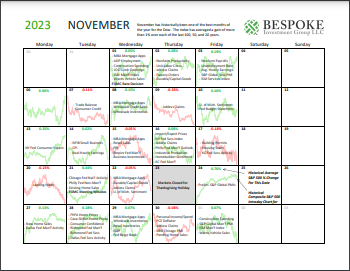
Bespoke Market Calendar — November 2023
Please click the image below to view our November 2023 market calendar. This calendar includes the S&P 500’s historical average percentage change and average intraday chart pattern for each trading day during the upcoming month. It also includes market holidays and options expiration dates plus the dates of key economic indicator releases. Click here to view Bespoke’s premium membership options.
Bespoke’s Morning Lineup – 11/1/23 – A Work of Stagnation
See what’s driving market performance around the world in today’s Morning Lineup. Bespoke’s Morning Lineup is the best way to start your trading day. Read it now by starting a two-week trial to Bespoke Premium. CLICK HERE to learn more and start your trial.
“If you knew how much work went into it, you wouldn’t call it genius.” – Michelangelo Buonarroti
Start a two-week trial to Bespoke Premium now to get full access to the Morning Lineup.
A 2.4% rally overnight in Japan hasn’t been enough to help the picture for US futures this morning, but we have seen some improvement following a slightly weaker-than-expected ADP report and the refunding announcement from the US Treasury. It’s a busy day of economic ahead with Construction Spending, JOLTS, and ISM Manufacturing. Then, at 2 PM we’ll get the interest rate decision from the FOMC. While the market is all but certain that there will be no change in rates, you never know what Powell will say at 2:30. Once we get through all of that, we’ll get earnings from Apple (AAPL) after the bell.
In yesterday’s Chart of the Day, we discussed the “Nowhere Nasdaq” as the index is basically unchanged since the start of 2021 – a period just two months short of three years! The S&P 500 has fared modestly better during this span, but overall returns have been, at best, ordinary.
The chart below shows the annualized performance of the S&P 500 on a total return basis over the last one, two, five, ten, and twenty years (green bars) and compares those returns to the long-term historical average (blue bars). Outside of the five- and ten-year time windows, returns through the end of October have been weaker than average with the weakest results over the last two years (-3% vs 10.6%). Over the last twenty years, the S&P 500’s average annualized return of 9.3% is 1.6 percentage points below the long-term average, and while that doesn’t sound like much, it adds up over time. For example, $100 invested 20 years ago that compounded at 9.3% is worth $592 today while that same $100 compounded at 10.9% would be worth $792 today.

As ‘meh’ as equity returns have been over time, they blow the returns of long-term US Treasuries out of the water. The BofA 10+ Year US Treasury Index has now had negative 1-year rolling total returns for a record 33 straight months.

Sign up for a two-week trial to Bespoke Premium to continue reading more of today’s macro analysis.
Net Short No More
In last night’s Closer, we discussed the latest positioning data from the weekly Commitments of Traders report published by the CFTC. Released last Friday with data as of the prior Tuesday, the report would have captured October options expiration, and likely thanks to this, there were a number of significant changes to positioning across assets. As we discussed last night, one key area that saw big changes was equities.
Perhaps the most notable of these was in S&P 500 futures. Whereas this past summer saw positioning shift to the most net short (meaning a higher share of open interest is positioned short versus long) levels in over a decade, the past few months have seen those readings steadily unwind, and last week marked the first net long reading since June 14, 2022. Meanwhile, the small-cap Russell 2,000 still remains deep in net short territory, although there was some improvement. The Russell went from a recent low of 14.3% net short five weeks ago to 8.53% net short last week. That’s the highest reading since March.

As previously mentioned, the S&P 500 is back to net long for the first time in well over a year. In fact, the streak of net short readings concluded at 70 straight weeks. That is now the longest such streak in the record of the data dating back to the late 1990s. The only other streak that comes close in length ended at 60 weeks in April 2016.

As for the Russell 2,000, its streak of net short positioning has also been impressive at 135 weeks. However, that is not even half the length of the previous record that lasted from the back half of the 2000s through the early 2010s. Put differently, positioning in Russell 2,000 futures has historically held a more pessimistic tilt with net short readings 72.5% of the time since data for the index begins in August 2002. Although current readings indicate there continues to be more speculators betting against rather than for the index, the recent rise also indicates there has been some improvement in optimism towards small caps.

Bespoke’s Morning Lineup – 10/31/23 – Two in a Row?
See what’s driving market performance around the world in today’s Morning Lineup. Bespoke’s Morning Lineup is the best way to start your trading day. Read it now by starting a two-week trial to Bespoke Premium. CLICK HERE to learn more and start your trial.
“You cannot keep birds from flying over your head, but you can keep them from building a nest in your hair.” – Martin Luther
Start a two-week trial to Bespoke Premium now to get full access to the Morning Lineup.
It’s been a while and it’s still early in the day, but with futures trading higher as we head into the opening bell, the S&P 500 is on pace for its first back-to-back run of gains in three weeks. Treasury yields are moving lower this morning, and the 10-year yield is barely hanging onto the 4.8% level after breaking above 5% just over a week ago. In international economic data, China released some weak PMI data, and GDP in Europe missed expectations.
Back here in the US, the Employment Cost Index came in slightly higher than expected at 1.1% versus forecasts for an increase of 1.0%. Besides that report, we still have home price data at 9 AM, Chicago PMI at 9:45, and Consumer Confidence at 10 AM.
There’s never a shortage of strange when it comes to the markets, and October has been no exception. In a month where geo-political uncertainty in the Middle East moved to the front burner, gold surged (which you would expect), but crude oil, which you would also expect to rally, quickly ran out of steam. The fact that crude oil was unable to get going given the geo-political backdrop reinforces the view that the market isn’t expecting a major escalation/spillover of the current unrest.

With crude oil down just under 9% this month and gold up just under 9%, October is on pace to be just one of 20 other months in the last 40 years that crude fell at least 5% in the same month that gold rallied more than 5%. In the table below, we list each of those prior periods along with each commodity’s forward three-month performance. Going forward, crude oil has tended to largely recoup the ground it lost, averaging a three-month gain of 8.9% (median: +5.3%) with positive returns just over two-thirds of the time. Gold, however, was not as strong. Over the next three months, it averaged a gain of just 1.2% with gains less than half of the time (42%) On a median basis, though, gold’s forward three-month performance was a loss of 0.2%.

Sign up for a two-week trial to Bespoke Premium to continue reading more of today’s macro analysis.
A Slow Correction
On Friday, the S&P 500 joined the Nasdaq in officially entering a correction having fallen over 10% from its July 31st high without a 10% rally in the interim. That is the 55th correction since 1952 when the five day trading week began, and as shown below, it was one of the longer streaks for the index to officially hit that 10% threshold. The median number of trading days across all corrections since 1952 to reach that 10% decline has been 32 days, about half the time the current correction took to hit 10%. That makes this the slowest (for lack of a better term) correction since May 2015 and April 2011 when it took 65 and 67 trading days, respectively. However, looking further back, there were much longer periods like 1980 when it took half a year.

As we have noted in the past, the S&P 500 entering correction is not exactly as scary as it may sound with regard to performance going forward. While there is always the chance that a correction will extend further (potentially becoming a bear market), historically, returns have been solid once the index first enters correction. In the chart below, we show the average one and five-year annualized performance of the S&P 500 from the day the index first enters correction territory (the day the S&P closes 10% from a high without having a 10% rally in between). As shown, whereas any normal one-year period has seen the S&P average a gain of close to 9%, after the first close down 10% from a high, it has averaged an even stronger 10.6% gain over the following year. As for five-year annualized performance, periods after a correction tend to outperform the norm albeit by a much smaller margin.

Bespoke’s Morning Lineup – 10/30/23 – Still Here
See what’s driving market performance around the world in today’s Morning Lineup. Bespoke’s Morning Lineup is the best way to start your trading day. Read it now by starting a two-week trial to Bespoke Premium. CLICK HERE to learn more and start your trial.
“When so many hours have been spent convincing myself I am right, is there not some reason to fear I may be wrong?” – Jane Austen
Start a two-week trial to Bespoke Premium now to get full access to the Morning Lineup.
While the record streak of positive Mondays ended last week, it’s looking like another positive start to the trading week this morning as investors breathe a sigh of relief that the world didn’t end over the weekend. The week is starting off slow in terms of news and data, but it’s going to be a busy week of data, earnings, and central bank decisions (FOMC, BoJ, and BoE).
Simply put, last week was a lousy one for US stocks. While the S&P 500 was down less than 1.5% for the month of October heading into the week, it now finds itself down just under 4%. What was notable about the declines, though, was in how uniform they were. In a market that has been so uneven for at least the last year (see the YTD performance numbers in the fourth column), all fourteen of the US index ETFs we track in our Trend Analyzer were down over 2% but less than 3%. Another common theme? All of them are at ‘Extreme’ oversold levels.

Sign up for a two-week trial to Bespoke Premium to continue reading more of today’s macro analysis.
Bespoke’s Brunch Reads – 10/29/23
Welcome to Bespoke Brunch Reads — a linkfest of the favorite things we read over the past week. The links are mostly market-related, but there are some other interesting subjects covered as well. We hope you enjoy the food for thought as a supplement to the research we provide you during the week.
While you’re here, join Bespoke Premium with a 30-day trial!
On This Day in History:
Black Tuesday: October 29th, 1929, better known in the history book as “Black Tuesday,” followed closely on the heels of Black Thursday, not even a week before. Black Thursday, or October 24th, 1929, was a day of panic in the market as the Dow Jones Industrial Average shed approximately 11% of its value. Despite efforts to glue the market back together in a hurry, it further off the cliff the following Tuesday as the Dow plummeted another 12%, leading to a total collapse. The collapse was, of course, catastrophic as many lost their life savings or fortunes. After nearly a decade of gains, it all came to an end in a matter of days after the panic and market crash of Black Thursday and Tuesday in October 1929. The ensuing period of economic hardship marked a new chapter of hardship in American history.

Artificial Intelligence
From doom to boom: AI is slowly re-energizing San Francisco (MSN)
As much as the pandemic killed the city of San Francisco as businesses closed, crime rates rose, and the drug crisis escalated along with the homelessness issue, the city appears to be experiencing an optimistic turnaround. In the city that’s home to the 49ers (at least in name), which was named after those who rushed West for gold, the AI gold rush shows some promise. The flow of venture capital into AI companies in San Francisco hit new highs, with startups raising significant sums. AI firms are leasing tons of office space in the city and recruiting has become easier due to the boom, all of which is expected to continue to drive economic growth. [Link]
Dropping Out of College to Join the AI Gold Rush (WSJ)
AI has a wave of college students dropping out to pursue AI startups. Over 25% of American startup investments this year have gone to AI companies, with a generative AI market estimated to be worth $43 billion in 2023. While many are applauding this surge of entrepreneurial spirit, there is also caution that not all ventures will succeed, and a shakeout is expected for companies that use AI simply as a branding tool. Critics argue that AI is deeply complex, and students still have so much to learn before dropping out and pursuing the new technology so fast. [Link]
This new data poisoning tool lets artists fight back against generative AI (MIT Technology Review)
A new tool called Nightshade allows artists to alter their art before uploading it online. Invisible to the human eye, the tools can disrupt AI training when using art without consent. While helping artists, Nightshade could damage future AI models and cause them to produce unpredictable results. The tool brings power to artists, promotes their creativity, and puts a check on the explosively popular new technology. Check out the article to see some images of Nightshade at work. [Link]
Artificial Intelligence Powers Mach Ai & Clout Ai Bats (Rawlings)
Making a baseball bat is way more complicated than it may appear. With AI in the picture, Rawlings claims to have made the best possible ones in the Mach Ai and Clout Ai bats. AI ran thousands of calculations to create unique barrel designs that balance factors like pop, swing weight, and forgiveness. AI can create design variations more than 100 times faster than human engineers and was able to produce models comparable to that of top-of-the-line bats. It looks like AI has even found its way into sporting goods. [Link]
Electric Vehicles
Toyota nears mass production of solid-state batteries (Financial Times)
Toyota claims it is in the process of scaling up “solid-state” batteries. If the automaker is successful, it’ll have a huge range and charge time advantage, as solid-state chemistries have significant advantages over traditional battery packs. [Link]
How to Make Sense of Electric Cars’ Month of Disarray (Heatmap News)
Tesla and Rivian, EV makers, are good examples of those who have tried to cross the “valley of death” between product development and large-scale production. The business is a tough one to be in. Legacy automakers like General Motors and Ford are facing those struggles as they attempt the transition to electric vehicles. Companies like GM and Ford typically earn profits from gas-powered vehicles while losing money on each EV sold, so they will need to find ways to bridge the gap and make burning cash to scale up operations and become profitable a reality as the path forward in the auto industry more clearly becomes electric. [Link]
Financial Services
Schwab Study: Millennials Want Fixed Income With Feels (WealthManagement.com)
Fixed-income investments are becoming more appealing to investors as interest rates rise. Surprisingly, millennials have a larger portion of their portfolios in fixed income compared to older generations, with up to 45% of their investments in bonds and other fixed-income assets. The study also highlights that ETFs are the preferred investment vehicle for 80% of respondents, and 55% are considering equity ETFs, 47% fixed income products, and 43% real assets. As millennials invest more in fixed income, it’s suggested that the generation wants to invest more with individual beliefs and values. [Link]
Elon Musk gives X employees one year to replace your bank (The Verge)
Elon Musk, full of ideas that many would categorize as crazy, has made another major announcement for his social media platform X, formerly Twitter. Musk envisions that X will handle various financial activities, including payments, money, securities, and more. He suggests it would eliminate the need for traditional bank accounts altogether. It’s not the first time Musk has mentioned plans to make X a financial platform before, and he does have experience with financial services with his old company X.com which eventually became part of PayPal. [Link]
Real Estate
Food Halls, a Hot Real-Estate Investment, Conquer the Suburbs (WSJ)
Food halls are growing in popularity in suburban areas as the popularity of hybrid work and foodie culture bodes well for the dining collections made well-known in big cities. These small restaurants offer diverse and gourmet food which are often local businesses rather than big chains. Thanks to the pandemic, food halls in the suburbs took off as people moved to more remote work and proved more resilient than traditional restaurants. To put the growth in perspective, the US has at least 364 of these food halls, and 120 more are expected to open by the end of the year. That’s a 33% increase by New Year’s. [Link]
The effect of bus rapid transit on local home prices (Science Direct)
Bus Rapid Transit (BRT) systems are becoming more common in cities across the US. BRT systems provide those looking for different transportation options, but they can be a bit of an inconvenience as they can come with increased noise levels and less space on the road for others. This research finds that homes within a 20-minute walk of a BRT station carry a price premium of 5-7%. The research also finds that the value of real estate near BRT systems increased six times more than what the system costs to build. It’s possible then that the profits from higher property values might help pay for new transit projects in the future. [Link]
Environmental
An Oil Giant Quietly Ditched the World’s Biggest Carbon Capture Plant (Bloomberg)
Occidental Petroleum (OXY) is constructing a billion-dollar complex called Stratos that aims to capture carbon from the atmosphere and bury it underground. In 2010, the company built a plant for carbon capture which was never successful. That plant used older technology, but OXY is hopeful that the new technology in Stratos will provide much more positive results. Other large corporations and even the US government are betting big on the project. It’ll be interesting to see the results. [Link]
Mental Health
Libraries Are the New Front Line in America’s Mental-Health Crisis (WSJ)
Over recent years, natural disasters, the pandemic, drug epidemics, and a lack of mental health services have led those in need to libraries for food, shelter, warmth, assistance, or just a safe space. In response to such a trend, librarians find themselves in a unique position to help those seeking it, whether it be drug overdoses, homelessness, or other odds and ends. Some libraries are hiring social workers and receiving training to provide the best assistance they can. Who knew all that was in the job description? [Link]
Sports Betting
Here’s Why Bettors Are Angry With DraftKings Over Franz Wagner Free Throws (Action Network)
A recent NBA game between the Orlando Magic and Houston Rockets had DraftKings sports bettors in a frenzy after an error in scoring that cost them their money. Franz Wagner made two free throws during the game which were mistakenly credited to his brother. That caused confusion on the points prop betting as Franz had 19 points in reality, but 17 were shown. DraftKings decided to honor the correct score and the issue was largely resolved in the end for those that would’ve lost money on that error. [Link]
Read Bespoke’s most actionable market research by joining Bespoke Premium today! Get started here.
Have a great weekend!