
Highest and Lowest Price to Sales (P/S) Ratios
In the S&P 1500, which encompasses the large-cap S&P 500, the Mid Cap 400, and the Small Cap 600, there are just under 1,175 stocks that have positive next-year EPS estimates and trailing 12-month revenues of more than $1 billion. We wanted to see which stocks of this group currently have the highest and lowest forward price-to-sales ratios. For those that aren’t familiar with the price-to-sales ratio, it’s simply a stock’s current market cap divided by annual sales (in this case, forward 12-month consensus sales estimates).
Of the 1,150+ stocks that fit our initial criteria, the average stock currently has a forward price-to-sales (P/S) ratio of 2.59, but the median is significantly lower at 1.73.
Notably, 31 stocks currently have forward P/S ratios greater than 10, meaning their market cap is 10x larger than projected annual sales. That’s a very high P/S ratio, and the company better be growing significantly if it hopes to maintain that type of multiple. Collectively, these 31 stocks are up an average of 43.34% over the last year! Below is the list for those interested.
NVIDIA (NVDA) currently has the highest forward price-to-sales ratio at 18.9. Its shares are up 211.7% over the last year.
Five other stocks have P/S ratios above 15: Fair Isaac (FICO), Eli Lilly (LLY), Cadence Design (CDNS), Intuitive Surgical (ISRG), and Monolithic Power (MPWR). Credit card companies Visa (V) and Mastercard (MA) both have 14x P/S ratios, and a few other very notable large-caps that have 10+ P/S ratios include Microsoft (MSFT), Broadcom (AVGO), and Texas Instruments (TXN). Clearly, many of the Tech stocks on this list have seen massive gains since late 2022 from the current AI boom, and investors are still expecting BIG things in the years ahead to justify these kinds of multiples. They have a lot to live up to indeed.

On the flip side are the stocks with the lowest price-to-sales ratios. There are currently 338 stocks with forward P/S ratios that are less than one, meaning their market caps are lower than annual sales estimates. When sales are greater than market cap, companies typically have very low (and usually declining) margins. Many of the names below with P/S ratios of 0.20 or lower come from slow and steady groups like wholesale food distributors, big box retail, or large health care insurance providers.
Whereas the 31 stocks with 10+ P/S ratios are up 43% over the last year, the group of stocks below are only up an average of 6% YoY. While many of these names are and will continue to be on a downward trajectory in the coming years, we’re confident that a few will end up turning around their margin situations, especially if we see a disinflationary environment. Now go dig deeper and find them!


Bespoke’s Morning Lineup – 5/10/24 – Streaking
See what’s driving market performance around the world in today’s Morning Lineup. Bespoke’s Morning Lineup is the best way to start your trading day. Read it now by starting a two-week trial to Bespoke Premium. CLICK HERE to learn more and start your trial.
“In general people put too much faith in the rich, the famous, the politicians, and not enough faith in themselves.” – Bono

Below is a snippet of commentary from today’s Morning Lineup. Start a two-week trial to Bespoke Premium to view the full report.
If the pre-market gains hold into the close, today will mark the eighth straight day in a row of gains. While that sounds impressive, there have been two other streaks of as long or longer since last summer, and the current seven-day streak is the fourth since last July. Last July, there was a thirteen-day winning streak (tied for the longest since at least 1953) while in December, the Dow was up nine days in a row. As shown in the chart below, while these types of streaks may not quite be a dime a dozen, with 93 seven-day streaks since 1953 and 51 eight-day streaks, they’ve been common.
Read today’s entire Morning Lineup.

For much more analysis of global equities and economic readings released this morning, read today’s full Morning Lineup with a two-week Bespoke Premium trial.
The Year of the Utes?
The Utilities sector has been the second best of the eleven S&P 500 sectors so far in 2024, and it’s the best performing sector so far in May.
The sector has been on fire.
Below is a look at eight charts from our daily Sector Snapshot that gets sent to Bespoke Premium and Bespoke Institutional clients daily.
Pretty much all readings are now very extended to the upside, including P/E ratio!

Below is a look at the individual stocks in the S&P 500 Utilities sector from our Trend Analyzer tool (also available to Bespoke Premium and Bespoke Institutional clients). As shown, every single stock is overbought, with the large majority in “extreme” overbought territory.
With AI and other new technologies demanding so much more electricity, have investors woken up to the fact that the companies providing it stand to benefit?

The Triple Play Report — 5/10/24
An earnings triple play is a stock that reports earnings and manages to 1) beat analyst EPS estimates, 2) beat analyst sales estimates, and 3) raise forward guidance. You can read more about “triple plays” at Investopedia.com where they’ve given Bespoke credit for popularizing the term. We like triple plays as an indication that a company’s business is firing on all cylinders, with better-than-expected results and an improving outlook. A triple play is indicative of positive “fundamental momentum” instead of pure fundamentals, and there are always plenty of names with both high and low valuations on our quarterly list.
Bespoke’s Triple Play Report highlights companies that have recently reported earnings triple plays, and it features commentary from management on triple-play conference calls, company descriptions and analysis, and price charts. Bespoke’s Triple Play Report is available at the Bespoke Institutional level only. You can sign up for Bespoke Institutional now and receive a 14-day trial to read this week’s Triple Play Report, which features 24 new stocks. To sign up, choose either the monthly or annual checkout link below:
Bespoke Institutional – Monthly Payment Plan
Bespoke Institutional – Annual Payment Plan

Lantheus (LNTH) is an example of a company that reported an earnings triple play recently. It makes special medical products, including imaging agents, which are often liquids that patients drink or have injected. These agents help doctors see inside the body more clearly on scans like X-rays or MRIs. They highlight specific parts like organs or blood vessels, making it easier to diagnose certain diseases or cancer. The stock is currently in an uptrend after declining through the end of 2023 into the new year. From its low in January, LNTH is up close to 50% and is teetering on the level it traded at before its sharp drop last December due to prostate cancer treatment trial data that came in worse than Novartis AG’s (NVS).

Looking at the snapshot below from our Earnings Explorer, LNTH has come out on top against analyst estimates for some time now, with its fair share of triple plays mixed in. A streak of EPS beats goes back six years and counting, while its streak of revenue beats goes back 14 quarters. LNTH has also generated some big swings on its earnings days on a percentage basis.

Most important to the company are PYLARIFY, a Prostate-Specific Membrane Antigen (PSMA) PET imaging agent for Prostate cancer, and DEFINITY, an agent for ultrasound imaging. In 2024 alone, the American Cancer Society estimates that the US will see close to 300,000 new cases of prostate cancer and more than 35,000 deaths as diagnosis rates have increased. One in eight men will be diagnosed during their lifetime. LNTH also does work in other areas like Alzheimer’s and cardiology. You can read more about LNTH and the 23 other triple plays in our newest report by starting a Bespoke Institutional trial today.
Bespoke Investment Group, LLC believes all information contained in these reports to be accurate, but we do not guarantee its accuracy. None of the information in these reports or any opinions expressed constitutes a solicitation of the purchase or sale of any securities or commodities. This is not personalized advice. Investors should do their own research and/or work with an investment professional when making portfolio decisions. As always, past performance of any investment is not a guarantee of future results. Bespoke representatives or clients may have positions in securities discussed or mentioned in its published content.
Claims Fine In Spite of Superlatives
Today’s data slate was light with the only release of note being initial jobless claims. The release is perhaps more in focus than normal given it comes on the back of weaker-than-expected labor data last week in the form of the nonfarm payrolls and JOLTS reports. Just like last week’s data, the weekly jobless claims number was a disappointment with seasonally adjusted initial claims totaling 231K. That was handily above the estimate of 212K and last week’s reading of 209K. As frequently quoted today, that results in the highest reading since last summer. Additionally, the 22K week-over-week jump marks one of the larger sequential increases of the past few years.

Despite those superlatives, one week does not make a trend. The chart below shows the four-week moving average of claims, which helps smooth out week-to-week fluctuations. By this reading, not much has happened. The moving average remains relatively flat with current levels consistent with those from the few years before the pandemic as well as those levels since the start of 2022 when pandemic era programs expired.

On a non-seasonally adjusted basis, claims totaled 290K. As shown below, for the comparable week of the year that is somewhat higher than the past several years (outside of the elevated 2020 and 2021 readings), but that is far from any alarmingly high level. The current week of the year did see claims rise week-over-week which is a bit unusual, though not without precedent having happened 39% of the time historically and is likely the reason for the big jump in the adjusted number.

As for seasonally adjusted continuing claims, it is a similar story. Claims matched expectations rising to 1.785 million versus 1.768 million the previous week. Once again, those levels are well within the range of readings of the past year and are little cause for concern.

Bespoke’s Morning Lineup – 5/9/24 – Higher Jobless Claims
See what’s driving market performance around the world in today’s Morning Lineup. Bespoke’s Morning Lineup is the best way to start your trading day. Read it now by starting a two-week trial to Bespoke Premium. CLICK HERE to learn more and start your trial.
“You don’t get rich writing science fiction. If you want to get rich, you start a religion.” – L. Ron Hubbard
Below is a snippet of commentary from today’s Morning Lineup. Start a two-week trial to Bespoke Premium to view the full report.
After a quiet week of economic data, there’s finally a meaningful report this morning with jobless claims at 8:30. Initial claims came in higher than expected (231K vs 212K) and ticked up to the highest level since last August. Continuing claims at 1.785 million were more in line with forecasts and the recent trend. Earnings have still been coming in fast, but the companies reporting aren’t as large from a market cap perspective. That doesn’t mean they’re any less important if you own them, and we continue to see large one-day moves from several companies reporting. Unfortunately, it feels as if most of those big moves have been to the downside.
Moves in the Japanese yen have made headlines recently as the cross broke above resistance taking the yen to multidecade lows versus the dollar. In terms of lead market stories, the yen has started to move off the front pages as investors look for the next shiny object, but recent moves have still been significant. As shown in the chart below, after April’s massive break, the BoJ intervention caused a brief rally which pulled the cross back to levels that had served as major resistance. In a textbook move, the former resistance for USDJPY served as support, and the last few days have seen a return to the upward trend.

The daily moves in the yen have become more subdued this week, but that follows what had been a period of extreme volatility. In the five days ending 5/2, USDJPY’s average intraday range was 2.5% which was tied with a period in November 2022 for the most volatile five stretch since the Covid crash. Since 1989, there have only been a handful of other periods where the cross had a more volatile five-day stretch.

All this volatility in the yen hasn’t been helpful for Japanese stocks. From its high in early March (right before the USDJPY cross broke above resistance at 152) to late April, the Nikkei 225 corrected by more than 10%, and while it bounced with global markets in the last two weeks, the rally has stalled out right at levels that had been acting as support.
Read today’s entire Morning Lineup.

For much more analysis of global equities and economic readings released this morning, read today’s full Morning Lineup with a two-week Bespoke Premium trial.
The Closer – Student Loans, Utilities’ New High, 10Y Auction – 5/8/24
Log-in here if you’re a member with access to the Closer.
Looking for deeper insight into markets? In tonight’s Closer sent to Bespoke Institutional clients, we begin with a checkup on student loan balances (page 1) followed by a rundown of tonight’s earnings reports (page 2). We then pivot into a look at the snapped streak without Utilities hitting a 52-week high (page 3). Next, we recap today’s weak 10 year note auction (page 4) before closing out with a review of the latest petroleum inventory data (page 5).

See today’s full post-market Closer and everything else Bespoke publishes by starting a 14-day trial to Bespoke Institutional today!
Bespoke’s Consumer Pulse Report — May 2024
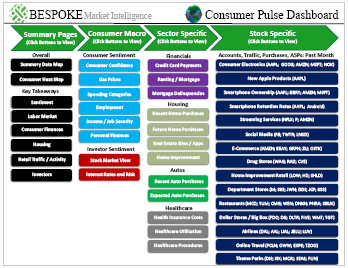
Bespoke’s Consumer Pulse Report is an analysis of a huge consumer survey that we run each month. Our goal with this survey is to track trends across the economic and financial landscape in the US. Using the results from our proprietary monthly survey, we dissect and analyze all of the data and publish the Consumer Pulse Report, which we sell access to on a subscription basis. Sign up for a 30-day free trial to our Bespoke Consumer Pulse subscription service. With a trial, you’ll get coverage of consumer electronics, social media, streaming media, retail, autos, and much more. The report also has numerous proprietary US economic data points that are extremely timely and useful for investors.
We’ve just released our most recent monthly report to Pulse subscribers, and it’s definitely worth the read if you’re curious about the health of the consumer in the current market environment. Start a 30-day free trial for a full breakdown of all of our proprietary Pulse economic indicators.
Bespoke’s Morning Lineup – 5/8/24 – Leadership Shift?
See what’s driving market performance around the world in today’s Morning Lineup. Bespoke’s Morning Lineup is the best way to start your trading day. Read it now by starting a two-week trial to Bespoke Premium. CLICK HERE to learn more and start your trial.
“Leaders get out in front and stay there by raising the standards by which they judge themselves—and by which they are willing to be judged.” – Fred Smith
Below is a snippet of commentary from today’s Morning Lineup. Start a two-week trial to Bespoke Premium to view the full report.
Futures have been drifting lower all morning. First, it was weaker-than-expected earnings reports in the tech/growth area (Shopify, Uber, etc). Then, Intel lowered Q2 sales guidance for the second time in less than two weeks. Now, Tesla (TSLA) is trading lower on reports of a criminal probe into claims it may have made concerning its full self-driving mode. All of these ingredients create a perfect recipe for an excuse for investors to take a step back after the recent bounce and reassess things. Outside of earnings, there’s little in the way of economic news today with Wholesale Inventories (10 AM) being the only report on the calendar.
We’ve become so used to US stocks leading the rest of the world in recent years, but this morning, there’s been a slight shift in the balance of power. Europe’s benchmark STOXX 600 is up 0.25% this morning for its fourth straight day of gains. In the process, the index has taken out its prior record high from late March, erasing all of the declines from April.

Meanwhile, the S&P 500 also closed out yesterday with its fourth straight day of gains but remains 1.5% below its record high from the end of March.

So, what explains the disparity in performance? The chart below shows the performance of STOXX 600 groups since the end of March when it last made a record high. Leading the way, Basic Resources, Banks, Energy, Utilities, and Drug Stores have all rallied over 3%. Most of these groups have larger weightings in the STOXX 600 than in the S&P 500 and therefore, they have provided a bigger ‘kick’ to the index’s performance. Meanwhile, Technology which isn’t nearly as heavily weighted in Europe as it is in the US is down 1.26%.
Read today’s entire Morning Lineup.

For much more analysis of global equities and economic readings released this morning, read today’s full Morning Lineup with a two-week Bespoke Premium trial.
Bespoke’s Morning Lineup – 5/7/24 – It at First You Don’t Succeed, Try Again
See what’s driving market performance around the world in today’s Morning Lineup. Bespoke’s Morning Lineup is the best way to start your trading day. Read it now by starting a two-week trial to Bespoke Premium. CLICK HERE to learn more and start your trial.
“Extremes to the right and to the left of any political dispute are always wrong.” – Dwight Eisenhower
Below is a snippet of commentary from today’s Morning Lineup. Start a two-week trial to Bespoke Premium to view the full report.
S&P 500 futures were just unchanged on the day in what has been a relatively quiet morning. Crude oil is modestly lower and treasury yields are slightly lower. In terms of earnings, Disney is sharply lower after reporting weaker-than-expected sales and dragging the Nasdaq lower, shares of Palantir (PLTR) are down over 8% despite reporting better-than-expected EPS and sales. Dragging the stock lower? A disappointing forecast relative to lofty expectations.
Heading into yesterday’s session to start the week, the setup looked much like the prior Monday. Then, we started the week following a Friday when the S&P 500 rallied but came up just shy of its 50-DMA. While we rallied to start last week, the market couldn’t maintain enough momentum to get back above its 50-DMA. We then followed that failed attempt with a disheartening three straight days of lower intraday highs and lower intraday lows. Last Friday, we rallied again and broke that streak of lower highs and lows and rallied but finished the week just shy of the 50-DMA.
One positive about weakness in the middle of last week around the Fed meeting was that from the lows in mid-April, the S&P 500 maintained a run of higher lows. Fortunately for bulls, Monday wasn’t a Groundhog Day type event, and the S&P 500 not only opened the week above its 50-DMA, but it stayed there the entire session in a run of three straight days of gains of at least 0.91%.

The picture for the Nasdaq looks a lot like the S&P 500. Unlike the S&P 500, though, the Nasdaq finished off last week above its 50-DMA and stayed there to kick off this week. Like the S&P 500, however, it took the Nasdaq two tries to get back above that short-term moving average. As the old saying goes, “If at first you don’t succeed, try again.”
Read today’s entire Morning Lineup.

For much more analysis of global equities and economic readings released this morning, read today’s full Morning Lineup with a two-week Bespoke Premium trial.