
Brunch Reads – 8/25/24
Welcome to Bespoke Brunch Reads — a linkfest of the favorite things we read over the past week. The links are mostly market-related, but there are some other interesting subjects covered as well. We hope you enjoy the food for thought as a supplement to the research we provide you during the week.
There’s No Place Like Home: On August 25th, 1939, The Wizard of Oz, hit the theaters. The story begins in sepia-toned Kansas, where young Dorothy Gale feels misunderstood and longs for a place “over the rainbow” where she can escape her troubles. When a tornado whisks her away to the vibrant, Technicolor world of Oz, she must find her way back home. Traveling down the yellow brick road, she meets the Scarecrow, who believes he lacks a brain, the Tin Man, who believes he lacks a heart, and the Cowardly Lion, who believes he lacks courage. They all represent a facet of human experience and come to teach Dorothy, and us, a deeper lesson about discovering our own strengths. As the story unfolds, we recognize Dorothy’s adventure back home as a timeless classic that continues to remind us that the qualities we seek (intelligence, love, courage, and a sense of belonging) are within us.

How A.I. Can Help Start Small Businesses (NYT)
Professors are encouraging students to use AI tools like ChatGPT to streamline business processes. Startups are using AI for everything from coding to marketing, allowing them to grow faster and attract investors. While there are challenges and limitations, AI is clearly a game-changer for entrepreneurs.
[Link]
Continue reading our weekly Brunch Reads linkfest by logging in if you’re already a member or signing up for a complimentary 30-day trial to Bespoke Premium today! Cancel at any time..
The Bespoke Report – 8/23/24 – Two Big Questions
To read our weekly Bespoke Report newsletter and access everything else Bespoke’s research platform has to offer, start a two-week trial to Bespoke Premium. This week we focus on two big questions as we move through the month of August.

Bespoke’s Morning Lineup – 8/23/24 – Positive Vibrations
See what’s driving market performance around the world in today’s Morning Lineup. Bespoke’s Morning Lineup is the best way to start your trading day. Read it now by starting a two-week trial to Bespoke Premium. CLICK HERE to learn more and start your trial.
“We will keep at it until we are confident the job is done.”– Jerome Powell, 8/26/22

Below is a snippet of commentary from today’s Morning Lineup. Start a two-week trial to Bespoke Premium to view the full report.
The word of the week has been vibes. This morning, positive vibes steer the market as S&P 500 futures are up over 50 bps and the Nasdaq is poised to open 1% higher. There hasn’t been much in the way of headlines to support the rally, and while earnings results after the bell yesterday were positive, we can’t remember a time when stocks like Intuit (INTU), Workday (WDAY), Cava (CAVA), and Ross Stores (ROST) were considered market movers. For now, bulls will take the gains, especially after yesterday’s pullback which was also based on not much else besides some negative vibes heading into today’s Jackson Hole speech from Fed Chair Powell. That speech comes at 10 AM Eastern, and if Powell does anything less than lay the groundwork for a rate cut at the September meeting, look out.
Although August has historically been a weak month, it hasn’t lived up to its reputation as the S&P 500 has a MTD gain of 0.88%. With August and September traditionally being such weak months, you would think that the last week of August would be especially negative, but historically, that has not been the case. The chart below shows the S&P 500’s performance during the last week of August dating back to 1953 (when the five-day trading week in its current form went into effect).
Overall, the S&P 500’s median performance to close out August has been a gain of 0.53% with positive returns 58% of the time. In the last ten years, performance has been even stronger with a median gain of 1.14%, or more than double the long-term average. Within those last ten years, there have been some big swings. In 2015, the S&P 500 had its best final week to August with a gain of 4.17%, although that followed what had been a MTD decline of 10.0%. At the other extreme, in 2022, the S&P 500 had its second worst-ever final week to August when it fell 4.49% after Powell was direct and to the point at Jackson Hole saying that the fed was “committed” to doing the job of bringing inflation down and that higher interest rates would cause “pain”. Bulls still have the scars from that one, but as he said in that speech, “Restoring price stability will take some time”. In the two years since that speech, has Powell finally seen enough?

As mentioned above, the S&P 500 is up 0.88% so far this month, but historically speaking, there hasn’t been much of a relationship between how the market performs leading up to the last week of August and how it does in the final week. The only time there has been any connection is after a rough start to the month. As shown in the chart below, in the six years when the S&P 500 was down more than 6% MTD heading into the final week of the month, it was up in the final week all six times. Ironically, in the last 71 years, there have only been four other years where the S&P 500 has been up between 0% and 1% heading into the last week of August. Just another example of how “boring” August has been so far. Right?

Continue reading today’s full Morning Lineup by starting a two-week trial to Bespoke Premium.
Bulls Take Off
Even though the rally in the S&P 500 lost steam over the past week, sentiment has soared. The latest weekly survey from The American Association of Individual Investors (AAII) showed 51.6% of respondents reported as bullish, up from 42.5% in the week prior. That’s the first time in five weeks that the majority of respondents have been bullish.

Considering there was an even more elevated reading of bullish sentiment only a little over a month ago, it is worth mentioning how optimism has been consistently elevated recently. As shown below, a one-year rolling average of bullish sentiment shows that this week’s reading increased to 42.5% – the highest reading since October 2007. It is also a quick turnaround versus various points last year when it was down around the lowest levels on record.

While bullish sentiment is elevated, less than a quarter of respondents considered themselves bearish. At 23.7%, this week’s reading was also the lowest in five weeks. That’s also a quick turnaround from the more elevated reading of 37.5% reached only two weeks ago, and the 13.8 percentage point drop over the past two weeks is the largest decline in such a span since the week of November 16, 2023.

Those corresponding moves to bullish and bearish sentiment resulted in the bull-bear spread rising to 27.9. Based on the comparisons to bullish and bearish sentiment, again this is the most elevated reading in five weeks. Zooming out, that reading is elevated ranking in the 88th percentile of all weeks since the start of the survey in 1987.


$10,000 in Gold (GLD)
In today’s “$10,000 in…” series, we’re taking a look at the gold ETF (GLD). The SPDR Gold Trust (GLD) began trading nearly 20 years ago in November 2004. It marked the first time that investors could easily allocate funds to gold in a brokerage account.
When GLD began trading on 11/18/2004, it had total assets of just under $600 million after its first day of trading. By the end of 2004, AUM had more than doubled up to more than $1.3 billion.
Today, GLD has more than $68 billion in AUM. At its last quarterly filing, it held more than 26 million ounces of physical gold valued at more than $62 billion.
So what would a hypothetical $10,000 investment in the GLD ETF on its release date in November 2004 be worth today? As shown below, $10,000 would now be worth roughly $52,000. That’s an annualized return of about 8.73%. Not bad for a piece of metal, right?

How does that $10k investment in GLD when it began trading nearly 20 years ago compare to something like the stock market? If we use the S&P 500 ETF (SPY) as a proxy for US large-cap stocks, a $10,000 investment in SPY on the same day that GLD began trading back in November 2004 with dividends re-invested would be worth about $68,725 today. That’s an annualized return of roughly 10.2%, or about 1.5 percentage points better than GLD annually. You can see how both GLD and SPY got to their current levels in the chart below.
As always, past performance is no guarantee of future results!

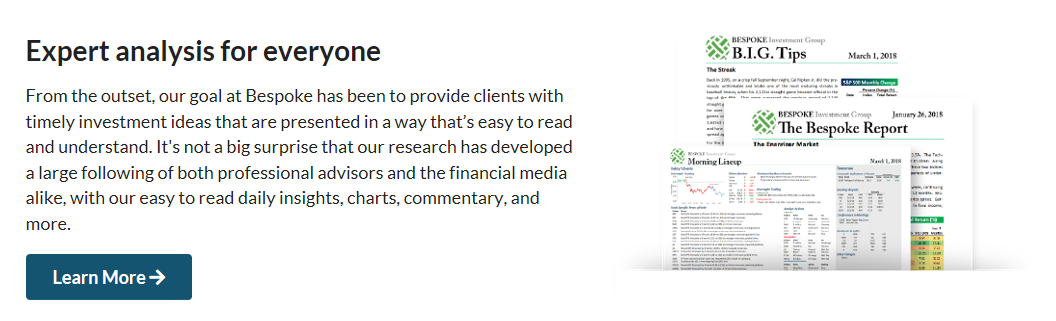
If you enjoyed this content, we think you’ll love Bespoke’s two membership levels. Below is a look at the various reports and tools included with a Bespoke Premium or Bespoke Institutional membership. Click here or on the image below to sign up for a two-week trial today!

Bespoke’s MORTGAS Misery Index
Last year when mortgage rates and gas prices were rising steadily day in and day out to multi-decade highs, we created our MORTGAS Misery Index that is simply the sum of the 30-year fixed mortgage rate and the cost of a gallon of gas.
Below is an updated look at both gas prices and mortgage rates.
The national average 30-year fixed mortgage rate according to Bankrate.com is currently down to 6.86%, which is the lowest level seen since seen May 11th, 2023. As shown below, the peak for mortgage rates during the current cycle was 8.09% on October 25th, 2023.

Longer term, of course, mortgage rates remain very elevated. They would need to fall another 40 basis points down to 6.45% to get back to the peak readings seen in the mid-2000s prior to the Financial Crisis.

Gas prices have also been falling steadily since peaking in the spring (which is usually the case from a seasonal perspective). Using AAA’s national average for a gallon of regular unleaded, gas prices are currently at $3.387/gallon. That’s down about 30 cents from the peak price seen so far in 2024 of $3.679 on April 18th. Prices are down about 50 cents from their September 2023 peak of $3.88/gallon.

Longer-term, gas prices are currently about 50 cents above the 20-year average of $2.89/gallon. The low-point of the current decade came on April 28th, 2020 when the national average hit $1.768/gallon. The high point came on June 13th, 2022 when prices ticked just above $5/gallon ($5.016).

Combined, our MORTGAS Index currently sits at 10.2. As shown below, the index is down 1.46 points from its record high of 11.66 seen in late 2023, but it’s still extremely elevated relative to the last 20 years. Looking on the bright side, the index is now back below its peak seen in 2008 during the Financial Crisis, but we’re going to need to see significant further easing to get back to the 20-year average of 7.62. A drop like that would likely mean mortgage rates falling at least into the 4-5% range and gas prices remaining closer to a 2-handle than a 4-handle.

If you enjoyed this content, we think you’ll love Bespoke’s two membership levels. Below is a look at the various reports and tools included with a Bespoke Premium or Bespoke Institutional membership. Click here or on the image below to sign up for a two-week trial today!
Bespoke’s Morning Lineup – Divergent Sectors
See what’s driving market performance around the world in today’s Morning Lineup. Bespoke’s Morning Lineup is the best way to start your trading day. Read it now by starting a two-week trial to Bespoke Premium. CLICK HERE to learn more and start your trial.
“Common sense is very uncommon.” – Horace Greeley
Below is a snippet of commentary from today’s Morning Lineup. Start a two-week trial to Bespoke Premium to view the full report.
It was a positive tone heading into weekly jobless claims, and futures have remained higher following an inline report. Initial claims were in line with forecasts at 232K while continuing claims were slightly lower than expected (1.863 mln vs 1.870 mln). In Europe this morning, equities are also trading higher following a stronger-than-expected composite PMI report which was goosed mainly by the Paris Olympics.
Outside of Energy (XLE), large-cap sectors have performed admirably over the last five trading days. Of the eleven sector ETFs shown below, only Energy has declined and Real Estate (XLRE) is the only other sector failing to rally more than 1%. At the top of the list are Consumer Discretionary (XLY) and Technology (XLK) which have both rallied nearly 5% or more. Behind those two leaders, four other sectors have rallied more than 2% while three sectors have gained more than 1%. Ten out of eleven sectors are above their 50-day moving averages with six in overbought territory (1+ standard deviations above their 50-DMA) and another two sectors – Consumer Staples (XLP) and Health Care (XLV)– trading in extreme overbought territory (2+ standard deviations above 50-DMA).

From the highs in late March through now, the S&P 500 has experienced a V-formation where the magnitude and speed of the bounce was a mirror image of the decline, and the charts of both Consumer Discretionary (XLY) and Technology (XLK) illustrate that pattern.


While Consumer Discretionary (XLY) and Technology (XLK) have followed the pattern of the broader market, most other sectors have followed their own unique paths. Energy (XLE), for example, has missed out on most of the rally, remaining well off of its late July highs.

At the other end of the spectrum, if you look at the charts of the Consumer Staples (XLP) and Utilities (XLU) you would never even know that there was a decline in the first place. In the years coming out of the Financial Crisis right up until Covid, investors became used to sectors moving closer in unison to each other, but as the last several weeks have illustrated, it’s not always a tide that lifts and sinks all boats.


Continue reading today’s full Morning Lineup by starting a two-week trial to Bespoke Premium.
Bespoke’s Morning Lineup – Target Hits the Bullseye
See what’s driving market performance around the world in today’s Morning Lineup. Bespoke’s Morning Lineup is the best way to start your trading day. Read it now by starting a two-week trial to Bespoke Premium. CLICK HERE to learn more and start your trial.
“He who moulds public sentiment goes deeper than he who enacts statutes or pronounces decisions.” – Abraham Lincoln
Below is a snippet of commentary from today’s Morning Lineup. Start a two-week trial to Bespoke Premium to view the full report.
Between the 10%+ rally in shares of TGT and last week’s 6%+ rally in Walmart (WMT) in reaction to its earnings report, it’s hard to get too concerned about the health of the US consumer. Yes, these are more anecdotal observations than quantitative, but they’re also two of the largest retailers in the country,
Let’s start with TGT. The chart below shows TGT’s historical performance on its earnings reaction days since 2002. With the stock trading up over 10% in the pre-market, today would be the third time in the last four quarters that the stock had a double-digit positive reaction to earnings. Since 2002, there have only been seven times when the stock had an earnings day reaction of more than 10%.

Regarding TGT’s stock performance, it had been ‘on sale’ for months heading into this morning’s report, but based on where the stock surged to in the pre-market, the downtrend from the spring high has been broken.

Looking back to WMT’s report last week, the stock’s 6%+ rally was the first time in at least 20 years that it experienced back-to-back earnings reaction day rallies of over 5%, and those two one-day rallies were the fourth and fifth best earnings reaction day performances since at least 2002.

Unlike TGT, which had been under pressure heading into today’s report, WMT’s chart has been more of a one-way move to new all-time highs. WMT’s strength could be construed as a sign that consumers are trading down due to a tough economic environment, but the company made no such comments in its conference call last week. CEO Doug McMillon flat-out rejected that idea when he said “So far, we aren’t experiencing a weaker consumer overall.” CFO John David Rainey reiterated that point when he said, “Each of the months of the second quarter were relatively consistent… Even in the first couple weeks of August here, things have been remarkably consistent.”

Turning to retail stocks in general, it’s been a rangebound summer for the sector. The chart below shows the performance of the SPDR S&P Retail ETF (XRT) which tracks the performance of retailers on an equal-weighted basis. After a strong rally of over 30% off last fall’s lows, the ETT stalled out just under $80 before the broader market corrected in the spring. Since then, XRT has made four additional attempts at breaking through the $80 level but has been stymied each time. TGT’s rally this morning will provide a boost to the sector, but it’s going to take more than that to get it over the hump.

On a longer-term basis, that $80 level in XRT represents an important level, and if and when it can finally break through that resistance, a run to the post-COVID stimulus-fueled highs would be the next level to watch for.

Continue reading today’s full Morning Lineup by starting a two-week trial to Bespoke Premium.
Country Small-Cap ETFs
Small-caps in the US have been extreme laggards compared to large-caps over the last couple of years, but what about small-caps in other countries? Below is a look at the price change (%) of seven small-cap country ETFs since February 2012 (the first point in which all seven were available).
The Russell 2,000 small-cap US ETF (IWM) is up 159.9% over these 12+ years, and only India small-caps (SMIN) have done better with a gain of 222.8%. India small-caps only recently took the lead on the US with a big jump higher over the last 18 months or so.
Small-caps in other countries have been poor options for US investors relative to owning something like the S&P 500 ETF (SPY). The Europe small-cap (IEUS) and Japan small-cap (SCJ) ETFs are up 68.2% and 63.9%, respectively, since February 2012, while the UK small-cap ETF (EWUS) is up 38.8%.
Small-cap ETFs for China (ECNS) and Brazil (EWZS) are flat-out negative over this extended 12+ year time frame with China down 41% and Brazil down 50%.
If you’ve been lamenting the lagging performance of US small-caps, it could have been worse!

If you enjoyed this content, we think you’ll love Bespoke’s two membership levels. Below is a look at the various reports and tools included with a Bespoke Premium or Bespoke Institutional membership. Click here or on the image below to sign up for a two-week trial today!
Bespoke’s Morning Lineup – 8/20/24 – 1,2,3,4,5,6,7,8…
See what’s driving market performance around the world in today’s Morning Lineup. Bespoke’s Morning Lineup is the best way to start your trading day. Read it now by starting a two-week trial to Bespoke Premium. CLICK HERE to learn more and start your trial.
“Capitalism does live by crises and booms, just as a human being lives by inhaling and exhaling.” – Leon Trotsky
Below is a snippet of commentary from today’s Morning Lineup. Start a two-week trial to Bespoke Premium to view the full report.
There’s no data on the economic calendar today, and there wasn’t a lot in the way of earnings reports overnight or this morning, and that has resulted in a relatively quiet (but slightly positive) tone in equity futures. Likewise, crude oil and treasury yields have seen little movement. The most exciting area of financial markets this morning could be in the gold and crypto markets where bullion is well over $2,500 per ounce and bitcoin is trading back above $60K.
Overnight in Asia, equity indices were all over the place with Japan up nearly 2% and China down about 1%. In China, the PBoC left 1 and 5-year prime rates unchanged. European stocks have seen little movement as the STOXX 600 is little changed as July CPI came in unchanged on a m/m basis which was right in line with forecasts. On the interest rate picture, ECB member Olli Rehn was on the wires saying that risks to the growth outlook have raised the odds of a rate cut in September.
Both the S&P 500 and Nasdaq composite have finished the day higher for eight straight days now, and if the current level of the futures holds, the streak for both indices will extend to a 9th straight day today. Since its inception in 1971, the Nasdaq composite has now had 89 different streaks of eight or more daily gains in a row which works out to about three streaks every two years. For the S&P 500, these streaks have been much less common with just 30 since 1971 or about one every two years. Concurrent streaks of eight or more days in a row have been even less common with just 15 since 1971, or about one every four years.

The charts of the S&P 500 and the Nasdaq below (both on a log scale) show where every concurrent streak of eight or more days of gains occurred, and while the average works out to about one every four years, they haven’t been evenly distributed. The current streak is the second in less than a year and the third in less than three years. Before that, the prior two were about four years apart (2017 and then 2013), but before the 2013 streak, there were more than 21 years without a single occurrence and that included the late 1990s dot-com bubble- a period that people look back on as thinking the market did nothing but go up! In last night’s Closer report, we included an analysis of the performance of both indices following those prior streaks, and performance was mixed with forward returns that were generally weaker than the average forward returns for all periods since 1971.

Continue reading today’s full Morning Lineup by starting a two-week trial to Bespoke Premium.