Feb 17, 2026
Bespoke’s Conference Call Recaps use AI to summarize lengthy earnings calls. The commentary below is AI-generated and then edited by Bespoke for quality control. As always, none of these summaries should be construed as recommendations to buy or sell any securities, and investors should do their own research and/or consult with a financial professional before making any investment decisions.
Our latest recap available to Bespoke subscribers covers Builders FirstSource’s (BLDR) Q4 2025 earnings call.

Builders FirstSource (BLDR) is the largest US supplier of building materials and manufactured components to professional homebuilders and remodelers, operating over 550 locations nationwide. The company offers everything from lumber and windows to prefabricated trusses, wall panels, and installed services, making it a barometer for single-family and multi-family housing activity, construction labor dynamics, and building product pricing. Q4 was weaker than expected as large builders aggressively pulled back starts late in the year to burn through excess housing inventory, driving a 12% sales decline and 44% adjusted EBITDA drop. Gross margins held at 29.8%, above the pre-transformation 27% level of 2019, but management guided a wide 28.5%–30% range for 2026, given early-year contract resets and volume uncertainty. BLDR is leaning into a $100 million SG&A cost-action plan, has consolidated 55 facilities over two years, and acquired Pleasant Valley Homes to experiment with factory-built modular housing as an affordability solution. The 2026 outlook assumes flat starts with a back-half-weighted recovery driven by easier comps. BLDR shares opened 1% lower on 2/17, but touched positive territory around noon after reporting EPS and revenue misses…
Continue reading our Conference Call Recap for BLDR by becoming a Bespoke Institutional subscriber. You can sign up for Bespoke Institutional now and receive a 14-day trial to read our newest Conference Call Recap. To sign up, choose either the monthly or annual checkout link below:
Bespoke Institutional – Monthly Payment Plan
Bespoke Institutional – Annual Payment Plan
Feb 17, 2026
See what’s driving market performance around the world in today’s Morning Lineup. Bespoke’s Morning Lineup is the best way to start your trading day. Read it now by starting a two-week trial to Bespoke Premium. CLICK HERE to learn more and start your trial.
“I’ve missed more than 9000 shots in my career. I’ve lost almost 300 games. 26 times, I’ve been trusted to take the game-winning shot and missed. I’ve failed over and over and over again in my life. And that is why I succeed.” – Michael Jordan

Below is a snippet of commentary from today’s Morning Lineup. Start a two-week trial to Bespoke Premium to view the full report.
It may be Tuesday morning, but futures are in a Monday mood as the S&P 500 is indicated to open down by 0.40% while the Nasdaq is down double that. The main culprit is the software sector as iShares Expanded Tech Software ETF (IGV) is down 1% in the pre-market, continuing a trend that has been in place for weeks now.
Treasury yields are also lower as the 10-year trades below 4.03%. Will we see a 3-handle this week? While yields are lower, crude oil prices are rallying over 1% to nearly $64 per barrel as President Trump made comments over the weekend that regime change “would be the best thing that could happen” in Iran. Despite the higher oil prices on geo-political concerns, though, gold prices are down 2% and back below $5,000, while silver is down over 4%. Along with lower metals prices, Bitcoin and other crypto assets are also down about 1%.
It was a quiet session in Asia as most markets are closed for the Lunar New Year. Japan was open for trading, though, but with a drop of 0.4% in the Nikkei, maybe it should have stayed closed too!
In Europe, it’s been a more positive tone as the STOXX 600 is up fractionally, led by larger gains in Italy and Spain. Economic sentiment, as measured by ZEW, was significantly weaker than expected, which perhaps makes the odds of rate cuts more likely.
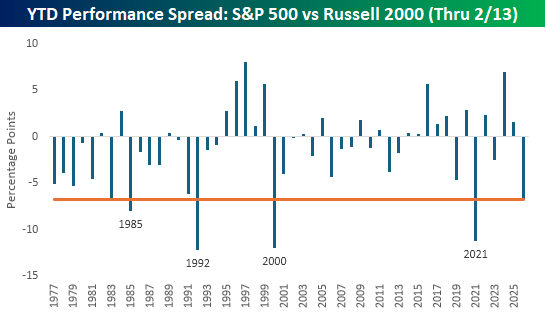
The S&P 500 went into the holiday weekend with a modest decline of 0.14% on a YTD basis, but the small-cap Russell 2000’s performance looks entirely different, as that index has already gained 6.64%. With 6.8 percentage points separating the two indices, small caps are off to their best start relative to large caps since 2021 and the fifth-best start to a year in the index’s history. The only other years besides 2021 when small caps got off to a better start were in 2000, 1992, and 1985.
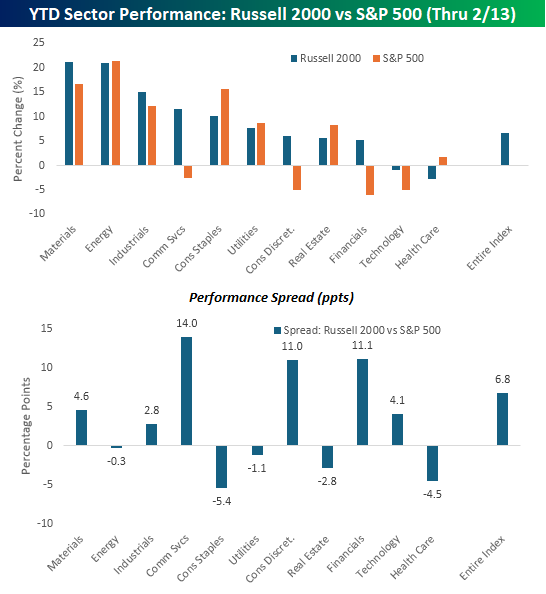
For most sectors, the performance disparity between small and large-cap stocks has been narrower. The top chart below shows the YTD performance (through 2/13) of each sector in both the Russell 2000 and the S&P 500, and the lower chart shows the performance spread between the two. As shown, the only three sectors where the performance disparity is wider than it is at the index level are in Communication Services, Consumer Discretionary, and Financials, and in all three cases, the disparity is, like it is at the index level, in favor of small caps.
Looking in the other direction, there are actually five sectors where large caps are outperforming their small-cap peers. The widest disparities in favor of large caps are in Consumer Staples and Health Care, but large-cap Real Estate, Utilities, and Energy are also outperforming.
Feb 13, 2026
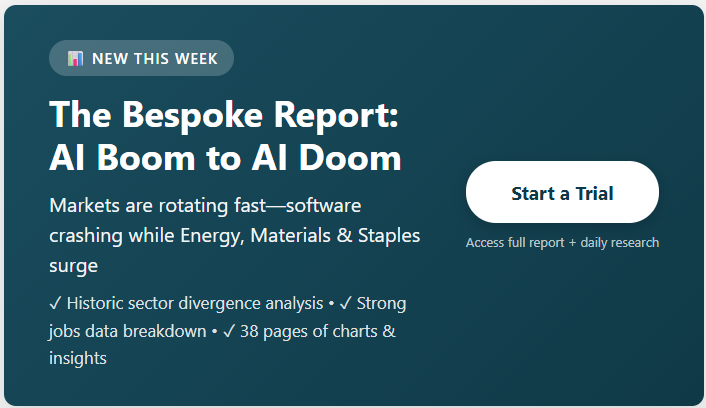
The “AI Boom to AI Doom” shift has happened: Software stocks have collapsed 25%+ while defensive sectors rocket higher in a rotation that’s never happened this fast—get the full 38-page analysis now. Read this week’s Bespoke Report newsletter and gain access to the rest of our product suite with a Bespoke trial. CLICK HERE or on the image below to proceed.
Feb 13, 2026
See what’s driving market performance around the world in today’s Morning Lineup. Bespoke’s Morning Lineup is the best way to start your trading day. Read it now by starting a two-week trial to Bespoke Premium. CLICK HERE to learn more and start your trial.
“Volatility obscures the future but does not necessarily determine the future.” – Peter Bernstein
Below is a snippet of commentary from today’s Morning Lineup. Start a two-week trial to Bespoke Premium to view the full report.
After yesterday’s sharp declines, bulls were in no rush to get back to work this morning ahead of the January CPI report, with futures on the major indices all down about 0.20%. The 10-year yield was basically unchanged at 4.10%, down from 4.23% earlier in the week. Crude oil was also modestly lower, while gold is marginally higher and silver rallies close to 3%. Bitcoin is up a little over 2% but still below $67K.
In Asia, equities were lower across the board with the Nikkei down 1.2%, Hong Kong down 1.7%, and China’s Shanghai Composite falling 1.3%. Despite those losses, Japan still finished the week 5% higher, while South Korea rallied more than 8%!
In Europe, equities were mostly lower but by more modest amounts. The STOXX 600 is down 0.4%, putting it in the red for the week, while Germany bucks the trend with a gain of 0.1%. Q4 GDP for the continent grew 0.3%, which was right in line with expectations.
CPI just hit the tape, and the market liked it! Headline CPI came in weaker than expected, with the y/y reading was 2.4% compared to forecasts for 2.5%. Core CPI was right inline with forecasts at 0.3% m/m. In reaction, futures have bounced into positive territory, while the 10-year yield dropped to 4.07%. Is a 3-handle on the way?
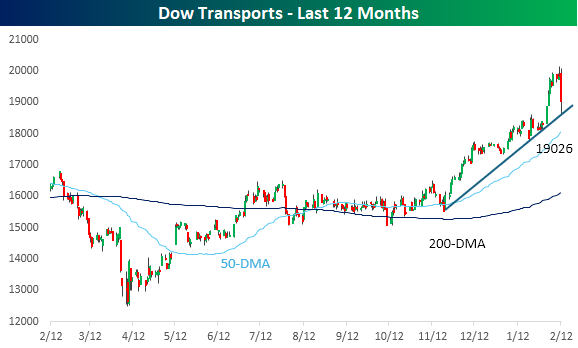
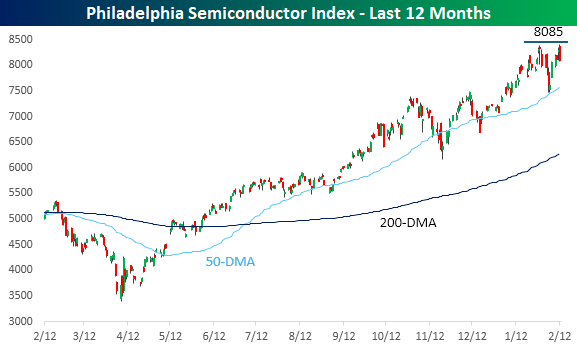
It was a rough day for two very important sectors often considered leading indicators of the physical and digital economy, as the Dow Transports fell 2.5% while the Philadelphia Semiconductor index (SOX) plunged just over 4%. That’s enough to instill some fear in the minds of already nervous investors.
Starting with the Transports, yesterday’s pullback found support right at the index’s uptrend line that has been in place since late last year. Looking at the chart, even bulls have to admit that as painful as yesterday’s sell-off was, the surge in the prior couple of weeks had also gotten ahead of itself.
Moving on to the transports of the digital economy, the SOX has been on a tear for nearly a year now, and even after yesterday’s decline, it has more than doubled off its April lows. Doubled! That being said, yesterday’s decline came right after the index had come up just shy of taking out its prior high from January, so until that resistance is taken out, the burden of proof is on the bulls.
Feb 12, 2026
See what’s driving market performance around the world in today’s Morning Lineup. Bespoke’s Morning Lineup is the best way to start your trading day. Read it now by starting a two-week trial to Bespoke Premium. CLICK HERE to learn more and start your trial.
“Volatility obscures the future but does not necessarily determine the future.” – Peter Bernstein
Below is a snippet of commentary from today’s Morning Lineup. Start a two-week trial to Bespoke Premium to view the full report.
Bespoke’s Paul Hickey appeared on CNBC’s Worldwide Exchange this morning to discuss AI disruption and other issues impacting the market. To view the segment, click on the image below.
US equity futures are higher across the board this morning, with gains ranging from 0.25% to 0.30%. Treasuries are also catching a bid with the 10-year yield falling 2 basis points to 4.16%. Oil prices are taking a rest and trading down fractionally, which is also the case for gold and silver. Crypto is catching a modest bid with Bitcoin prices inching up towards $68K.
In Asia, it was a mixed session. The Nikkei was down 0.02% after being closed for a holiday yesterday, but South Korean stocks were higher again as the KOSPI rallied 3.1%. Those types of moves for a major country benchmark were once considered out of the ordinary, but lately, multi-percentage point moves in the KOSPI (mostly to the upside) have become commonplace.
In Europe, stocks are trading higher across the board. The STOXX 600 is up 0.4%, and the German DAX is leading the gains with a rally of 1.3%. UK GDP for Q4 was weaker than expected, but outside of some individual earnings reports, it’s been a quiet session.
Here in the US, it’s also a quiet day for data. The main report will be jobless claims at 8:30, followed by Existing Home Sales at 10. Since it’s Thursday, the weekly individual investor sentiment survey from AAII showed that optimism towards the stock market fell for the second week in a row to 38.5%, its lowest level since Christmas. Bah humbug!
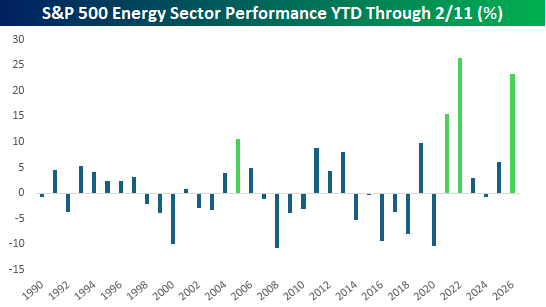
You need energy for a rocket to lift off, and boy, does the Energy sector have a lot of it! After essentially trading rangebound for the second half of 2025, the sector broke out in mid-January and has been gaining altitude ever since.
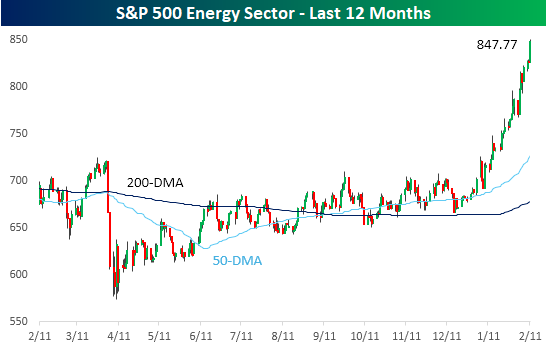
While most sectors have outperformed the S&P 500 YTD, none of them hold a candle to Energy’s gain of over 23%. Since sector data begins in 1990, this year’s gain ranks as the second-best start to a year through 2/11, trailing only the 26.5% gain to start 2022. That was a bit of a different situation, though, as the market was gearing up for Russia’s invasion of Ukraine. This year also now ranks as just the fourth year since 1990, that the Energy sector was up at least 10% YTD through 2/11. The others were 2021 and 2005.
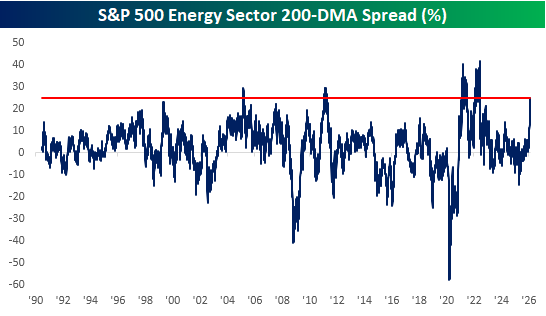
As the sector’s price has gone parabolic over the last few weeks, the spread between the Energy sector’s price and 200-DMA has ballooned to one of its highest levels on record. The only times it was wider were in 2005, 2011, 2021, and 2022.
Feb 11, 2026
See what’s driving market performance around the world in today’s Morning Lineup. Bespoke’s Morning Lineup is the best way to start your trading day. Read it now by starting a two-week trial to Bespoke Premium. CLICK HERE to learn more and start your trial.
“The greatest minds are capable of the greatest vices as well as of the greatest virtues.” – Rene Descartes
Below is a snippet of commentary from today’s Morning Lineup. Start a two-week trial to Bespoke Premium to view the full report.
Anticipation is the word of the morning, as markets waited for the delayed January jobs report. Heading into the report, S&P 500, Nasdaq, and Dow futures were all up a modest 0.10%. The 10-year yield was down a basis point to 4.13%, and crude oil was up over 2% and back above $65 per barrel. Precious metals are back in rally mode as gold rallies 1.5%, silver surges 6%, and Platinum rises 4%. Crypto, meanwhile, is struggling as Bitcoin pulls back 3% and trades back below $67. Metals rallying, crypto falling? Looks like things are getting back to normal!
The January payrolls report just hit the tape, and it was higher across the board. Non-Farm Payrolls were twice as much as expected (130K vs 65K), while the Unemployment Rate dropped to 4.3% 4.4% expected. Average hourly earnings and the average workweek were also both higher than expected. In response to the report, the 10-year yield ripped higher to just under 4.2% while equity futures added to their gains.
Japan was closed overnight, but most other major benchmarks in the region finished the session higher, with Australia rallying 1.6% while South Korea added another 1.0%. South Korea reported an 44.4% y/y increase in exports during the first ten days of February, aided by a 138% increase in chip exports. In China, January CPI came in weaker than expected, rising 0.2% versus an expected 0.3% increase.
In Europe, the STOXX 600 isn’t closed, but it’s unchanged on the session. The FTSE 100 is up nearly 1%, but every other major benchmark in the region is lower. It’s been a quiet session in terms of economic data, with Italian Industrial Production (better than expected) being the only major report on the calendar.
If I told you that software stocks had lost a third of their value over the last five months, you’d say the Nasdaq was in a deep correction, at minimum. Conversely, if I told you that the number of stocks hitting new 52-week highs was routinely at the highest levels in at least a year, you’d be asking when the Nasdaq crossed 25,000. Well, both trends outlined above have played out, but neither assumed result has played out for the Nasdaq, as both forces have essentially cancelled each other out, creating a period of stasis that has been going on for the last five months.
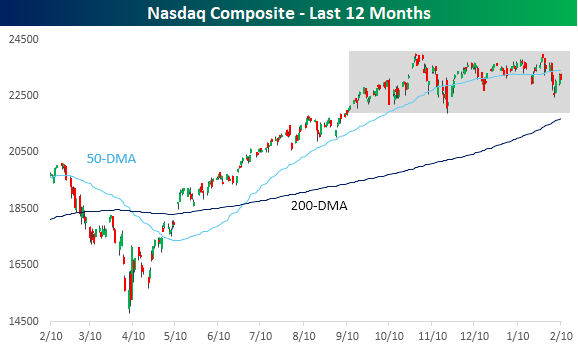
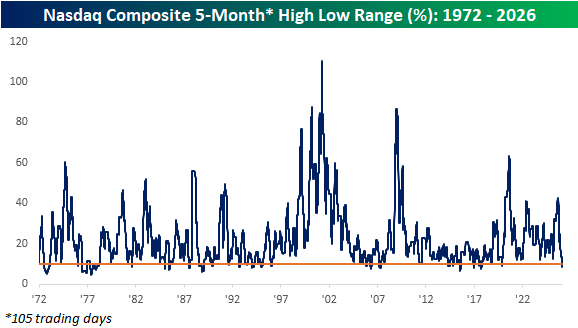
With the Nasdaq basically going nowhere since September, the spread between the index’s closing high and low recently dropped below 10%, and as of yesterday’s close, it was just 8.7%. That’s the first time that the five-month trading range dropped below 10% since 2019, and the narrowest range since October 2017. Back in the mid-teens, the Nasdaq’s five-month range was routinely below 10%, but since 1972, it has only occurred on less than 10% of all trading days.