Apr 2, 2026
See what’s driving market performance around the world in today’s Morning Lineup. Bespoke’s Morning Lineup is the best way to start your trading day. Read it now by starting a two-week trial to Bespoke Premium. CLICK HERE to learn more and start your trial.
“The more wonderful the means of communication, the more trivial, tawdry, or depressing its contents seemed to be.” – Arthur C Clarke, 2001: A Space Odyssey

Below is a snippet of commentary from today’s Morning Lineup. Start a two-week trial to Bespoke Premium to view the full report.
Leading up to last night’s national address from the President, there was some optimism that he would lay out a path of ending the hostilities and/or reopening the Strait of Hormuz. We got neither. Instead, the speech was more just a reheating of leftover talking points from the last few weeks.
The market response was as you would expect. Equity futures are sharply lower. The S&P 500 and Nasdaq are both indicated to open down by at least 1.5%. Treasury yields are higher, with the 10-year yield up 3 bps to 4.352%. The big move is in oil markets, though, as WTI is trading up more than 9.5%, which would be one of the largest one-day gains since the war started! Gold prices are sharply lower with a decline of close to 4%, while Bitcoin is also 3% lower. With a three-day weekend looming and an incredibly large (and increasing) presence of US military assets in the Middle East, you can’t blame someone for not wanting to take too much risk ahead of the weekend.
In international markets, Asia was sharply lower, with the Nikkei down over 2% while South Korea tanked over 4%. European markets are all down at least 1%, continuing the trend of weakness we have seen since the President’s speech started at 9:02 Eastern last night.
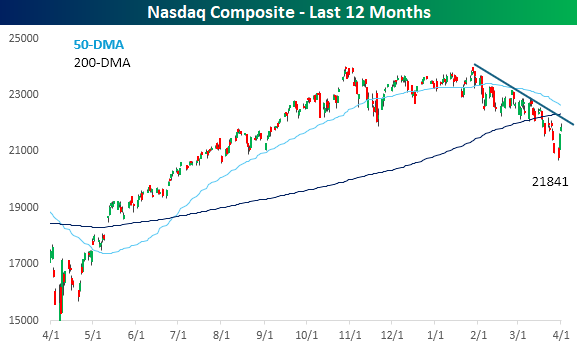
The last two days of trading were a relief for bulls after the weakness of the last few weeks. As the chart of the Nasdaq below illustrates, though, the gains have done little at this point to break the downtrend that has been in place for the last several weeks. Mornings like today serve as a reminder of that. It’s also hard not to blame investors for being more cautious ahead of a three-day weekend, just as the President threatens in a national address to bomb Iran back to the Stone Age.
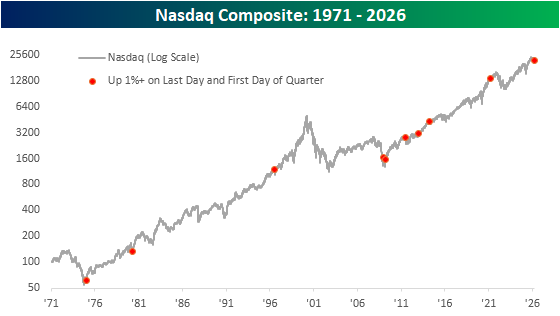
What was notable about the last two trading days was that the Nasdaq ended Q1 and started Q2 with gains of at least 1% on each trading day. The quarter-end gains were easily attributable to relancing, but gains to start a quarter tend to indicate actual inflows, which is a positive. Since the Nasdaq’s inception in 1971, the last two days were only the 10th time that the index gained at least 1% on the last day of a quarter and subsequently the first trading day of the next quarter.
The long-term chart of the Nasdaq below shows each occurrence, and they didn’t occur during the early stages of market downturns.
Apr 1, 2026
This content is for members only
Apr 1, 2026
See what’s driving market performance around the world in today’s Morning Lineup. Bespoke’s Morning Lineup is the best way to start your trading day. Read it now by starting a two-week trial to Bespoke Premium. CLICK HERE to learn more and start your trial.
“I felt that if I stayed with them I would probably end up being the richest man in the cemetery.” – Ron Wayne, Co-Founder, Apple (AAPL)
Below is a snippet of commentary from today’s Morning Lineup. Start a two-week trial to Bespoke Premium to view the full report.
Wait, is this some upside follow-through the market is seeing this morning? Equity futures are firmly higher this morning as the S&P 500 is indicated to open 0.9% higher, while the Nasdaq is up over 1%. Treasury yields are lower, with the 10-year yield down below 4.3%, while crude oil is down 3% to $98.5 per barrel. Brent crude, more sensitive to Iran events, is also down 2.5% to $101.4. That price is way below the levels it was quoted at yesterday, but that’s because the contract rolled overnight. Gold prices are up 2.5% to more than $2,760 per ounce, and Bitcoin is up over 1%. If these levels can hold into the end of the trading day, bulls will likely start to feel a bit more emboldened.
What a night the markets had in Asia. Markets in the region were sharply higher with the Nikkei surging 5.2%, and if you think that was impressive, look at the 8.4% rally in South Korea! Besides rebounding on the overall global relief rally on signs of a potential withdrawal from Iran, officials in South Korea noted that the country has ample supplies of helium and ethylene to last through the first half of the year. PMI Manufacturing reports for the region all remained in contraction territory, suggesting that the region’s economy is withstanding the impacts of the Iran war for now.
European markets were mostly closed when markets surged higher yesterday afternoon, so they played catch-up today. The STOXX 600 is up over 2%, as is the case with every regional market, including Italy and Spain, which are both up over 3%. Here again, PMI Manufacturing indices for the region were mostly positive, with Spain being the only notable laggard as it dipped into contraction territory.
Turning back to the US, it’s a busy morning for economic data with ADP Employment (higher than expected: 62K vs 40K forecast), Retail Sales (better than expected), Manufacturing PMIs, and Business Inventories all on the calendar. Besides those releases, we’ll also hear from a few Fed speakers and get auto sales for March throughout the day.
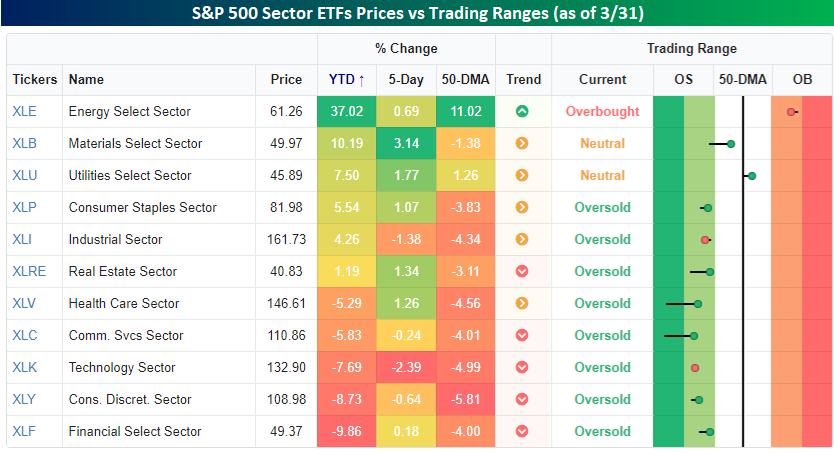
2026 is now behind us, and already it’s been an eventful year for the world and the markets. Our focus here is on markets, so we’ll start with what’s going on in the US, and specifically the S&P 500. The snapshot below from our Trend Analyzer shows the performance of the eleven different sector ETFs during Q1 and where they closed relative to their trading ranges.
Starting with performance, it has been one of, if not the widest, performance gaps between the top and bottom performing sectors in Q1 that we can remember. Topping the list, Energy (XLE) has rallied more than 37% this year, while Financials (XLF) is down just under 10%. While the S&P 500 is down more than 4% this week, just over half of all sectors finished higher in Q1, while five declined. Interestingly or unfortunately, depending on your perspective, all the sectors that are lower YTD have declined at least 5%. At the other end of the spectrum, four of the six sectors that are higher YTD are up more than 5%. The only two sectors that haven’t rallied or declined more than 5% are Industrials (XLI) and Real Estate (XLRE). Talk about the haves versus the have-nots!
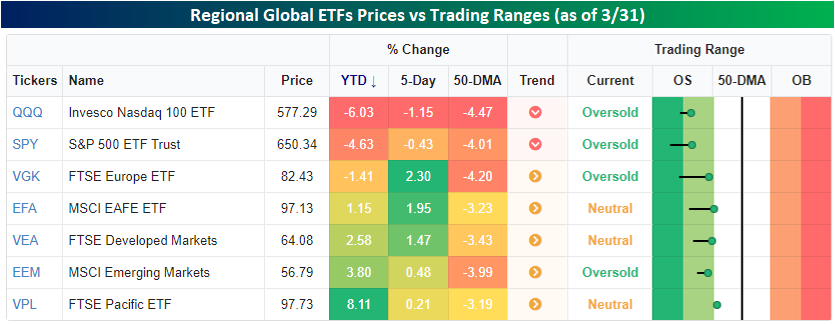
Looking out across the world, US stocks have outperformed their global peers since the war started at the end of February, but on a YTD basis, global stocks have still outperformed. As shown below, the Nasdaq 100 (QQQ) and S&P 500 (SPY) finished the first quarter down 6.03% and 4.63%, respectively, while most other regional ETFs are all higher, except Europe (VGK), which is down just 1.41%. Regardless of the paths they have taken in the first three months of the year, they all finished Q1 in either oversold territory or just barely outside of it.
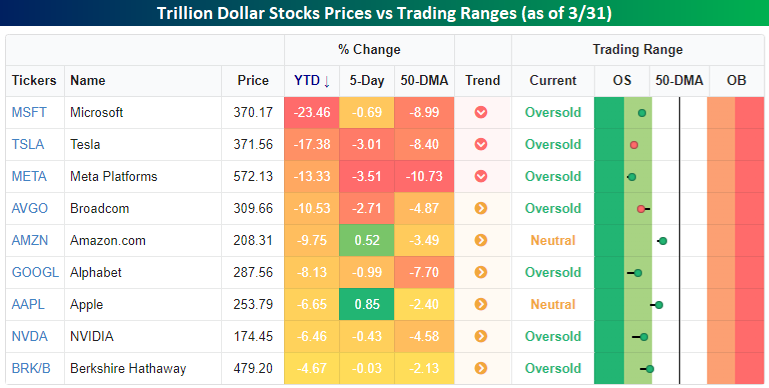
Finally, a newsflash. Remember the days when the mega-caps traded as a monolith in terms of their outperformance relative to the rest of the world? In 2025, the correlation between the trillion-dollar stocks started to break down as they went their separate ways. In Q1, the mega-caps returned to more of a positive correlation in that they all underperformed the S&P 500 in the quarter. While the degree of underperformance varied widely, the fact that all nine of these stocks, which account for nearly 40% of the entire index, suggests that the other 491 have done just fine. In fact, they finished the quarter with an average gain of 1.02%!
Mar 31, 2026
This content is for members only
Mar 31, 2026
See what’s driving market performance around the world in today’s Morning Lineup. Bespoke’s Morning Lineup is the best way to start your trading day. Read it now by starting a two-week trial to Bespoke Premium. CLICK HERE to learn more and start your trial.
“I try not to worry about things I can’t do anything about.” – Christopher Walken
Below is a snippet of commentary from today’s Morning Lineup. Start a two-week trial to Bespoke Premium to view the full report.
Sometimes the headlines make you scratch your head. This morning, equity futures are sharply higher with the rally attributed to a Wall Street Journal report that “Trump Tells Aides He’s Willing to End War Without Reopening Hormuz”. As we highlight below, stocks have been following the lead of oil prices at an unprecedented rate over the last several weeks, and if the US just walked away from the Middle East with the Strait still blockaded, energy markets would likely remain incredibly supply-constrained, keeping prices high. The longer prices are high and supplies are limited, the worse it’s going to be for the global economy and ultimately stock prices.
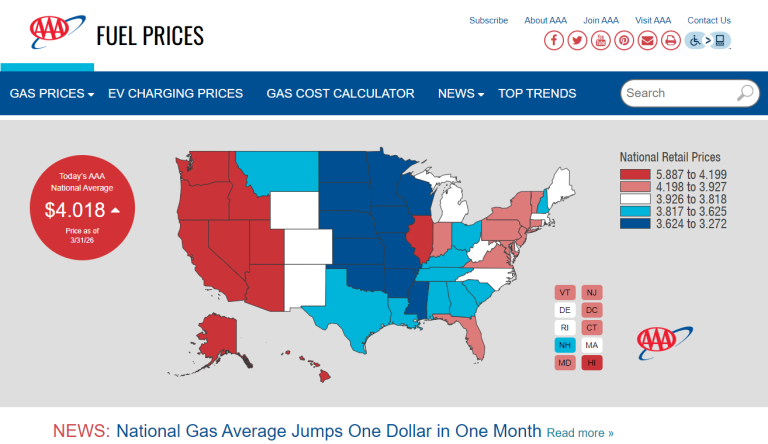
Just today, the national average price of a gallon of gas is above $4 for the first time since 2022, and as shown in the image below, it has increased by more than a dollar in just the last month.
Regardless of the reason, equity futures are up about 1% this morning, treasury yields are lower, and crude oil is slightly higher. Again, higher oil prices in this environment are negative for equity prices, and the gains we are seeing in futures may be nothing more than rebalancing ahead of quarter-end. Gold prices are up over 1%, and Bitcoin has seen a fractional gain.
We’re still in the ‘shoulder season’ for earnings, but it’s a busy day for economic data. At 9:45, we’ll get the Chicago PMI for March, followed by Consumer Confidence and JOLTS at 10 AM. The Chicago PMI and Consumer Confidence reports are both for March, so they will give some of the first reads on how the war has impacted economic and consumer sentiment.
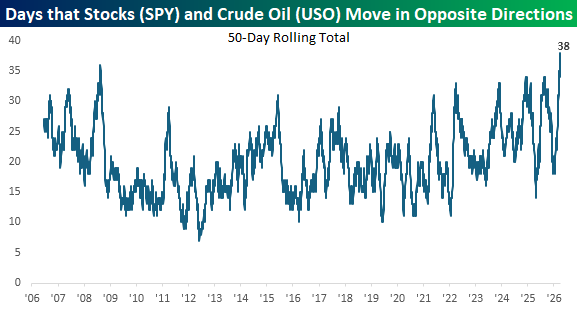
If you want to know the direction of the equity market these days, look at crude oil and go with the opposite. It’s become cliché, but it also hasn’t been truer at any point in at least the last 20 years. Just look at the performance of the SPDR S&P 500 ETF (SPY) compared to the US Oil Fund (USO) over the last six months. The two series have mirrored each other.
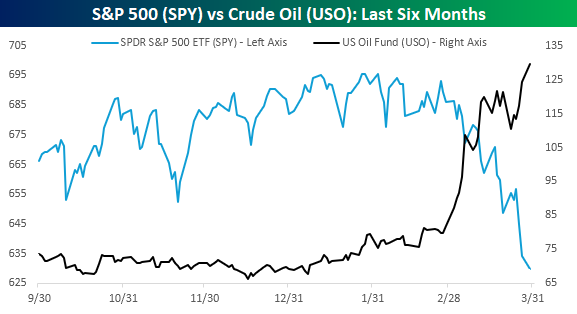
USO launched in 2006, and we compared the daily direction of the ETF and SPY for every trading day since its inception. The chart below shows the rolling 50-day total of the number of days that the two ETFs moved in opposite directions on the day. In the most recent 50-trading-day period, when USO zigged, SPY zagged 38 times, or 76% of all trading days. In the ETF’s history, its daily moves have never been more inversely correlated to the direction of SPY. The only other time the number of occurrences even approached current levels was back in August 2008. Ironically, that was also part of the price spike when crude oil first crossed $100, ultimately peaking above $147.
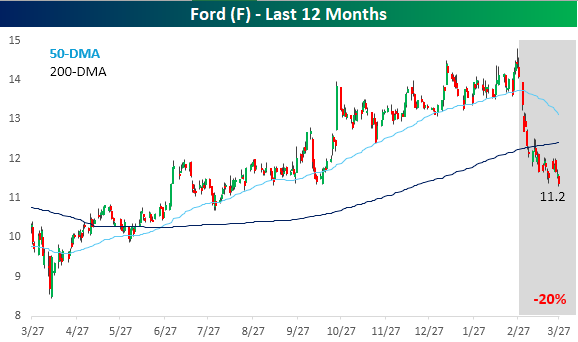
One sector that has felt the pain of higher oil prices is the traditional auto OEMS. Just moving alphabetically down the list, shares of Ford (F) had performed exceptionally well leading up to the war, with shares in a steady uptrend and trading at 52-week highs on the eve of the first missiles being fired. Since then, it’s down 20%.
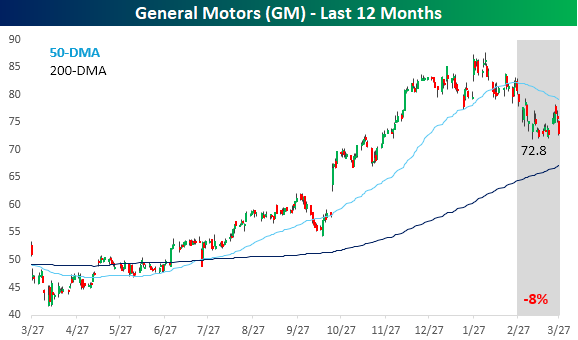
General Motors (GM) performance leading to the war was also very strong, and even though it wasn’t’ right at 52-week highs, shares were up more than 70% in the prior year. Shares have declined more than 17% from their peak and are down 8% since the war started.
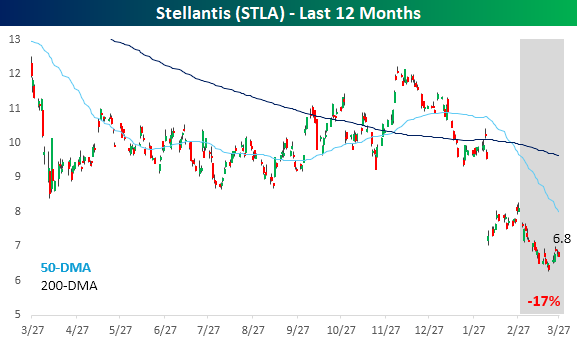
Unlike F and GM, Stellantis (STLA) was already weak leading up to the war and down sharply from its 52-week highs. Since then, it’s only got worse as shares are down 17% this month.
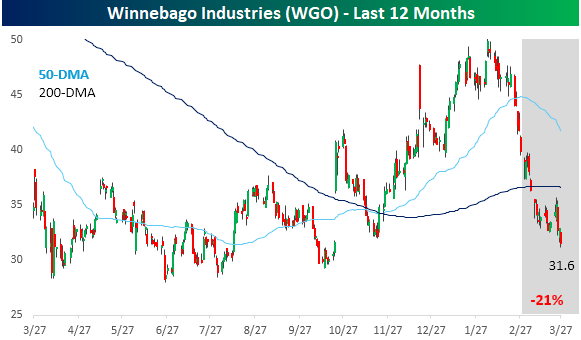
When you think of car stocks, Winnebago (WGO) may not be the first stock that comes to mind, but boy, is it ever exposed to higher gas prices. Right before the war, the stock was right at 52-week highs, perhaps on optimism that many Americans would take road trips to celebrate America turning 250. A month later, with gas prices at $4 per gallon nationwide, and suddenly that 10-mile-per-gallon gas guzzler doesn’t seem nearly as good an idea.
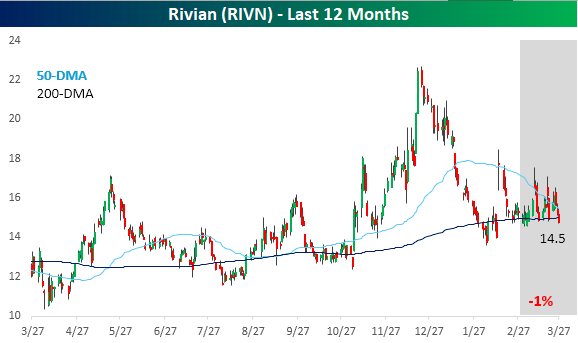
While traditional car companies with a focus on internal combustion engines have had a rough March, what about EV companies? Well, RIVN hasn’t rallied this month, but in this market, a decline of 1% is basically a win.
Until gas prices at the very least stop going up as quickly as they have, it’s going to be hard for these traditional auto stocks to get out of their own way.