Jan 8, 2024
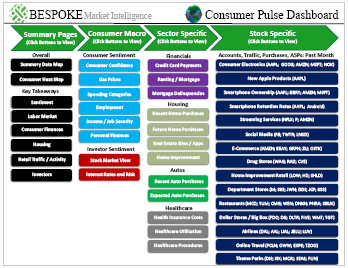
Bespoke’s Consumer Pulse Report is an analysis of a huge consumer survey that we run each month. Our goal with this survey is to track trends across the economic and financial landscape in the US. Using the results from our proprietary monthly survey, we dissect and analyze all of the data and publish the Consumer Pulse Report, which we sell access to on a subscription basis. Sign up for a 30-day free trial to our Bespoke Consumer Pulse subscription service. With a trial, you’ll get coverage of consumer electronics, social media, streaming media, retail, autos, and much more. The report also has numerous proprietary US economic data points that are extremely timely and useful for investors.
We’ve just released our most recent monthly report to Pulse subscribers, and it’s definitely worth the read if you’re curious about the health of the consumer in the current market environment. Start a 30-day free trial for a full breakdown of all of our proprietary Pulse economic indicators.
Jan 4, 2024
At the end of last year we wrote an educational post highlighting some of the similarities between the sports card collectibles industry and stock market investing. We wanted to see how well we’d do if we invested in some boxes of the newest baseball card product — 2023 Bowman Draft — featuring a rare Tom Brady autograph card and the rookie cards of Major League Baseball’s most recent batch of prospects. As we noted in our prior post, opening packs of cards is the riskiest part of the sports card industry. You simply don’t know which cards you’re going to pull, so your investment can quickly become close to worthless if you don’t pull any good cards, or you can hit it big by pulling a rare or highly sought-after card. In the sports cards world, opening sealed packs is similar on the risk scale to buying stock options in financial markets that can quickly move sharply higher or go to zero.
So how’d we do in our recent box break?
Below are pictures of the various cards we pulled across the six boxes we opened. All in all, of the 4,500 cards, we got 30 different autographed rookie cards along with dozens of “short-printed” parallel cards that are serial numbered. These serial-numbered cards are more rare and thus more valuable than the non-numbered “singles” that fill up the majority of packs that we opened.
Our best pull was a Paul Skenes blue autographed rookie card serial-numbered out of 150 that was selling for roughly $450 on eBay at the end of December. Skenes was the #1 overall pick last year by the Pittsburgh Pirates; a pitcher from LSU who is maybe most famous right now for dating LSU gymnast and NIL-celebrity Livvy Dunne.
After checking the most recent completed sale prices on eBay for all the cards we pulled, we found that the entirety of our collection was worth about 50% of our total purchase price of the six boxes. Ugh. We certainly didn’t find the rare Tom Brady that would have immediately doubled or tripled our initial investment!
From an investment standpoint, our experiment was not a success! Down the road, there’s a chance that one of the autographed rookie cards we pulled will skyrocket in value. After all, Mike Trout was a relative nobody when his rookie autographs first showed up in the 2009 version of the same product we opened. The least rare of the Trout rookie autographs currently sells for five figures. But the higher likelihood is that we’ll never make our initial purchase price back on these packs!
For any card collectors reading this that might see a card they’re interested in, feel free to reach out!


Jan 2, 2024
While broad swathes of the equity market rose in 2023, that is not to say there were not areas of weakness. Of course there were some major spotlight stocks that investors would have completely lost their shirt on like Silicon Valley Bank had they been invested in the beginning of the year, but for those stocks still standing, below we show the 35 Russell 1,000 members that fell by at least 30% during the year. 2021 short squeeze and meme stock darling AMC Entertainment (AMC) was the worst performer on the year in 2023. Price action in the stock was actually pretty flat throughout the year up until the summer. That’s when prices plunged on news that the company would be approved to convert its one year old preferred shares to common stock and a 1-for-10 reverse split. Ultimately, AMC would go on to finish the year with an 85% loss.
One theme popping up in the biggest losers is clean energy. As EV sales decelerated last year, prices of stocks like ChargePoint (CHPT) and Lucid (LCID) hit major speedbumps, falling by 75.55 and 38.36%, respectively. Other clean energy names like Enphase (ENPH) also faced large losses.
A handful of various retailers also made the list like Petco (WOOF), Advanced Auto Parts (AAP), and Dollar General (DG). Dollar General possesses the largest market cap of those stocks, but of all the biggest losers, the vaccine makers were the largest in size. Both Pfizer (PFE) and Moderna (MRNA) fell by over 40%. In the case of PFE, the stock is now below pre-pandemic levels.


Jan 2, 2024
In last Wednesday’s Closer, we noted how there was a somewhat elevated share of the S&P 500 experiencing gains of over 100%. Expanding to the Russell 1,000, there were 34 stocks with total returns of more than 100%. Two members of the Financials sector topped the list, Affirm (AFRM) and Coinbase (COIN), with gains of 408% and 391%, respectively. Two mega caps also found their ways into the top of the list in the five and seven spots: NVIDIA (NVDA) and Meta Platforms (META). One of NVIDIA’s largest competitors Advanced Micro (AMD) was also an over 100% gainer, though it falls a bit further down the list with a 127.8% gain. Other large caps like Broadcom (AVG) and Tesla (TSLA) also posted 100%+ gains.
Those semi conductor names were certainly boosted by the emergence of AI during the year, but other themes were also present among the year’s biggest gainers. For starters, cruise liners like Royal Caribbean (RCL) and Carnival (CCL) put big dents in their post pandemic recoveries with RCL even closing in on pre-pandemic highs. In spite of high rates tamping down demand, housing inventories are historically tight meaning there is an increasing importance on new inventories hitting the market. As we showed in our Annual Report, like AI, housing was also a major theme across earnings calls last year. That offers a potential boon to the homebuilders and it showed in stock performance in 2023. The homebuilder industry had strong representation with names like Builders FirstSource (BLDR), Top Build (BLD), PulteGroup (PHM), and Toll Brothers (TOL) posting over 100% gains.

Jan 2, 2024
2023 turned out to be a fantastic year for stocks after a horrible 2022. Below we show the average total return of all stocks in each sector of the Russell 1,000 in 2023. While most areas of the market moved higher during the year, the one area of equity markets that actually provided a negative return was Utilities. That sector’s stocks lost an average of 4.1% compared to a 20.5% average gain for the whole of the Russell 1,000. As a reminder, Utilities has the highest dividend yield of any sector, but even after factoring in those relatively high dividend yields, the average stock in the sector posted a negative total return in 2023. Consumer Staples just barely netted out an average gain, while Health Care, Energy, Real Estate, and Materials all also underperformed the broader index. That leaves Communication Services, Financials, Consumer Discretionary, Industrials, and Technology each with the average stock gaining more than 20% on the year. Given the emergence of AI in 2023, Tech was the top performer. In fact, the average Tech stock was up 43.8%, which was more than twice that of the average Russell 1,000 stock.


