Feb 29, 2024
The average S&P 500 stock rose 3.87% in February even though the index itself was up more than 5%. You can check out the performance of various ETFs across asset classes in February in this post, but below we take a look at the best and worst-performing individual S&P 500 names during the month.
While NVIDIA (NVDA) got a lot of attention (as always) after its most recent blowout earnings report, two stocks outdid the “King of AI” in February: Constellation Energy (CEG) and Ralph Lauren (RL).
Additional big winners in February included 20%+ gainers like Quanta Services (PWR), GE HealthCare (GEHC), Axon Enterprise (AXON) — the maker of Tasers and video software for police departments, Tapestry (TPR), and Uber (UBER). Other notables include Diamondback Energy (FANG), NXP Semi (NXPI), General Electric (GE), Vulcan Materials (VMC), and Eli Lilly (LLY). And finally, even Disney (DIS) managed to make the list of the 30 biggest winners in February with a gain of 16.17%.

Not everything went up during the month, however. In fact, of the S&P’s 500 stocks, 350 were up and 150 were down in February. That’s pretty weak breadth for a 5%+ up month.
Below is a list of the 30 S&P 500 stocks that fell the most in February. Notably, three of the five biggest losers were from the Communication Services sector: Paramount (PARA), Charter (CHTR), and Warner Bros. (WBD). Other big blue chips that fell in February include Amgen (AMGN), Adobe (ADBE), Palo Alto Networks (PANW), Comcast (CMCSA), and Deere (DE).


Feb 29, 2024
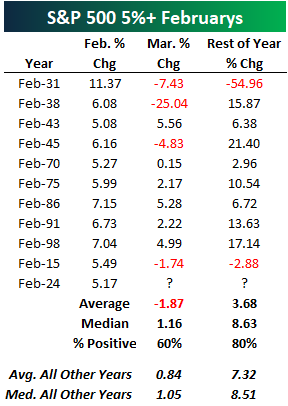
The S&P 500 finished February with a gain of more than 5% for just the 11th time in the index’s history since 1928. Below is a look at prior 5%+ gains in February along with the S&P 500’s performance in March and for the remainder of each year. The last time we had a 5% February was 2015. That March, the S&P fell 1.74%, and the index fell 2.88% from the end of February through year-end. Let’s hope we don’t see that type of action for the remainder of 2024, although a repeat of 2015 would be a lot better than what investors experienced in 1931 when the S&P rallied 11.37% in February only to fall 54.96% for the rest of the year!
Below is a look at our key ETF performance matrix highlighting total returns across asset classes in February, year-to-date, and year-over-year. Mid-cap growth (IJK) was the best area of US markets in February with a 9.58% gain. Dividend stocks (DVY) were the weakest area with a gain of just 1.16% during the month. Looking at sectors, Consumer Discretionary (XLY), Industrials (XLI), and Materials (XLB) actually performed the best in February, beating out Tech’s (XLK) gain of just 4.7% even though the semis (SMH) were up 14%.
Outside of the US, China (ASHR) finally had a big month along with Israel (EIS), which gained 8.6%. Mexico (EWW) and Spain (EWP) were the only two country ETFs that fell in February.
Natural gas (UNG) once again fell sharply, adding to its year-over-year decline of more than 50%. Finally, fixed income ETFs were broadly lower in February, led down by the 20+ Year Treasury ETF (TLT).

Within the S&P 500, there are 67 stocks that show up in at least one of eight “AI” ETFs traded here in the US. As shown below, the 67 “AI” stocks in the S&P were up an average of 5.7% in February compared to a gain of 3.6% for the 433 non-AI stocks. On the year, the 67 “AI” stocks are up 5.9% versus a gain of 2.6% for the non-AI stocks. Given how much some of the most well-known AI names like NVIDIA (NVDA) are up so far in 2024, it’s surprising to us that there isn’t even more separation in performance between the AI and non-AI groups.

Feb 29, 2024
See what’s driving market performance around the world in today’s Morning Lineup. Bespoke’s Morning Lineup is the best way to start your trading day. Read it now by starting a two-week trial to Bespoke Premium. CLICK HERE to learn more and start your trial.
“We must walk consciously only part way toward our goal, and then leap in the dark to our success.” – Henry David Thoreau

Below is a snippet of commentary from today’s Morning Lineup. Start a two-week trial to Bespoke Premium to view the full report.
When looking at the market’s longer-term trend, we like to use a chart of the S&P 500’s 200-day moving average on its own with the daily price changes removed from the chart completely in order to eliminate the day-to-day noise and smooth the trend out. What’s notable here is that the S&P’s 200-day just recently took out its prior all-time high made in early 2022, ending a streak of 460 trading days without a new all-time high for the 200-DMA. While the S&P made a new all-time high on its daily price chart back in January, a new all-time high for the smoothed out 200-DMA is yet another confirmation of the current bull that has been legging higher for the last month or so.


For more analysis of global equities and economic readings released this morning, read today’s full Morning Lineup with a two-week Bespoke Premium trial.
Feb 26, 2024
NVIDIA (NVDA) is up nearly 2,000% over the last five years, but would you believe that there’s another stock — a non-AI stock — that’s up even more?
As shown below, while NVDA is up 1,937% since February 2019, cosmetics-maker e.l.f. Beauty (ELF) has that number beat with an even bigger gain of 2,639%!

While the two are in completely different industries, one thing they have in common is their penchant for reporting earnings triple plays. As a reminder, an earnings triple play occurs when a stock reports earnings and 1) beats analyst EPS estimates, 2) beats analyst sales estimates, and 3) raises forward guidance.
As shown in the snapshot from our interactive Earnings Explorer below, NVIDIA (NVDA) has now reported five earnings triple plays in a row.

e.l.f. Beauty (ELF) has that topped, though, with seven triple plays in a row dating back to August 2022!

If you’re interested in reading about more stocks that have recently reported earnings triple plays, start a Bespoke Institutional (All Access) trial today and access our latest Triple Play Report (thumbnail preview below).

Feb 26, 2024
This content is for members only
