
Bitcoin, IBIT Trounce Stocks
The iShares Bitcoin ETF (IBIT) has been the fastest-growing ETF of all time, eclipsing $70 billion in assets in less than 18 months and currently up to $85 billion. That’s already big enough to rank it in the top 20 or so of the largest “mega-ETFs” in the US.
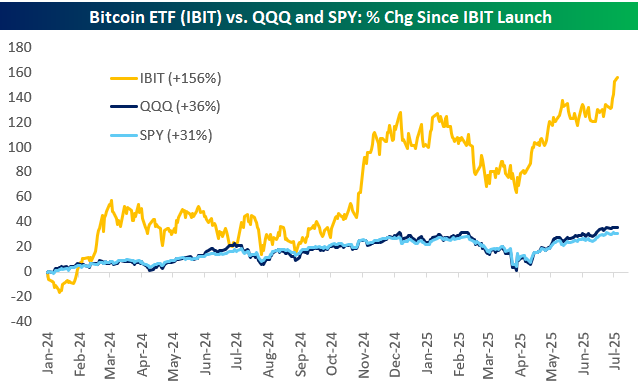
Since its closing price on launch day back on January 11th, 2024, IBIT is up 156%. That compares to gains of 36% for the Nasdaq 100 ETF (QQQ) and 31% for the S&P 500 ETF (SPY).
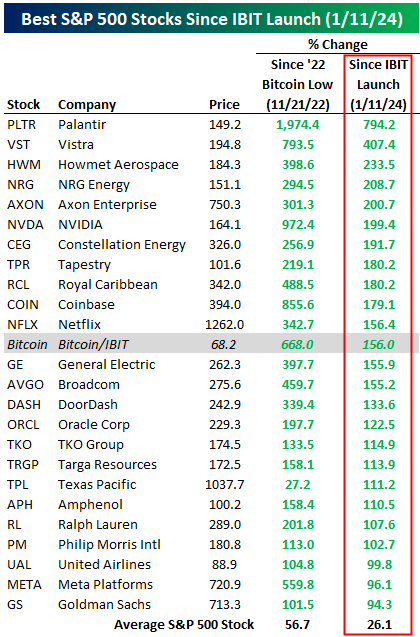
Compared to current S&P 500 stocks, IBIT’s gain of 156% since it launched on 1/11/24 would rank 12th in terms of performance. There are eleven stocks in the index up even more than that, led by Palantir’s (PLTR) gain of 794%. Other big winners since IBIT launched include Vistra (VST), Howmet Aerospace (HWM), Axon (AXON), NVIDIA (NVDA), Tapestry (TPR), Royal Caribbean (RCL), Coinbase (COIN), and Netflix (NFLX). There are 21 stocks in the S&P up more than 100% since IBIT’s launch in early 2024, while the average stock in the index is up 26.1%.
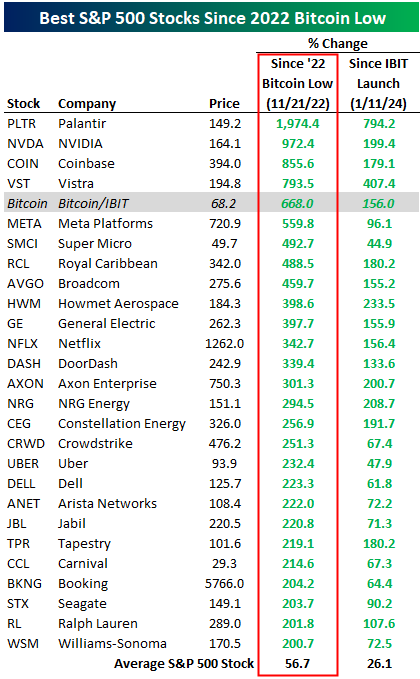
Bitcoin prices were in the mid-$10,000s back in November 2022. Since its low point during that month, Bitcoin is up 668%. We also looked to see how that gain compares to the best-performing S&P 500 stocks over the same time frame. As shown below, just four stocks in the index are up more than Bitcoin since its 2022 low: Palantir (PLTR) — up nearly 2,000%, NVIDIA (NVDA) — up nearly 1,000%, Coinbase (COIN), and Vistra (VST). Another four stocks are up more than 400% over the same time frame: Meta (META), Super Micro (SMCI), Royal Caribbean (RCL), and Broadcom (AVGO).

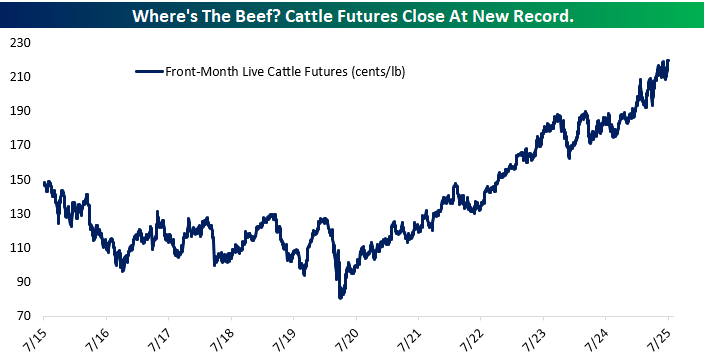
Cattle Futures and Cattle to Corn Ratio Hit Record Highs
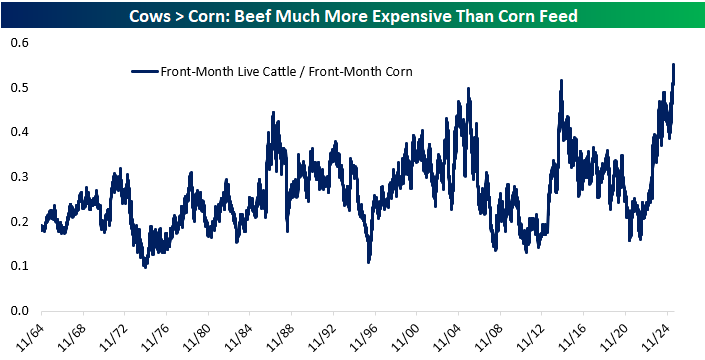
Beef prices continue to sizzle. Live cattle futures just closed at a new all-time high, climbing to $2.20 per pound after a multi-year rally that’s been quietly unfolding since mid-2020. While inflation has cooled in many parts of the economy, the beef market remains red-hot, driven by a combination of shrinking cattle herds, ongoing drought conditions in key ranching states, and steady consumer demand for beef across both retail and food service channels.
What makes this even more striking is how cheap corn, the primary feedstock for cattle, has remained in relative terms. A long-term chart of the cattle-to-corn ratio shows that beef has never been this expensive relative to feed costs, with the spread hitting its highest point in over six decades. For cattle producers, this is an extremely favorable setup: high output prices and low input costs translate into wide margins.
This divergence has interesting implications. Publicly traded meat processors could benefit from stronger margins. It also speaks to broader commodity cycles: while grain prices have cooled post-Ukraine shock, protein prices have marched higher. If you’re looking for margin tailwinds in the ag and food supply chain, the beef market is one to chew on.
UPDATE: Biggest Winners and Losers Since the Release of ChatGPT
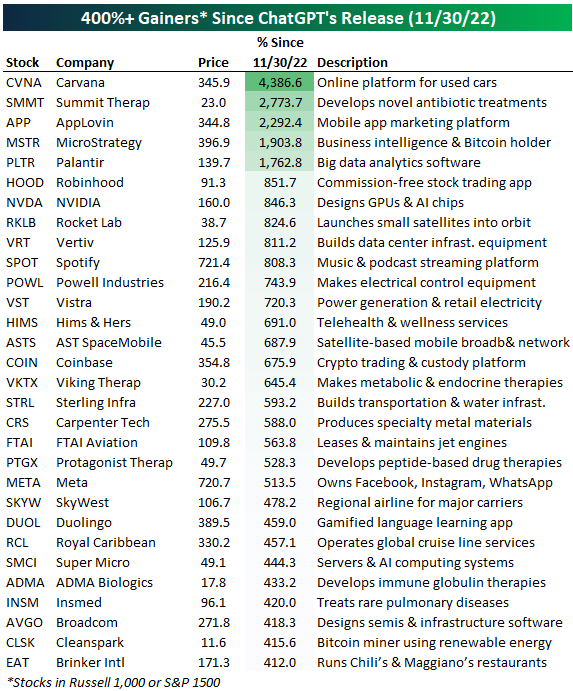
Since the launch of ChatGPT in November 2022, the stock market has seen an explosion of interest in companies exposed to artificial intelligence, digital transformation, and infrastructure innovation. While the average stock across the Russell 1,000 and S&P 1,500 is up roughly 50% since 11/30/22 when ChatGPT launched, there are 30 stocks that have gained more than 400%.
The list of 400%+ gainers since AI’s pivotal moment highlights several key themes driving outsized performance. At the top is Carvana (CVNA) with a staggering 4,386% gain, an example of a distressed digital-first business that rebounded sharply as cost-cutting, improved execution, and investor optimism around e-commerce platforms collided. Similarly, Summit Therapeutics (SMMT) and AppLovin (APP) reflect how early-stage biotech breakthroughs and ad-tech optimization powered by AI can supercharge investor enthusiasm, with both stocks up over 2,700%.
The AI boom itself is strongly represented: NVIDIA (NVDA), the GPU powerhouse enabling nearly all modern AI workloads, has surged 846%, while companies like Super Micro Computer (SMCI) and Vertiv (VRT) have ridden the infrastructure tailwinds, supplying AI servers and data center power/cooling systems. On the software side, Palantir (PLTR) and Meta (META) are capitalizing on surging enterprise demand for AI-driven insights and next-gen consumer experiences.
Beyond AI, this list captures a broader tech renaissance: MicroStrategy’s (MSTR) embrace of Bitcoin, Coinbase (COIN) benefiting from crypto’s resurgence, and Duolingo (DUOL) leveraging gamified ed-tech all reflect how tech adaptability is being rewarded. Meanwhile, healthcare and biotech have seen some stealth rallies too, with Hims & Hers (HIMS), Protagonist Therapeutics (PTGX), and ADMA Biologics (ADMA) riding innovation in drug delivery, telehealth, and immune therapies. Even travel and leisure names like Royal Caribbean (RCL) and SkyWest (SKYW) are enjoying massive comebacks as post-pandemic demand meets operating leverage.
In short, the market’s biggest winners since the AI boom began aren’t just about chips and chatbots. They span digital platforms, infrastructure enablers, health breakthroughs, and comeback stories, all unified by their exposure to innovation, scalability, and renewed investor confidence.
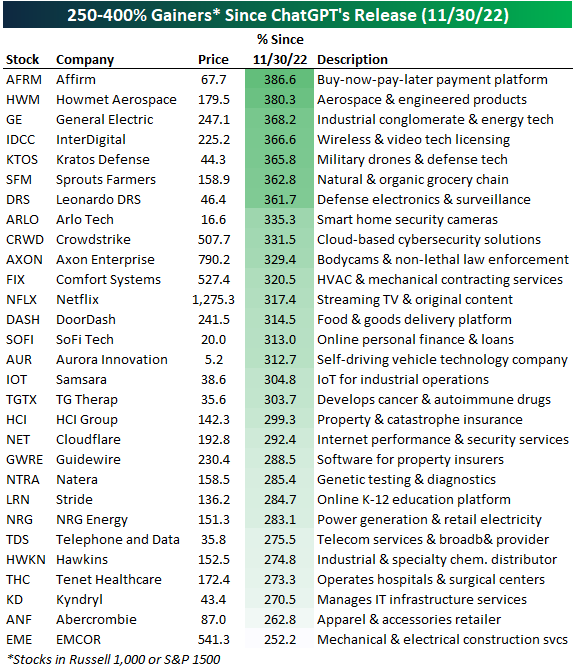
There are another 29 stocks up between 250% and 400% since ChatGPT’s release, which we show in the table below.
The list of 250% to 400% gainers since the launch of ChatGPT in November 2022 showcases a diverse group of companies benefiting from technological disruption, infrastructure tailwinds, and consumer trends. Leading the pack is Affirm (AFRM), up nearly 387%, as investors embrace the resurgence of digital lending and Buy-Now-Pay-Later platforms amid a growing shift in consumer payment behavior. Industrial heavyweights like Howmet Aerospace (HWM) and General Electric (GE) also made major strides, reflecting renewed investor interest in manufacturing, defense, and energy transition infrastructure.
On the software side, the gains in CrowdStrike (CRWD), Cloudflare (NET), and Guidewire (GWRE) highlight how enterprise IT security and insurance software remain core beneficiaries of the digital transformation. Consumer-facing names like Netflix (NFLX) and DoorDash (DASH) continue to outperform as scale, brand loyalty, and subscription models drive durable growth.
Altogether, many of these names may not have made headlines like the mega-cap AI leaders, but their gains reflect a broader, powerful undercurrent of digital acceleration and operational leverage across the economy.
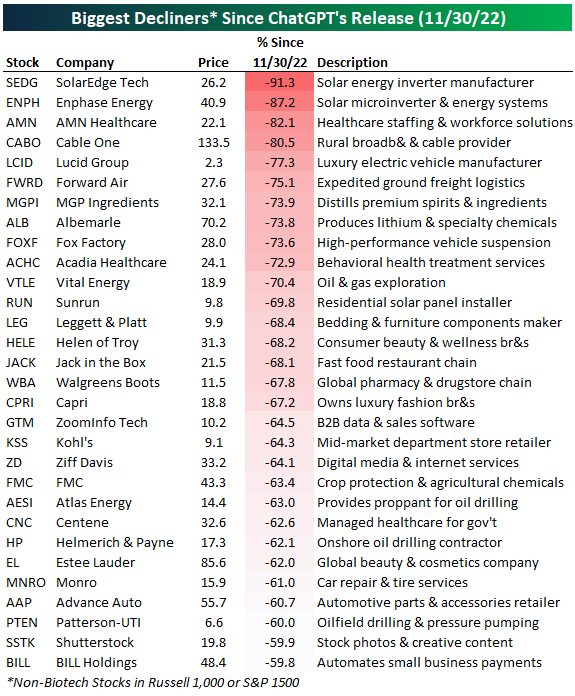
The list of biggest decliners since ChatGPT’s release in November 2022 paints a sobering picture of sectors and business models that have struggled to gain traction in a rapidly shifting market landscape. Solar energy names have been hit the hardest, with SolarEdge (SEDG) and Enphase Energy (ENPH) each down over 85%, victims of rising rates, margin compression, and a post-IRA (Inflation Reduction Act) hangover that failed to meet investor hype. These moves show how even long-term secular themes like clean energy can suffer during periods of tightening financial conditions and execution hiccups.
Other notable losers include AMN Healthcare (AMN) and Acadia Healthcare (ACHC), which struggled as labor costs and reimbursement pressures weighed on the post-pandemic healthcare sector. Consumer-facing brands like MGP Ingredients (MGPI), Helen of Troy (HELE), and Capri Holdings (CPRI) saw sharp drawdowns, reflecting broader concerns around slowing discretionary spending and inventory issues. On the industrial side, stocks like Lucid (LCID) and Forward Air (FWRD) highlight the risks of capital intensity and poor cost control, while ZoomInfo (GTM) and Ziff Davis (ZD) show how some B2B tech and digital media firms are being rerated lower in a more selective market for growth.
Fossil (FOSL): From 8,000% to 6%
Fossil Group (FOSL) was one of the biggest post-financial crisis winners in the market, with its stock surging to a post-IPO gain of more than 8,000% at its highs in the mid-2010s. The company had built a dominant brand in watches, and investors rewarded it with a meteoric run that outpaced just about everything else at the time. But as the chart below shows, that entire move ultimately proved fleeting. Today, FOSL is up just 6% since its IPO in 1993, while the S&P 500 is up more than 2,500%. So what happened?
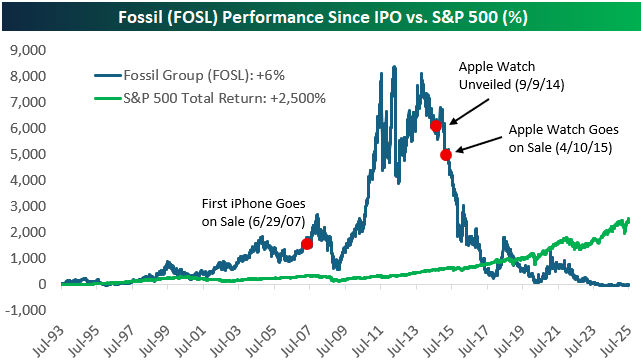
The turning point came in September 2014 when Apple unveiled the Apple Watch. At the time, the product hadn’t launched yet and there was still plenty of debate over whether consumers would embrace wearable tech. But investors didn’t wait to find out. FOSL’s stock started dropping almost immediately and has never recovered. As Apple’s ecosystem expanded, Fossil’s relevance shrank, and the stock followed.
Fossil wasn’t a company in obvious decline when the Apple Watch was announced. In fact, its fundamentals were still strong. But the market is forward-looking, and it doesn’t wait for earnings reports to adjust. Just the idea of a better product from a bigger competitor was enough to spark a mass exodus. While consumers were still deciding if they needed a smartwatch, Wall Street had already moved on.
That’s why this chart matters for today’s winners. Any of the stocks leading the market higher right now could be like Fossil in 2014. Massive runs, strong fundamentals, and dominant positions in a booming narrative. But disruption rarely announces itself in advance, and today’s leaders don’t have to stumble on their own to fall out of favor. All it takes is a shift in the landscape, whether it’s a better chip, a new platform, or a change in demand.
No one’s saying today’s market leaders are doomed, but Fossil’s chart is a reminder of how quickly things can turn, and how the market often sees it before the headlines do. Even an 8,000% gain can vanish if the narrative flips. It’s a good reason to stay humble and diversified and always think about what’s coming around the corner.