See what’s driving market performance around the world in today’s Morning Lineup. Bespoke’s Morning Lineup is the best way to start your trading day. Read it now by starting a two-week trial to Bespoke Premium. CLICK HERE to learn more and start your trial.
“We must go on, because we can’t turn back.” – Robert Louis Stevenson

Below is a snippet of commentary from today’s Morning Lineup. Start a two-week trial to Bespoke Premium to view the full report.
It’s over. After 43 days, the longest Federal Government shutdown has ended, and investors don’t know whether to smile or cry. While Washington was closed, the S&P 500 rallied 2.4% and the Nasdaq rallied 3.33%, but the Equal-weight S&P 500 was up just 0.1%, so maybe where you were invested depends on how you feel. Markets aren’t exactly sure how to react either, as equity futures trade modestly lower with the S&P 500 indicated to open down 0.1%. Treasury yields are modestly higher, which makes sense since all they do in Washington is spend money they don’t have. Meanwhile, crude oil is up fractionally after plunging below $60 per barrel yesterday, while gold and bitcoin rally.
In Asia overnight, major equity indices were higher across the board with gains of less than 1%. Loan data out of China was weaker than expected, while PPI in Japan rose less than expected, and employment data in Australia was better than expected.
In Europe, trading has been mixed. The STOXX 600 is down fractionally, led lower by Germany and the UK, while Italy, France, and Spain are all higher. Industrial Production in Europe missed by a lot in September as the year/year growth rate of 1.2% missed forecasts by nearly a full percentage point.
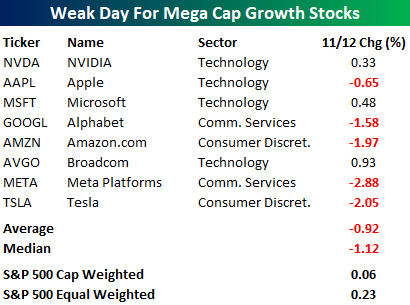
As the Dow rallied to a record high yesterday, the S&P 500 barely gained, and the Nasdaq finished down 0.26% as megacap growth stocks acted as a drag. Of the eight trillion-dollar market cap growth stocks, five finished down on the day, with four trading down over 1%. Their median decline was just over 1% compared to a gain of 0.06% for the cap-weighted S&P 500 and 0.23% for the equal-weighted index.
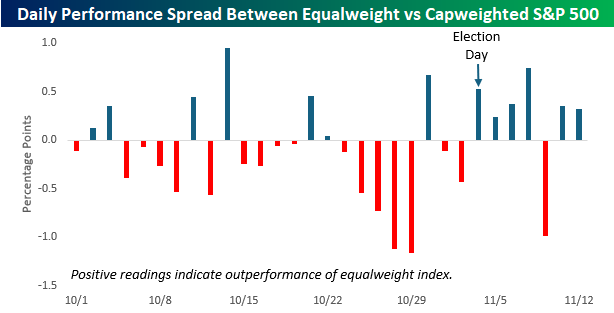
With no economic data to speak of, all anyone could talk about during the shutdown seemed to be the outperformance of the cap-weighted S&P 500 versus the equal-weight index. On 16 of the month’s 23 trading days, the equal-weight index underperformed the cap-weight index, and towards the later part of the month, the daily divergences were increasingly wide, with spreads of more than a full percentage point on 10/28 and 10/29. That certainly raised some eyebrows!
Just as the underperformance of the equal-weight index reached an extreme, though, the trend started to reverse, and so far this month, the equal-weight index has outperformed the cap-weighted index on six out of eight trading days. Since Election Day, when it became clearer that the shutdown was nearing an end, there has only been one day when the equal-weight index underperformed.
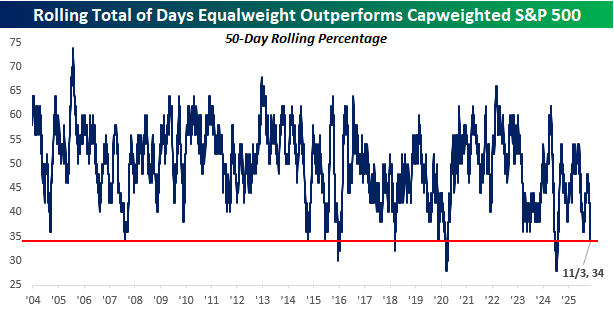
Even with the recent broadening of the market, the overall trend of the cap-weighted index outperforming has remained entrenched. The chart below shows the rolling 50-day percentage of days where the equal-weight S&P 500 outperformed the cap-weighted index. As of 11/3, the percentage dropped to 34% which was the lowest since last summer and a level that has only been breached to the downside a handful of other times in the last 20 years, with all of them occurring in the last ten years as markets have become more concentrated at the top.
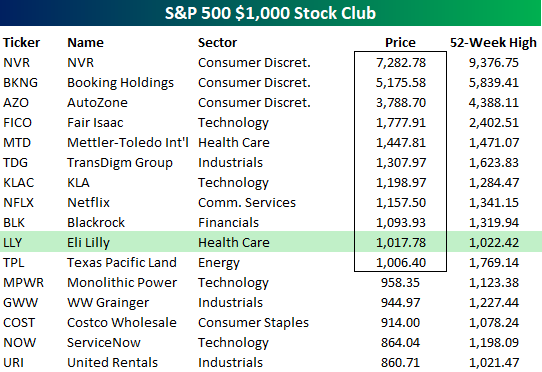
Another notable milestone was reached yesterday as the $1,000 stock price club gained another member when shares of Eli Lilly (LLY) rallied 3% to a record high of $1,017.78. At current prices, LLY is one of eleven companies in the S&P 500 with a four-digit share price, and one of 16 that have had a four-digit share price at some point in the last year. Homebuilder NVR (NVR) and travel company Booking Holdings (BKNG) both have share prices in excess of $5,000, and NVR even got within 6.3% of the five-digit club last November. Just like stock splits, share prices have no meaningful impact on the fundamentals of a company, and are more of a status symbol than anything else, but with the penny going away yesterday, we find it fitting that the $1,000 club got another member, and we only expect to see more in the years ahead. A thousand dollars isn’t what it used to be!