Outperformers Underperform
This morning, we highlighted the recent performance of sector ETFs noting how Health Care has led the way higher rising the furthest above its 50-DMA. Consumer Discretionary (XLY), Technology (XLK), Materials (XLB), Communication Services (XLC), and Consumer Staples (XLP) each had also risen above their 50-DMAs. Given their outperformance, as shown in the table below, headed into today these were the sectors closest to their levels on the S&P 500’s last all time high on February 19th. The Health Care ETF (XLV) actually headed into today less than 2% away from its 2/19 levels and XLP was also under 10% away.

Today, that performance was turned on its head as some of the sectors that have been playing catch up outperformed while those that have been the outperformers recently underperformed. Whereas it has typically been the strongest sector, Health Care (XLV) actually fell the most dropping ~2%. On the other hand, Energy (XLE) rose over 2.1% and it even finally rose above its 50-DMA. Other areas of strength today included Financials, Industrials, and Materials which all finished up over 1%. Recent winners were the losers today while the recent laggards were today’s winners. Start a two-week free trial to Bespoke Institutional to access our full range or research and interactive tools.

Who Is Now Overbought?
Over the past couple of weeks, as equities have mean reverted, the vast majority of S&P 500 stocks have moved out of oversold territory. In fact, today there are just two stocks that are oversold: Everest (RE) and Southwest Airlines (LUV). Meanwhile, more and more stocks have gotten extended above their 50-DMAs. At the moment, there are around 16% of stocks in the S&P 500 that are overbought. That is certainly not a large amount of the index, but it is the most we have seen in some time now.

Taking a look across the stocks that are currently overbought, very few of them were those that had gotten hit the hardest from the February 19th peak to the March 23rd low. In fact, of the 100 worst performing S&P 500 stocks in that period, there is only one that is overbought, Truist Financial (TFC), and there are only twelve (including TFC) that have retaken their 50-DMAs. Currently, the median distance from the 50-DMA of those 100 worst performers from 2/19 through 3/23 is 9.31% below their 50-DMA. In other words, the hardest hit stocks during the worst of the sell off have still yet to completely mean revert (more specifically, move back to their 50-day average).
As for the stocks that have mean reverted and are now looking a bit extended (at least 1 standard deviation above their 50-DMAs), most were of the better performing half of the S&P 500. In the table below, we show the 40 names that were hit the hardest during the sell off from 2/19 through 3/23 out of the 77 S&P 500 stocks that are currently overbought. While these are the worst hit of the currently overbought stocks, most of these were actually some of the strongest performers of the broader S&P 500 during the sell off though that does not mean they were totally immune from massive declines. For example, 17 of these stocks were in the top 100 best performers during the sell off. On the other hand, only three stocks, Truist Financial (TFC), Hologic (HOLX), and Humana (HUM) were in the bottom performing half of the index during the sell off. The massive rebounds that these names have staged has led them to their current overbought levels. Overall, due to the size of the massive declines in February and March, the hardest hit stocks in the S&P 500 have rallied considerably but have not yet reached overbought territory so much as even retaken their 50-DMAs. That means that many of the least hard hit stocks are the ones that have first reached and are currently sitting in overbought territory. Start a two-week free trial to Bespoke Institutional to access our full range of research and much more.
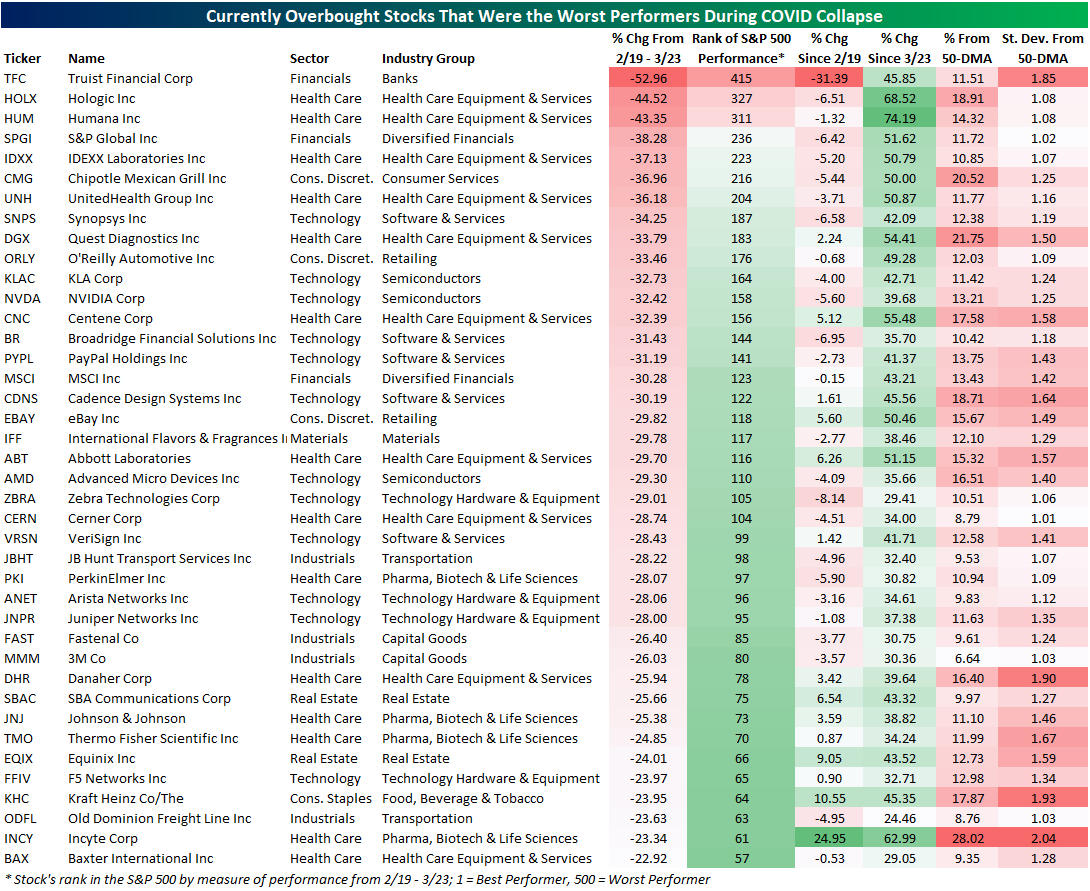
Chart of the Day – Consumer Confidence Craters
More and More Equity Market ETFs Back Above Their 50-DMAs
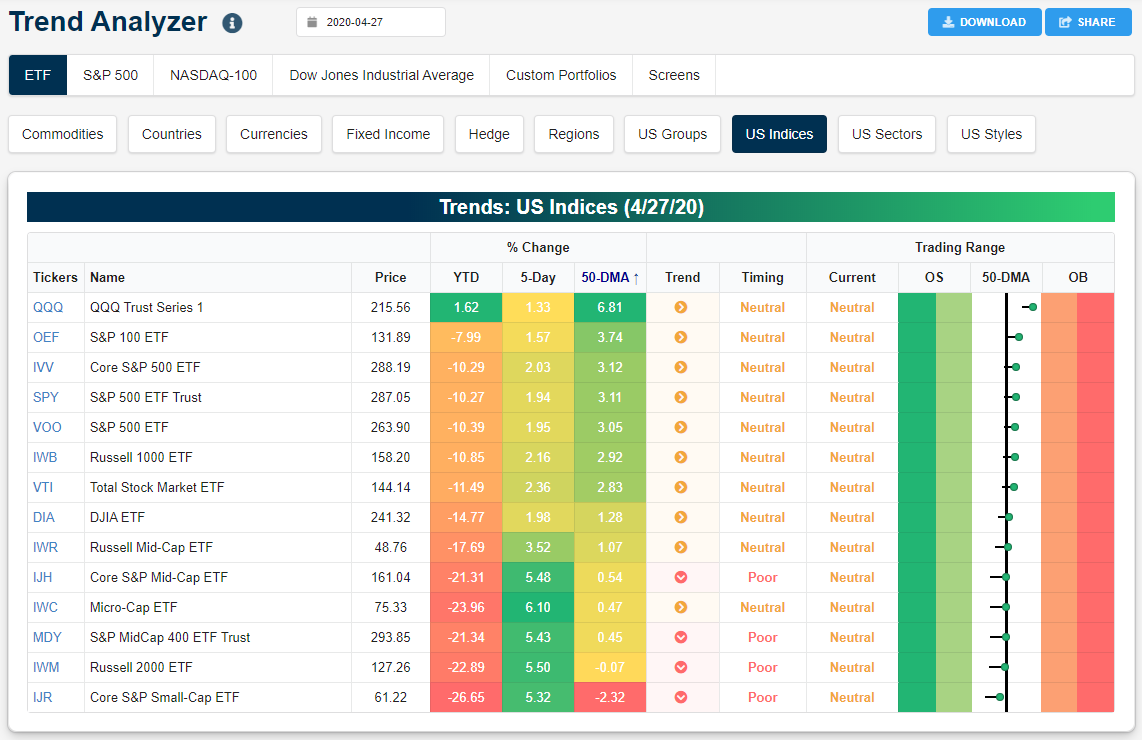
It hasn’t been talked about much but the Nasdaq 100 (QQQ) remains up on a year-to-date basis with a 2020 gain so far of 1.62%. Below is a snapshot of QQQ and other major US index ETFs run through our Trend Analyzer tool that’s available to Bespoke Premium and Bespoke Institutional members. Note that all but two of these index ETFs have now moved back above their 50-day moving averages, which often acts as a key support/resistance level. The Nasdaq 100 (QQQ) is the farthest above its 50-DMA at +6.81%, followed by the S&P 100 (OEF) and the three main S&P 500 ETFs (IVV, SPY, VOO). The Total Stock Market ETF (VTI) is 2.8% above its 50-DMA, while the mid-cap ETFs like IWR, IJH, and MDY are all just slightly above their 50-DMAs. While the Micro-Cap ETF (IWC) is above its 50-DMA, the two main small-cap ETFs (IWM, IJR) are the ones that remain slightly below. Start a two-week free trial to Bespoke Institutional to access our interactive economic indicators monitor and much more.
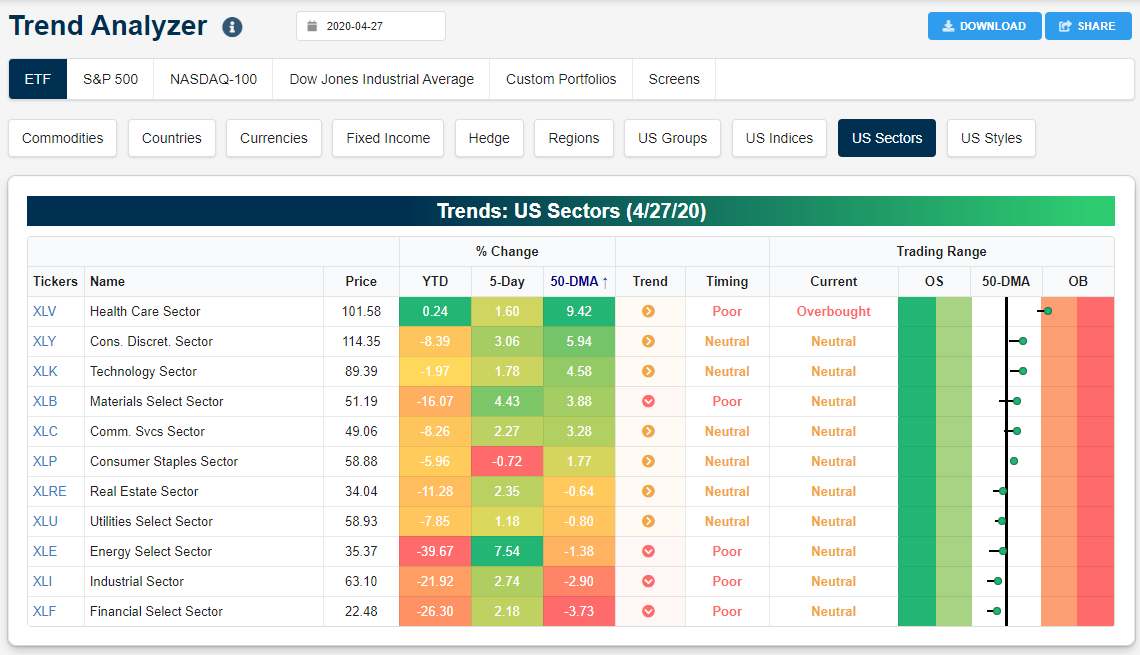
Below is a snapshot of the main S&P 500 sector ETFs from our Trend Analyzer tool. While almost all of the broad US index ETFs are back above their 50-DMAs, only six of eleven of the sector ETFs have re-taken them. The Health Care sector (XLV) is the farthest above its 50-DMA at +9.42%, and Health Care is the only sector that is now trading in overbought territory. It’s also the only sector that’s up year-to-date, similar to QQQ. Consumer Discretionary (XLY), Technology (XLK), Materials (XLB), Communication Services (XLC), and Consumer Staples (XLP) are the other five sectors above their 50-DMAs.
On the downside, the Energy sector (XLE) is no longer the farthest below its 50-DMA; that title now belongs to Financials (XLF) which is 3.73% below. The Industrials sector (XLI) is 2.9% below its 50-DMA, followed by Energy (XLE) at -1.38% and Utilities (XLU) at -0.80%.
While Health Care is up on the year, three sectors — Energy, Industrials, and Financials — are still down more than 20% year-to-date. Gain access to our Trend Analyzer tool and our daily investment research with a two-week free trial to Bespoke Premium.
Five Largest Market Caps Report This Week — AAPL, AMZN, FB, GOOG, MSFT
The earnings slate ramps up in a big way this week. Included in the 784 total companies reporting this week are the five largest stocks in the S&P 500. As shown below, Alphabet (GOOG) will kick things off tomorrow followed by Facebook (FB) and Microsoft (MSFT) on Wednesday and Amazon (AMZN) and Apple (AAPL) Thursday evening.

Our Earnings Explorer tool lets users conduct in-depth analysis of individual companies and how their share prices typically react to quarterly results. Below we highlight the ins and outs of quarterly earnings for the five largest stocks in the S&P 500 — all of which report Q1 results this week.
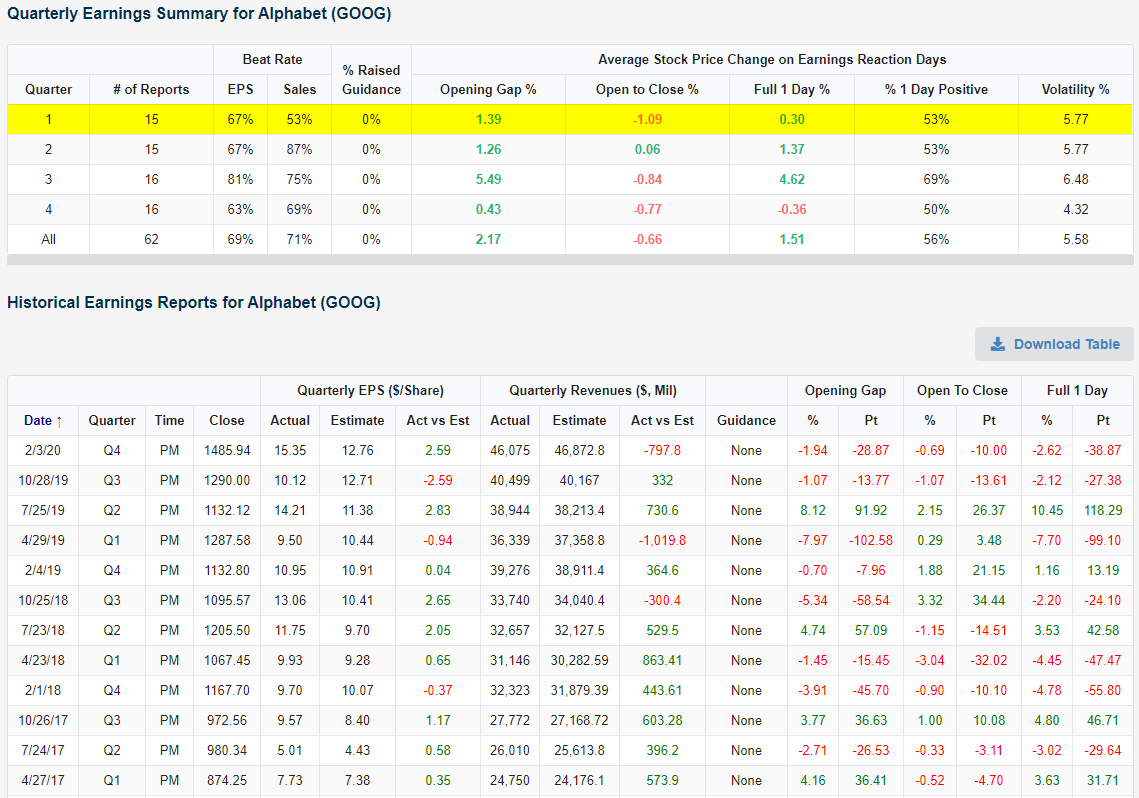
Below is a snapshot from our Earnings Explorer that shows how Alphabet’s (GOOG) share price has historically performed on its earnings reaction day. For GOOG’s Q1 earnings report specifically, the stock has historically averaged a small one-day gain of 0.30% in reaction to the news with positive returns just 53% of the time. Conversely, GOOG’s best earnings reports have come on its Q3 release where the stock has averaged a one-day gain of 4.62% in reaction to the news. For GOOG, the first quarter has also been the one that the company most often misses sales estimates.
As for Facebook (FB), which reports on Wednesday, historically the stock has beaten EPS estimates 94% of the time and sales estimates 90% of the time. In terms of share price reaction, FB has been a big winner on earnings with an average one-day gain of 2.7%. Looking at Q1 specifically, FB shares have averaged a gain of 3.38% on earnings reaction days with positive returns 57% of the time.

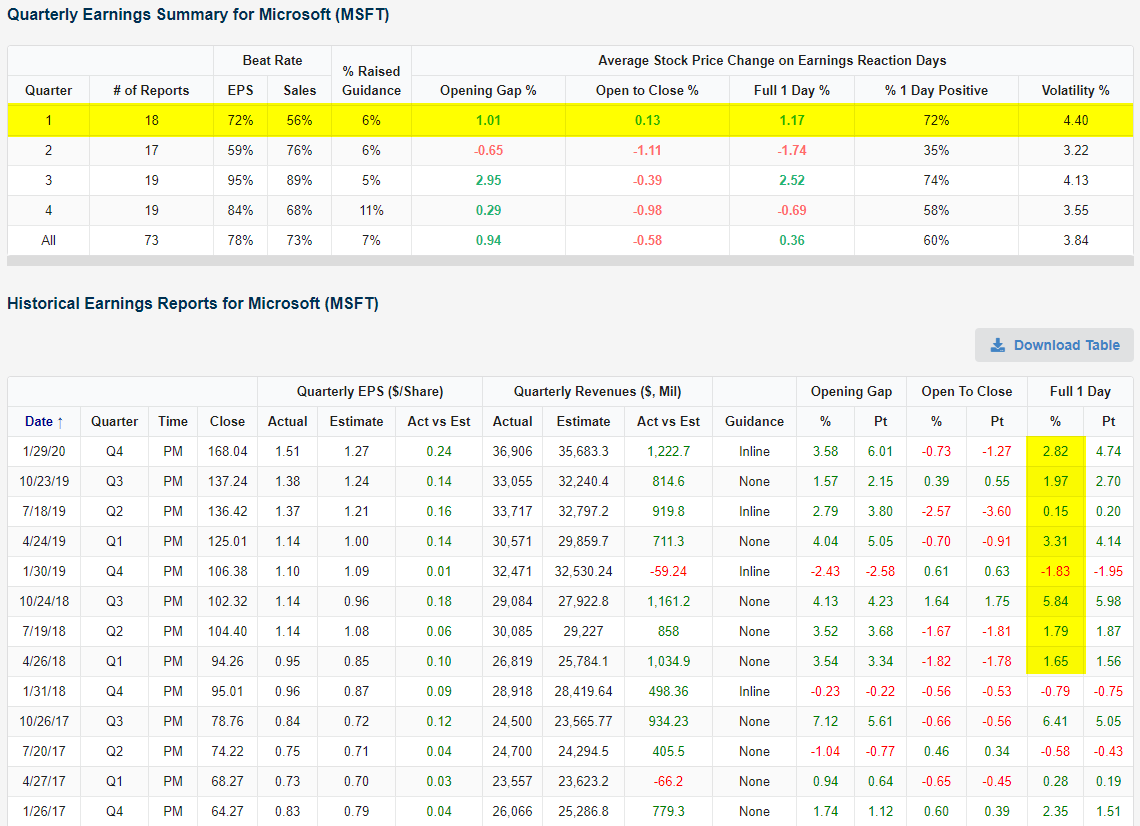
Microsoft (MSFT) heads into Q1 earnings as the largest stock (by market cap) in the S&P 500 and on a bit of a hot streak. As shown in the snapshot below, MSFT has seen gains on seven of its last eight earnings reaction days dating back to April 2018. On Q1 earnings days, MSFT has averaged a full day gain of 1.17% and has closed higher 72% of the time. Q3 is the only other quarter that has seen MSFT average gains on earnings reaction days. The worst quarter for MSFT earnings has historically been Q2 (reported in July). MSFT has averaged a decline of 1.74% on its Q2 earnings reaction days with positive returns only 35% of the time.
Amazon (AMZN) has been notable recently in that it managed to break out to fresh all time highs. With that strength at its back, AMZN heads into what is typically its strongest quarter in terms of share price reaction. Amazon has the highest sales and beat rates in the first quarter, and as a result, the strongest stock price reaction of any quarter. As shown below, AMZN has averaged a full day gain of 4.86% on Q1 earnings days compared to a 1.23% gain for all quarters. It has also been in the green around two-thirds of the time.

Like AMZN, Apple (AAPL) also heads into what has historically been one of its strongest quarters for earnings on a hot streak. The stock has risen on every earnings day of the past five quarters and Q1 earnings has been the second strongest for the stock with an average one-day gain of 2.07%. Additionally, every quarter of the past year has seen Apple report a triple play (EPS beat, sales beat, raised guidance). While nothing is out of the realm of possibilities, given the current environment’s impact on business, it is questionable if the company will keep up that streak of triple plays. For example, today it was reported that there will be delays in the new iPhone’s production. Regardless of whether or not the triple plays streak stays alive, AAPL has been seasonally strong in Q1, consistently beating EPS and sales estimates with the stock price reacting accordingly. Start a two-week free trial to Bespoke Institutional to access our interactive Earnings Explorer and much more.
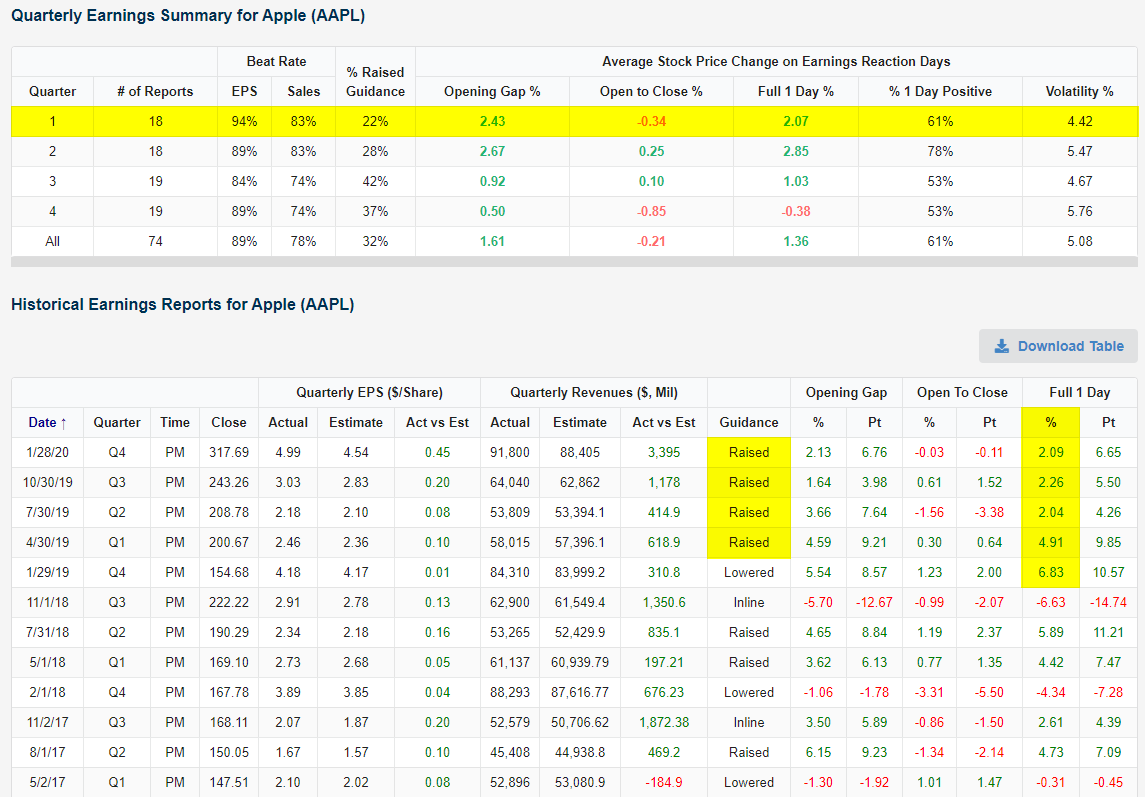
Chart of the Day – Years Like 2020
Another Regional Fed Record Low
What an encore. Following the largest decline ever and a record low reading in the Dallas Fed’s Manufacturing index for March, April’s fared even worse as the headline index fell even further, dropping from -70 to -73. Although that is a new record low and far from a sign of good conditions in that region, it wasn’t as bad as the consensus reading of -75.
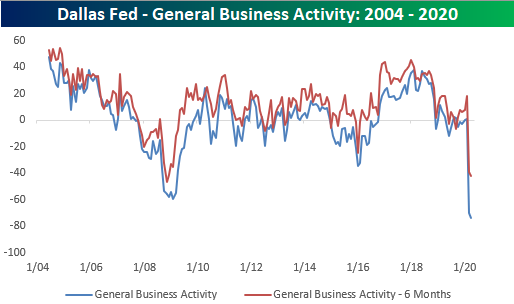
That thin silver lining aside, this month’s report was broadly weak. In addition to the headline number, the indices for current conditions on Production, Capacity Utilization, New Orders and New Order growth, and Shipments were all at their lowest levels ever (since 2004), and the six-month outlook indices for Company Outlook and Wages and Benefits were also both at record lows. As for the rest of the categories, if they were not at a record low they were close with most coming in at the 5th percentile or lower of all readings.
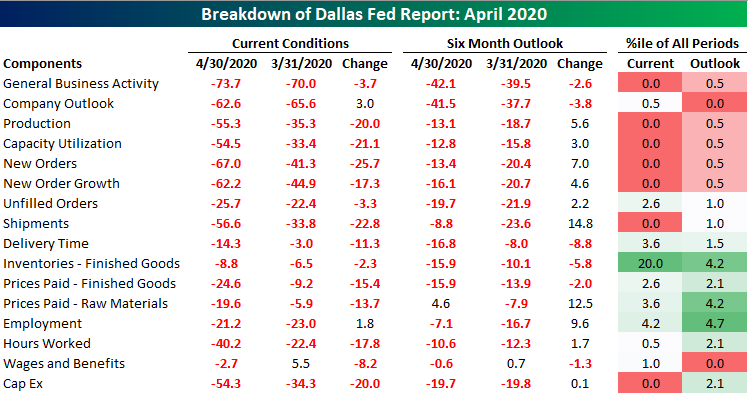
As we have frequently highlighted over the past month for other regional Fed indices, demand has been absolutely crushed. Each of the categories for demand like those for new and unfilled orders and shipments have completely collapsed. On the bright side, although they still remain low and the increases were small, there was a slight pickup in the outlook indices across these indicators in April.

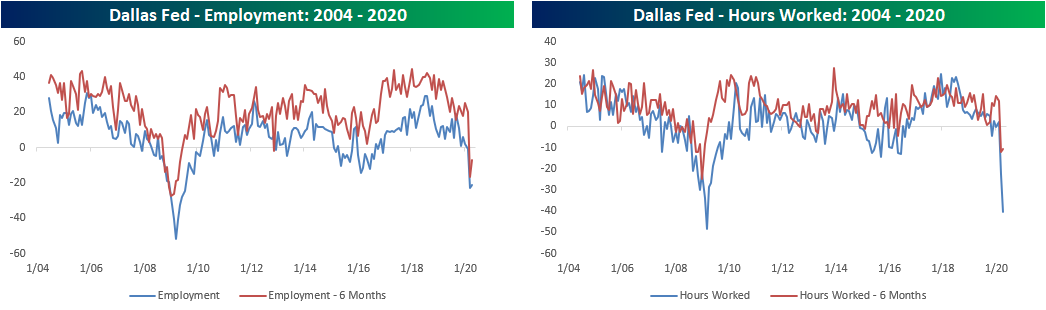
The same can also be said for the categories covering employment. Outlook six months ahead for Employment and Hours Worked both picked up in April. Albeit, these are still around some of their lowest levels since the global financial crisis, and the index for current hours worked continued to fall in April as shutdowns remain in place. Start a two-week free trial to Bespoke Institutional to access our interactive economic indicators monitor and much more.
The Smaller The Better
While lately it seems as though all anyone is talking about is the concentration of market cap in the largest stocks in the S&P 500, you may be surprised to hear that small caps have actually been leading the charge higher from the market lows. It’s been neck and neck, but while the S&P 500 is up just over 31% from its intraday March low, the Russell 2000 is up over 32%.

Granted, the Russell 2000 is only outperforming the S&P 500 by a slim margin, but it’s micro-cap stocks that have stolen the show. Since its low in March, the Russell Micro Cap Index is up 36% and actually back above its 50-day moving average for the first time since late February. The index is still down much more from its highs than either the Russell 2000 or the S&P 500 and the index’s entire market cap is only $365 billion (less than the market cap of Walmart WMT), but from the lows at least, micro-cap stocks have been on fire.
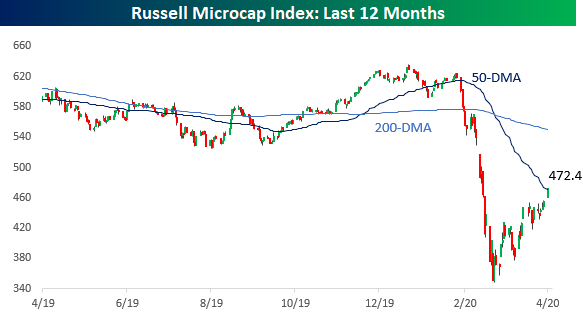
The last four days have been especially strong for the smallest of the small stocks as the Russell Micro Cap index has risen at least 1% on each of the last four trading days, including a 3.8% gain today. The Russell Micro Cap Index has only been around since 2006, but during that time there have only been two other periods where the index saw four straight days of 1%+ gains. The first was in late October 2008 while the second was in August 2009. Back in October 2008, if you chased micro-cap stocks after their four-day rally, the next few months were pretty painful, but the occurrence in August 2009 came in the early stages of the bull market. Receive full access to our research and commentary with a free two-week trial to Bespoke Premium.

Bespoke Brunch Reads: 4/26/20
Welcome to Bespoke Brunch Reads — a linkfest of the favorite things we read over the past week. The links are mostly market related, but there are some other interesting subjects covered as well. We hope you enjoy the food for thought as a supplement to the research we provide you during the week.
While you’re here, join Bespoke Premium for 3 months for just $95 with our 2020 Annual Outlook special offer.
State Lines
Escape from New York City by Anne Kadet (WSJ)
The COVID-19 pandemic has led to a flight out of the most dense urban area in the country, which has been hardest-hit by the pandemic; of course, only some can afford to run for the suburbs amidst the chaos. [Link; paywall]
Barr Threatens Legal Action Against Governors Over Lockdowns by Chris Strohm (Bloomberg)
In a strange inversion of the traditional ideological alignment over “states’ rights”, the Trump Justice Department is prepared to take governors to court to enforce reopening regardless of the health circumstances. [Link; soft paywall]
Investing
Stock Investments Lose Some Luster After COVID-19 Sell-Off by Justin McCarthy (Gallup)
Gallup surveys show a sharp decline in the share of Americans who view stocks as the best long-term investment, while more than one-third (the highest in years) view real estate that way. [Link]
AIMCo’s $3 Billion Volatility Trading Blunder by Leanna Orr (Institutional Investor)
Alberta Investment Management Corp, the pension and sovereign wealth manager for Alberta’s huge provincial public asset pile, has been burned by volatility trades that stemmed from the market blow-up this spring. [Link]
Sports
The NCAA saved money in case of a canceled March Madness. Then it spent it. by Will Hobson (WaPo)
A rainy day fund designed to keep college sports’ finances in order in case its hallmark tournament was cancelled got cashed out just a few years ago. [Link]
Social distancing takes a hit as Taiwan baseball teams brawl (AFP/Yahoo)
Given the success Taiwan has had containing its outbreak of COVID-19, the island has been able to keep baseball games going, but onfield brawls aren’t consistent with the need for social distancing. [Link]
COVID-nomics
Global Economic Effects of COVID-19 (Congressional Research Service)
The CRS is a fantastic public service, producing deeply researched and highly informed analysis for Congressional staffs at their request. This late April report details the likely impact of COVID across the global economy. [Link; 75 page PDF]
Wealth, Race, and Consumption Smoothing of Typical Income Shocks by Peter Ganong, Damon Jones, Pascal Noel, Diana Farrell, Fiona Greig, and Chris Wheat (University of Chicago Booth School of Business)
An analysis identifying worker-level consumption elasticity with respect to income shocks. While all households reduce spending 0.23% for every 1% decline in income, lower-income households reduce it by almost 0.4% for every 1% drop; in short, inequality and economic cyclicality are correlated. [Link; 84 page PDF]
Commodity Contango
Oil world zeroes in on Cushing, Oklahoma by Gregory Meyer (FT)
With the emergence of negative commodity prices, global futures markets are focused on Cushing, Oklahoma, a town with a tiny population and enormous role in global crude flows. [Link; paywall]
Farmers Are Starting to Destroy Their Pigs After Factories Close by Jen Skerritt, Michael Hirtzer, and Isis Almeida (Blooomberg)
Pig farmers from Quebec to Minnesota are euthanizing hogs in order to avoid paying for their upkeep as slaughterhouse capacity has been shuttered thanks to COVID-19 outbreaks in a few of the facilities. [Link; soft paywall]
Viral Update
COVID-19 Outbreak Associated with Air Conditioning in Restaurant, Guangzhou, China, 2020 by Jianyun Lu1, Jieni Gu, Kuibiao Li, Conghui Xu, Wenzhe Su, Zhisheng Lai, Deqian Zhou, Chao Yu, Bin Xu, and Zhicong Yang (CDC)
The flow of air within enclosed spaces appears to be an extremely important factor in mass-spreading events, or spreading events which take place on a somewhat smaller scale like this study of a restaurant in Guangzhou. [Link]
“Human challenge trials,” where healthy volunteers would be exposed to Covid-19, explained by Dylan Matthews (Vox)
Healthy patients who haven’t been exposed to coronavirus may need to be exposed to the virus after receiving potentially useful vaccines as part of a “challenge trial” though the ethics of putting volunteers at risk are dicey ground. [Link]
Controversial idea to speed coronavirus vaccine gains ground by Peter Sullivan (The Hill)
Members of Congress are signing up to the idea that challenge trials may be a useful way to fight COVID-19 and identify the best vaccines. [Link]
Front Line Stories
A New Doctor Faces The Coronavirus In Queens by Rivka Galchen (The New Yorker)
An emergency room doctor at Elmhurst Hospital, a ground zero for the Queens COVID outbreak, shares what the experience has been like and who it has hit the hardest. [Link]
Emergency room doctors facing pay cuts and understaffing during pandemic by Nikki Battiste (CBS Evening News)
Despite surging demand for emergency department resources across the country, ER doctors are taking 40% pay cuts and bearing the brunt of the financial impact. [Link; auto-playing video]
Viral Travels
‘We Needed to Go’: Rich Americans Activate Pandemic Escape Plans by Olivia Carville (Bloomberg)
The combination of wealth and paranoia is being perfectly met by New Zealand, which is a hotbed for survival bunkers which are popular with the wealthiest tier of Americans fleeing the Coronavirus. [Link; soft paywall, auto-playing video]
Empty resorts spell long crisis for Caribbean as coronavirus hits (Reuters)
With international travel essentially zeroed out amidst the shutdown of borders, there have been virtually no visitors to Caribbean locales that usually host a bustling trade in tourism. [Link]
Social Shifts
‘Staying Nimble’: How Small Businesses Can, and Do, Shift Gears by Amy Haimerl (NYT)
Plunging demand for sit-down restaurants has opened up niches for alternative forms of small business, even if the overall market has shrunk considerably. [Link; soft paywall]
‘It’s Going to Be a Lot More Lonely.’ A Dramatically Different Ramadan for U.S. Muslims Amid Coronavirus Lockdowns by Sanya Mansoor (Time)
Ramadan, the global month of fasting during daylight observed by more than one billion Muslims around the world, will be a very different affair this time around. [Link]
Three Hours Longer, the Pandemic Workday Has Obliterated Work-Life Balance by Michelle F. Davis and Jeff Green (Bloomberg)
After six weeks of working from home, white-collar workers around the country are getting tired of longer work hours, less continuity, and the burdens of childcare. [Link; soft paywall, auto-playing video]
Tragedy
After He Died Of The Coronavirus, She Opened Up His Phone And Found His Last Words To Her by Julia Reinstein (BuzzFeed)
This story of a man separated from his wife and young daughter forever by COVID-19 brought tears to our eyes, and illustrates the massive danger from the disease even in statistically lower-risk groups. [Link]
Vulnerability
You’ve Got (0-click) Mail! (ZeCops)
A flaw in the iOS email app allows an attacker to take control of Apple devices using an email sent to the device in question. [Link]
Media Studies
Misinformation During a Pandemic by Leonardo Bursztyn, Aakaash Rao, Christopher Roth, and David Yanagizawa-Drott (Becker Friedman Institute)
Viewers of Fox News content that expressed an earlier embrace of the dangers of COVID tended to lead to better outcomes related to the disease at the county level. [Link]
Read Bespoke’s most actionable market research by joining Bespoke Premium today! Get started here.
Have a great weekend!
The Bespoke Report — 4/24/20
This week’s Bespoke Report newsletter is now available for members.
US economic data from March is revealing the devastation to output wrought by the impact of COVID-19. Oil prices plunged into unthinkable territory this week, trading far below $0. Earnings are in full swing on both sides of the Atlantic. All of this has created massive cross-currents for investors, which we help to address in our weekly review of market performance, economic data, and investor sentiment. To read the report and access everything else Bespoke’s research platform has to offer, start a two-week free trial to one of our three membership levels. You won’t be disappointed!