
See what’s driving market performance around the world in today’s Morning Lineup. Bespoke’s Morning Lineup is the best way to start your trading day. Read it now by starting a two-week trial to Bespoke Premium. CLICK HERE to learn more and start your trial.
“There is nothing so uncertain as a sure thing.” – Scotty Bowman
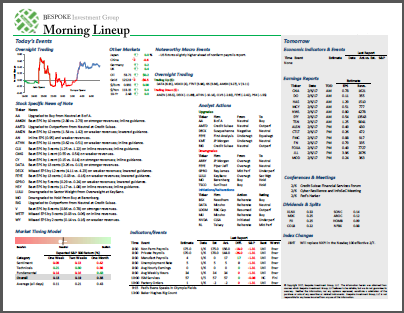
Below is a snippet of commentary from today’s Morning Lineup. Start a two-week trial to Bespoke Premium to view the full report.
US futures have been weakening as the opening bell approaches, and while the Nasdaq is still indicated to open slightly higher, the S&P 500 is fractionally lower. The culprit for the weaker tone is interest rates, which have been rising throughout the morning, taking the 10-year yield up to 4.98%. Crude oil is still lower but is on the verge of going positive for the day. Gold prices are fractionally higher, and Bitcoin is rebounding 2% to just under $78K.
Overnight, Asian stocks saw some follow-through to yesterday’s US gains. The Nikkei rallied 1.4% and finished up by a similar amount for the week after the BoJ raised rates by 25 bps to 1.25%. While the move was expected, it wasn’t unanimous as two members voted against a hike. Chinese stocks also finished higher but by less than 1%, while the Kospi topped every other major benchmark in the region, gaining 2.7%.
Unlike Asia, European stocks are lower across the board this morning. The STOXX 600 is down about 0.5%, with Italy and Spain leading the losses, declining more than 1% each. There’s been some hawkish commentary from various ECB officials regarding inflation, and news that Saudi Arabia said it will suspend crude oil shipments to Europe in October following the recent pipeline attack won’t help.
In the US today, Industrial Production and Capacity Utilization will both hit the tape at 9:15, followed by Leading Indicators at 10 AM. We’ll also hear from a couple of FOMC members as the blackout from this week’s meeting lifts.
In yesterday’s email, we highlighted how the S&P 500 wasn’t far from a high, but it masked some weakness underneath the surface. Following up on that theme, within the S&P 500, the index’s components are down an average of 19.3% from their respective 52-week highs. So, if you look through your portfolio and think “weren’t some of these stocks a lot higher a few months back?”, you’re not alone.
While the average distance from a 52-week high paints a much different picture than the much more modest declines at the index level, it is important to remember that the numbers always look worse at the individual stock level. The market and individual stocks tend to have a positive correlation, but they don’t move in lockstep with each other, so when the market hits a new high (or low), many individual components have already peaked (or bottomed).
At the sector level, there are four sectors where the average stock is down more than 20%, including Consumer Discretionary, where stocks in that sector are down an average of 25.6%. The other three sectors below the -20% threshold are Technology, Communication Services, and Industrials. The weakness in Consumer Discretionary and Communication Services is understandable, as those two sectors have also underperformed the S&P 500 by a wide margin this year, but Technology and Industrials are still the second- and fourth-best-performing sectors YTD!
At the other extreme, it shouldn’t surprise you to see that stocks in the Energy sector are only down an average of 11.3% from their respective highs. Along with Energy, the only other sectors where the average component is down less than 15% are Health Care (-14.5%) and Financials (-14.9%).

Looking at this another way, the chart below shows the percentage of stocks in each sector that are down at least 20% from their respective highs. For the S&P 500, 40% of the index’s components are in ‘bear market’ territory. The Consumer Discretionary sector has the most stocks in bear market territory with two-thirds, followed by Technology (60%) and Industrials (51%). Surprisingly, nearly half of the stocks in the Consumer Staples sector are down at least 20% from their highs even though the sector itself is down just 8%.

Finally, when it comes to the biggest losers, 17 stocks in the S&P 500 have been more than cut in half from their respective 52-week highs. Given the weakness in the Consumer Discretionary sector, you would expect to see this Ozempic list – the names that have shed the most weight – littered with stocks from the sector. Only two – Lululemon (LULU) and Nike (NKE) – made the list, and three sectors have more components on the list, including Technology with four.

Start a two-week trial to Bespoke Premium to continue reading today’s full Morning Lineup.
