
See what’s driving market performance around the world in today’s Morning Lineup. Bespoke’s Morning Lineup is the best way to start your trading day. Read it now by starting a two-week trial to Bespoke Premium. CLICK HERE to learn more and start your trial.
“You have your way. I have my way. As for the right way, the correct way, and the only way, it does not exist.” – Friedrich Nietzsche
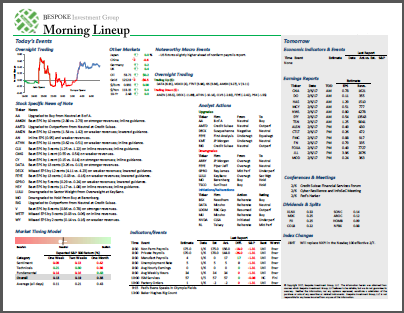
Below is a snippet of commentary from today’s Morning Lineup. Start a two-week trial to Bespoke Premium to view the full report.
It’s not looking like a good day for the bulls this morning. Equity futures are indicated firmly lower, but the real pain is in the Nasdaq. S&P 500 futures are down 0.3%, but the Nasdaq is down over 1%. We just got a huge slug of economic data. PPI was the most widely anticipated and came in much higher than forecasts. Retail Sales, though, also came in better than expected, and Jobless Claims also remain very positive. We also got two regional Fed manufacturing reports for October. Empire Manufacturing came in at double expectations while the Philly Fed report was weaker than expected. In response to the data, Treasury yields have shown little reaction (so far), and equity futures saw a modest bounce.
Call it a sharp decline, a plunge, or a crash; however you want to describe it, South Korea’s Kospi is down more than 20% in the last seven trading sessions, including a 7.6% drop just last night. To find a larger decline in seven trading days, you have to go back to the depths of the Covid crash in March 2020. Japan’s Nikkei has been down for six straight sessions (Monday was a holiday in Japan), and it’s “only” down 9%. Half of that decline came in last night’s 4.9% drop.
Both selloffs reflect ongoing concerns about the durability of the AI investment cycle, even as Taiwan Semiconductor (TSM) reported an earnings triple play. It’s not about what a company has done, though; it’s about what investors fear (or hope) is coming next. The one bright spot in Asia was India, which has largely sat out the AI trade; the Sensex gained more than 2%.
European markets have far less AI exposure than Asia’s, so they’ve held up much better amid the recent AI worries. This morning, the STOXX 600 is down just 0.3%, and no major European benchmark is down anywhere close to 1%. Eurozone industrial production fell 0.5% m/m in August versus expectations for no change, while UK GDP unexpectedly grew 0.1%.
Yesterday was a lousy day all around for just about anything tech-related. As noted in last night’s Closer, the Nasdaq 100, Philadelphia Semiconductor Index, and S&P 500 Software Group all fell over 2%. While those types of declines are always painful, we noted how the performance of all three indices over the next three months was largely in line with historical norms (chart below). Over the short term, though, performance strayed much further from the long-term average, so if you didn’t see it last night, make sure to check it out.

In addition to the Nasdaq 100’s 2% drop, the S&P 500 also fell more than 1% yesterday, which was the first decline of that magnitude since July. At 53 trading days, the streak was far from a record, but it was the longest of the post-Covid era.

Not only was the Nasdaq 100 down over 2% yesterday, but it’s also on pace to gap down more than 1% at the open. While that sounds pretty extreme, we were surprised to see that there have been 97 prior occurrences since 2000 when the Nasdaq 100 fell more than 2% and then gapped down over 1% the next day. The chart below shows each of those prior occurrences, and they occurred almost daily during the unwind of the dot-com bubble.

What makes today slightly more unusual is that even after yesterday’s 2% decline, the Nasdaq 100 was still above its 50-DMA. When we screened for periods when the Nasdaq 100 fell more than 2% and closed above its 50-DMA and then gapped down over 1%, the 97 prior occurrences dwindled down to 16. By adding that filter, there were far fewer occurrences during the dot-com unwind, but they still showed up during the various dead cat bounces. The most recent occurrence was last November, and before that, early in the 2022 bear market.
Whatever headlines they generated at the time, the prior occurrences showed up at all stages of the market cycle and, like the attention-grabbing headlines, weren’t a reliable signal of the market’s direction.

Start a two-week trial to Bespoke Premium to continue reading today’s full Morning Lineup.
